



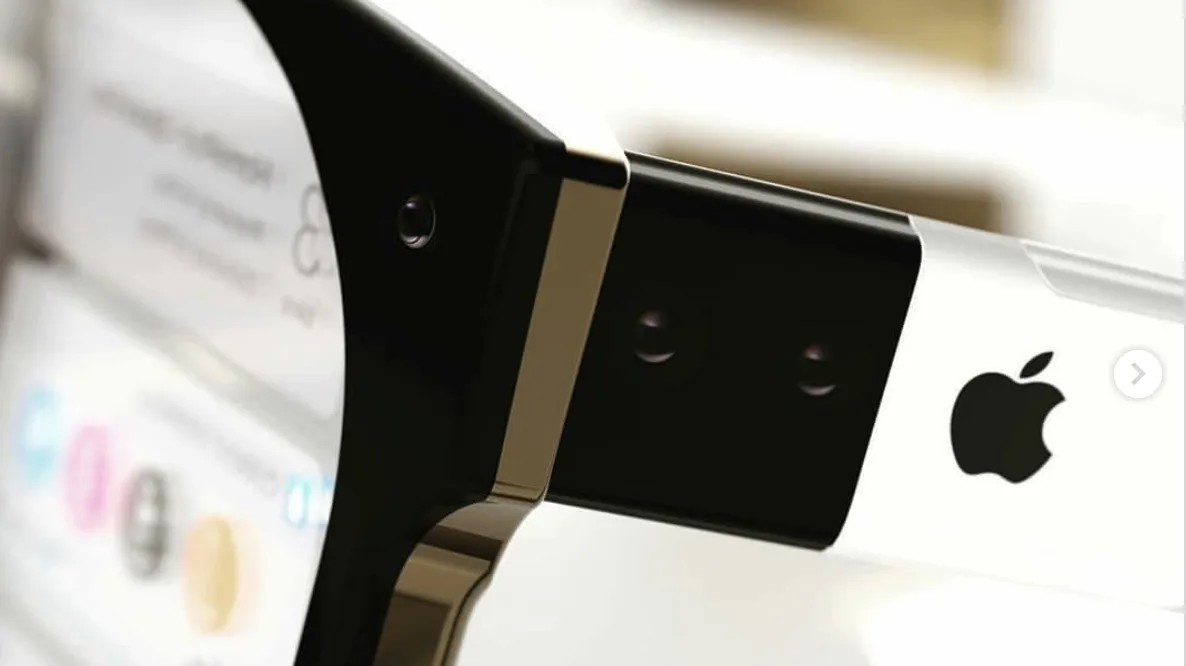
A patent granted to Apple has further fuelled the rumor fire that the Apple Glasses - or Apple Glass - won’t need prescription lenses as the smartglasses will automatically adjust for people with poor eyesight.
The "Head-mounted display apparatus for retaining a portable electronic device with display” patent granted on Tuesday by the US Patent and Trademark Office, envisions a head-mounted display that has an “optical subassembley” that adjusts based on the wearer’s prescription.
- Apple Glasses: Release date, price, features and leaks
- 'Hey Siri, I'm getting pulled over' — this shortcut records police
- Plus: WWDC 2020 preview: 5 things to expect at Apple’s big event
“The optical subassembly comprises at least one dynamic optical component and wherein the processor is configured to adjust the dynamic optical component based on the prescription information,” the patent reads.
Having such a system would effectively bypass a key drawback of smartglasses and the best VR headsets , which can be tricky to use with glasses. And the patent notes that the head-mounted display will also adapt to “the limitations or corrections” of a person’s eyesight through the automatic analysis of their eyes.
“For example, if a user is myopic in one eye, the optical module associated with that eye may modify the image displayed to correct the user's myopia,” the patent explains. “The system may determine the correction required for each eye, if any, using any suitable approach. For example, the user may enter a glasses or contact lens prescription that indicates the required correction.”

This is arguably a bit of a sci-fi concept, but going by the images in the patent this head-mounted display won’t exactly look super futuristic. That’s because Apple sees it being used with an iPhone, much like other VR headsets that don’t require a connection to a powerful PC. From the patent drawings, the device looks like a cross between a smartphone VR headset and a traditional pair of glasses.
As such, this may not be a patent relating directly to the Apple Glass smartglasses, and could instead be Apple’s idea for an easy-to-use smartphone VR device. But the patent also details how the headset can use cameras to effectively see the outside world and thus be used as an augmented reality headset as well as VR device.
“The head-mounted display system can operate in an external viewing mode, which allows the user to view the outside world. The head-mounted display system 200 can provide external viewing of the user's surroundings using any suitable approach,” the patent noted. “In the illustrated embodiment, the portable electronic device includes a camera on its backside opposite the display screen and the head mounted device includes an aperture within the mounting region that provides camera access to outside the head mounted device.”
Automatically adjusting optical elements could still be a feature of future Apple glasses though. But according to the rumors so far, the first-generation Apple Glass wearable is set to require prescription lenses if people need them.
This patent could lead to nothing as many do. Yet it stands as a solid indication that Apple is definitely looking at wearable devices beyond the Apple Watch 6. And if it can make a slick set of smartglasses with this kind of intelligence, Apple could push the entire category forward.

