Last October, I set up on my front lawn what I thought were two of the more ridiculous Halloween decorations: the 12-foot Home Depot Skelly and Lowe’s 20-foot inflatable skeleton. They were an instant hit with the kids, and in the end, Lowe’s won out, as it was easier to set up, and was simply more ridiculous for its size.
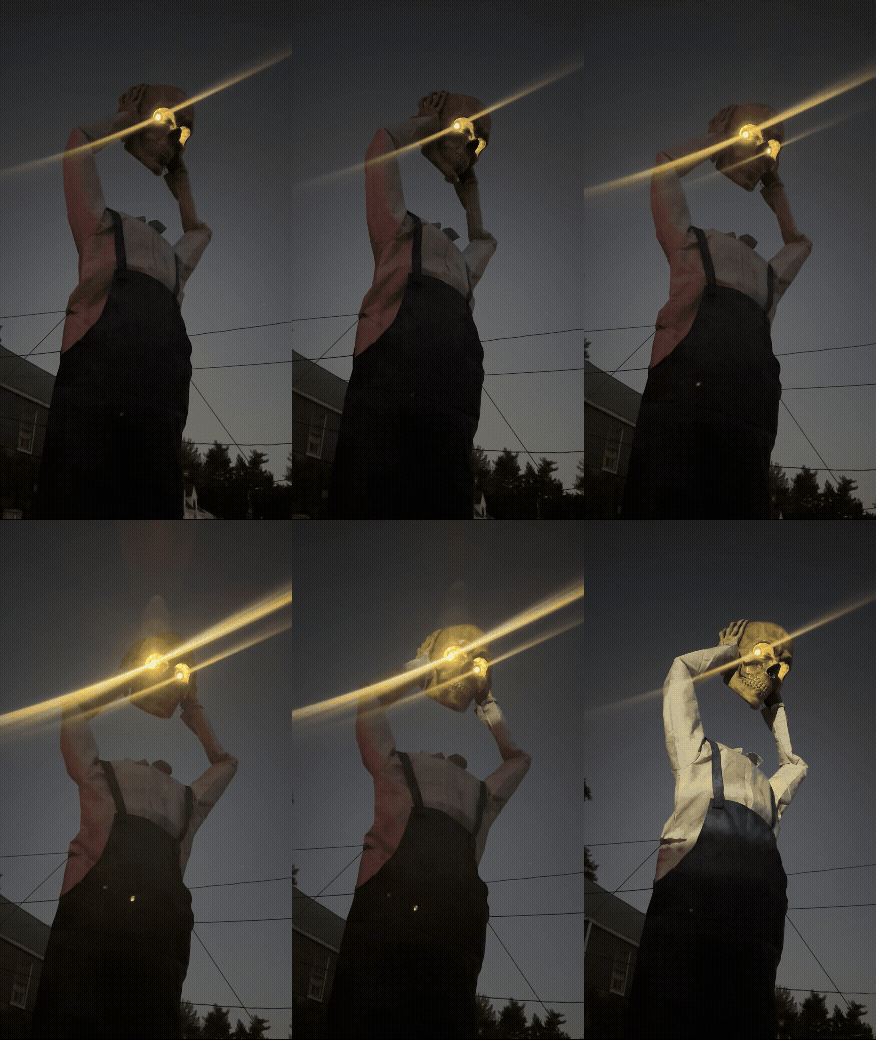
This year, both Lowe’s and Home Depot came out with animatronic oversized skeletons; Home Depot’s 12-foot version has a head that turns and a jaw that moves; you can even program custom phrases via a smartphone app. Lowe’s 15-foot skeleton — called the Watcher — holds its head above its body, rotates back and forth, beams lights out of its eyes, and also has a speaker with a bunch of spooky phrases.
Naturally, I wanted to see how these two teched-up decorations compared. The neighborhood children also couldn’t wait. Neither are cheap; Home Depot’s skeleton costs $379, while Lowe’s model is $429, yet as of this writing, both are selling out fast.

You can change the color of the Skelly's eyes as well as the lights in the ribcage. An app lets you record phrases and change the tone of your voice to have it say whatever you want, and the jaw moves in sync with what it's saying.

Lowe's overall-covered skeleton rotates from the torso up, and its eyes beam two lights up to 20 feet away. It cycles through several creepy phrases, and you can plug in a speaker to make it even louder.
Storage and setup
The first thing to note is that while neither are small, the Lowe’s skeleton comes in a box about two-thirds the size of Home Depot’s — the latter measures 40 x 44 x 27 inches — something to consider if you have limited storage space.
I don't know that a farmer's getup is the outfit that's most going to instill fear in the hearts of trick-or-treaters, but here we are.
Assembling Lowe’s skeleton was a more involved affair; the internal frame is made up of metal hoops running up each leg and the torso, which gives the skeleton its shape. Each hoop is held in place with cotter pins, and each part of the frame is secured with thumb screws. Suffice it to say, there’s a lot of really small pieces that could be easy to lose.
And, you also have to "dress" the skeleton with its gigantic overalls. I don't know that a farmer's getup is the outfit that's most going to instill fear in the hearts of trick-or-treaters, but here we are.

As you’re putting the whole thing together, you also have to attach a series of electrical connectors inside the body; they snap together easily enough, but there are more than a few of them. It took me a good hour or so to piece everything together. It’s also held in place by four guy strings, to keep it from toppling over.
Home Depot’s Skelly instructions are pretty much the same as its non-smart version. It’s a metal frame with plastic pieces covering it, and far fewer pieces than the Lowes model. The only real difference are the few wires that connect from its pelvis, up the spine, and to the head. Maybe it was my familiarity from last year’s model, or the fact that there are not as many parts, but assembly went much faster. I was done in about half an hour.
I assembled both skeletons myself, and while it’s not advisable, it’s doable. The trickiest part is lifting the whole thing in the air. There was a moment or two with each that I thought it would topple right over.
Animatronics
Both models have motion sensors, so you can set them to activate only when someone approaches your house. The sensors are sensitive enough to detect motion up to 20 feet away; I found that traffic driving by my house would trigger the Home Depot skeleton, which became annoying after a while.
The upper torso, arms, and head of the Lowe’s skeleton rotate back and forth, and its eyes beam two rays of light that were bright enough to illuminate my sidewalk some 20 feet away. As it moves, it also runs through several pre-set sayings. Hidden inside the left leg is a large control box, where you can adjust the volume and even connect a larger speaker, should you choose.

Home Depot’s Skelly is a bit more, well, animated. Its head moves back and forth and its jaw moves up and down in sync with whatever it’s saying.
What Skelly says is only limited by your imagination. We had the most fun when we recorded our daughter. The sight of a 12-foot-tall skeleton threatening doom in a small child’s voice is hilarious.
You have to download an app to customize what the Home Depot Skelly says. You then have to press a button on its underside (which feels a little dirty) to put it in Bluetooth mode. Only then can you connect it with the app. However, you then have to switch it out of Bluetooth mode if you want it to do its thing.
Recordings can be up to 30 seconds in length, and not only can you control what it says, but you can also customize the chest and eye lights. What it says is only limited by your imagination. We had the most fun when we recorded our daughter. The sight of a 12-foot-tall skeleton threatening doom in a small child’s voice is hilarious.
I even got it to “sing” the Philadelphia Eagles fight song, which no doubt rankled my Giants-loving neighbors.
Which was the most spooktacular?

Ultimately, Home Depot’s 12-foot Skelly won this year’s faceoff. I found it easier to set up, and, despite a little wonkiness with its app, the ability to have it say anything you want really adds something special. It also happens to be $50 less than Lowe’s model.
You can’t go wrong with either skeleton. There’s something sublimely ridiculous about a massive decoration in your yard, especially for Halloween. But, being able to customize the Home Depot Skelly to make it truly frightening or funny made it the real winner.

Follow Tom's Guide on Google News and add us as a preferred source to get our up-to-date news, analysis, and reviews in your feeds.
More from Tom's Guide