




In honor of the Opera browser turning thirty, the company has set up an internet time machine named “Opera Web Rewind,” and it truly got me right in my feelings for a good long while.
From the screech of the dial-up connection to the meteoric rise of the AI prompt, every significant moment that changed the web is preserved here as a digital “artifact” that you can interact with.
So I spent a couple of hours browsing through it, reminiscing about the good old days, thinking about where we are now, and where we will be looking ahead.
A trip down memory lane
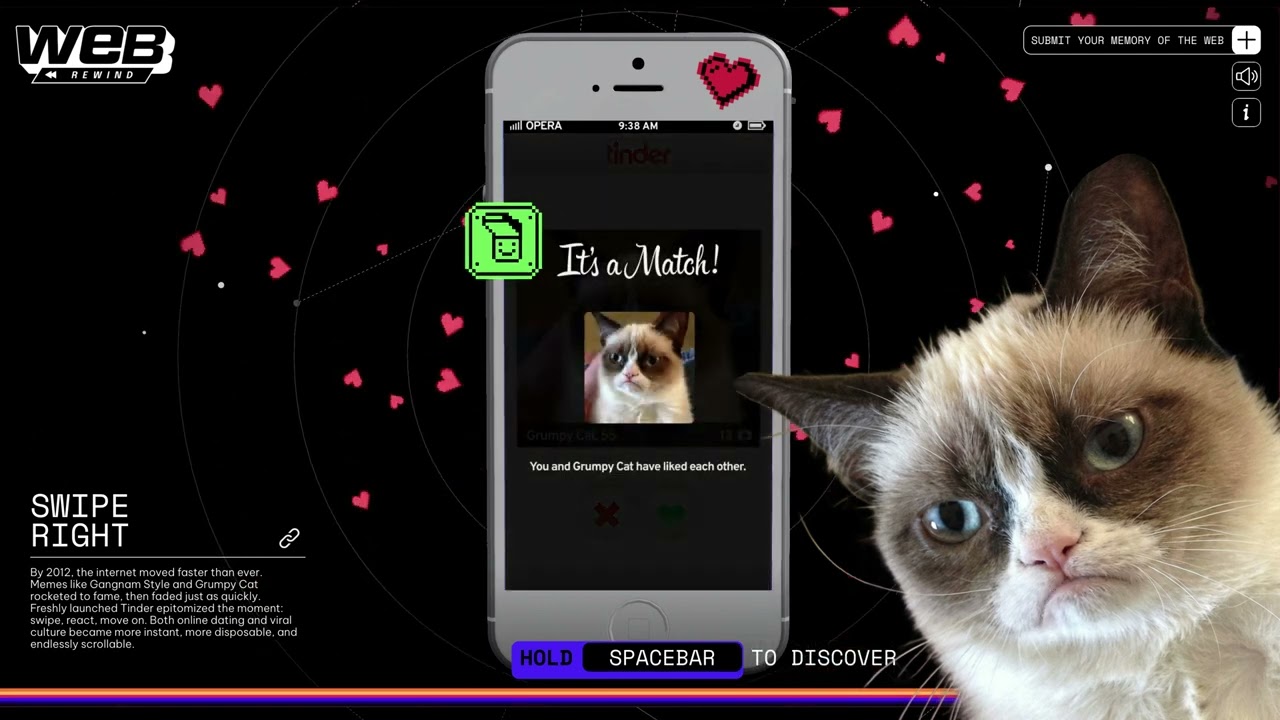
Simply put, this is an interactive museum of the web over the past 30 years — since Opera’s browser first launched in 1996. By pressing and holding the spacebar, I was immediately taken back to the glory days.
Whether it’s the “You’ve Got Mail” era, the explosion of Limewire, the time we all created our own custom MySpace pages or the birth of the viral video, it’s all here, and it’s a glorious trip back through time.

Just hearing those dial-up tones of connecting to a 56k modem fired up my fight or flight response — anticipating my mom shouting at me to “get off the internet” so she can make a call.
But of course, the internet has been so much more significant than just thinking about small moments in time.
The reason why we remember these things is because being connected has become an essential element of humanity, and whether it’s documenting the world’s history on Wikipedia or bringing scientists together to turbo-boost the speed of discoveries, it has been life-changing.

“In three decades, the web has evolved from a niche scientific tool to an indispensable part of our entire lives. At Opera, we’ve spent 30 years building a faster, better, and more creative window to the world,” said Jan Standal, Senior Vice President at Opera.
“Web Rewind is our tribute to the community that shaped the web. We want to celebrate the memes, the breakthroughs, and even the quirks that made the web what it is today.”
All of the biggest moments are documented, and if you’re feeling lucky, you can enter a competition to win a trip to CERN in Switzerland — the place where the World Wide Web was born in the 90s.
Our favorite internet moments
It got me thinking back to all the experiences I’ve had on the web over the past 26 years, so I had one very obvious question for the team: what is your most cherished internet memory?

If I wasn’t on Tumblr reblogging “edgy” quotes and fandom GIFs, I was on Club Penguin earning coins and redecorating my igloo for the hundredth time.

For a whole generation, it was the after-school ritual: logging in to see who was online, adopting a new puffle, trying (and failing) to tip the iceberg, and grinding mini-games like it was serious business. Club Penguin honestly felt like the early internet at its safest and most imaginative.
Even though I hadn’t played in a while by 2017, it still felt like a real shame when Club Penguin was shut down and replaced with a mobile app that didn’t capture the same magic (and then that got shut down not long after). Some things are meant to end, I guess, but it doesn’t change the fact that it’s a core memory.

Like many, the first thing I would do as soon as I came home from school was fire up my family PC, connect to dial-up internet and immediately “nudge” anyone online on the iconic MSN Messenger.

It’s the instant messaging client that kicked off mass communication over the web, and for me, the latest gossip around school. Sadly, it was discontinued over a decade ago, but MSN Messenger paved the way for WhatsApp, Facebook Messenger, Slack, Signal and plenty more to flourish.
Instant messaging has shaped digital communication as we know it, and you can thank MSN Messenger for that. In hindsight, though, perhaps “nudging” wouldn’t translate too well in today’s world (imagine getting a “nudge” from your boss!), but you can bet I miss annoyingly shaking up somebody’s screen.

In 2001, my middle school library trips were meant for "learning." But thanks to non-existent parental controls, I spent that wide-open internet time discovering Flash games instead.

It would be easy for me to reminisce here — talk about Joe Cartoon, Newgrounds, Xiao Xiao 3 and the World’s Hardest Game. But what these actually did was become a wild test bed for a lot of the AAA experiences you love today.
Roguelites like “Hades”? You can thank the likes of “Learn to Fly” and “Burrito Bison” for that. Love the environmental puzzles in “The Legend of Zelda: Tears of the Kingdom”? Yep, “Crush the Castle” did physics-based puzzling first. It all started in a browser.
But has AI slop killed it?

One part that piqued my curiosity was the birth of ChatGPT in 2022, and seeing the advent of AI video in 2024.
And it made me think about my usual web-browsing habits nowadays — never about discovering amazing projects, like I did in the past, but much more transactional in the walled gardens of chatbots and Google AI Overview. Something’s gone wrong here.
Am I viewing the world through rose-tinted spectacles by reminiscing? Quite possibly. I’ve been called “unc” a few times, and this could very well be a very real expression of that.
But surely, I’m not alone in thinking this, right? A study from AWS back in 2024 estimated around 57% of online content is already AI-generated, and while there are no specifically researched numbers for 2025, the fact that Merriam-Webster named “slop” its word of the year gives the impression that the problem is getting worse.

Content discovery has been all but eliminated by getting answers to your questions scraped from said websites, and AI-generated images and videos dominate the social feeds of hundreds of millions. And while vibe coding is capable of making cool things for sure, they can quite often be massive security concerns.
After web eras of human creation, it seems like we’re entering a synthetic web of AI in everything. Gartner’s surveys have shown that 70% of consumers believe that more generative AI in social media will harm the user experience, but it seems like they’re not listening.
And what do we get in return? Skyrocketing RAM prices. I really didn’t want to turn this into a rant, because I do indeed see the value of AI to humanity. But to put a finer point on it, when I said AI could very well be a bubble, I don’t mean the core technology itself — I mean generative AI.

Follow Tom's Guide on Google News and add us as a preferred source to get our up-to-date news, analysis, and reviews in your feeds.
More from Tom's Guide
- I tested the world’s first mindful browser — it finally convinced me to ditch Google Chrome
- 300,000+ Chrome users installed these malicious extensions posing as AI assistants — delete them right now
- “The vast majority of people can continue using Discord exactly as they do today”: Discord addresses backlash over controversial age verification
