Tom's Guide Verdict
The TCL QM9K pulls out all the stops with a 144Hz native refresh rate, a peak brightness that’s over 6,000 nits and too many dimming zones to count — it just does so at the wrong time in the TV release cycle. There’s better value below it and better performance above it, plus new models that leverage Mini-RGB technology right around the corner. Still, it delivers top performance from a 2025 Mini-LED, especially if you’re putting it in a room with lots of ambient light.
Pros
- +
Dazzling peak brightness
- +
Great contrast
- +
Dolby Atmos FlexConnect
- +
Google TV is very responsive
Cons
- -
Sound quality has its quirks
- -
Black level crushing
- -
Motion artefacting
Why you can trust Tom's Guide Our writers and editors spend hours analyzing and reviewing products, services, and apps to help find what's best for you. Find out more about how we test, analyze, and rate.
Price: $1,699.99
Screen size: 75 inches
Model: 75QM9K
Resolution: 3,840x2,160
HDR: HDR10, HDR10+, Dolby Vision IQ, HLG
Refresh rate: 144Hz
Ports: 2x HDMI 2.1, 2x HDMI 2.0
Audio: 2.1 Channel
Smart TV software: Google TV
Size (without stand): 65.28 x 37.36 x 2.01 inches
Weight (without stand): 62.61 pounds
The TCL QM9K is a great TV and one that I actually quite like, with a panel so bright it’s tailor-made for rooms with lots of windows and ambient light. However, its unfortunate release timing really hurt its chances of becoming the best TV of 2025. It launched at the last-minute and followed on the coattails of the ultra-popular (and more affordable) TCL QM8K.
These days the QM9K bumps up against other carryovers from 2025 like the Hisense U8QG and the Samsung QN90F, two of the best TVs from last year when it comes to show-stopping Mini-LED screens. It’s also around the same price as the LG C5 OLED, the only TV to be awarded a perfect score from our editorial team in 2025.
Given its current price of $1,499 and its above-average performance, it’s certainly still a compelling buy in the face of new 2026 models that are priced much higher (see: the $6,999 TCL X11L) but the QM9K’s biggest mistake is that it’s a casualty of circumstance: There’s better value below it and better performance above it, plus new models that leverage Mini-RGB technology right around the corner.
TCL QM9K review: Price and release date
The TCL QM9K is the ultimate TCL Mini-LED from 2025. It launched back in September in 65-, 75-, 85- and 98-inch screen sizes.

Here are the current sale prices for the TCL QM9K:
- 65-inch 65QM9K: $1,999 at launch | $1,499 on sale
- 75-inch 75QM9K: $3,499 at launch | $1,999 on sale
- 85-inch 85QM9K: $2,999 at launch | $2,499 on sale
- 98-inch 98QM9K: $5,999 at launch | $3,999 on sale
If you’re looking to buy the QM9K, I think the 75-inch model is the best bang for your buck. You’ll get all the performance and features of a flagship TV at a slightly more affordable price.
If $2,000 is more than you wanted to spend — and I certainly wouldn’t blame you — you can find both the 65-inch QM8K and 75-inch QM7K for just under $1,000. You’re losing out on some specular highlights and better on-board audio by buying one of the two cheaper TCL Mini-LED TVs, but I wouldn’t let that stop you.
TCL QM9K review: Design
For review, Tom’s Guide was sent the 75-inch version of the QM9K. All models use a QD-Mini-LED backlight and color system with Full Array Local Dimming, but larger sizes come with more dimming zones (up to 6,000). The 75-inch model, as the middle child between the 65- and 85-inch models, offers a nice compromise between the upper and lower limits.

All models in the lineup except the 98-inch version use a central pedestal stand that allows you to place them on smaller tables. It’s not something I’d recommend, as TVs with pedestal designs are easier to tip thanks to a higher center of gravity — but not everyone has to worry about an overly curious one-and-a-half year old toddling around their office.
Should you decide to hang it on the wall, the 75-inch model is compatible with a standard 400mm x 400mm VESA mount.
Wall-mounting is going to be slightly problematic, however. The QM9K isn’t exactly slim at roughly two inches thick and, even without the stand, you’re looking at lifting around 63 pounds. It’s definitely a two or three person job.

For what it’s worth, though, I do like the limited brushed aluminum bezel that beautifully frames the glossy, perhaps-slightly-too-reflective screen.
TCL QM9K review: Ports
On the TCL QM9K you’ve got four full HDMI 2.1 ports — two more HDMI 2.1 ports than you’ll find on the more affordable QM8K and QM7K. Most folks probably won’t need all four of them right now in 2026, but it’s good to be prepared for the future.

In addition to the HDMI port selection, you’ve got USB ports to pick from (one of which is 3.0 compliant), an ethernet port, optical audio out and a coaxial port for an HD TV antenna.
Inside the TV is a tuner that supports ATSC 3.0 for 4K over-the-air broadcasts (these are location-dependent so be sure to check before buying it based on this one spec alone) and Wi-Fi 6. There’s also support for Dolby Atmos FlexConnect in addition to standard Bluetooth, AirPlay 2 and Chromecast Built-in. FlexConnect, Dolby’s latest technology that allows you to place speakers anywhere in your living room and get calibrated spatial audio sound tuned to wherever you want to sit, is one of the biggest advancements in audio in the last five years, so it’s great to see it included here.
TCL QM9K review: Performance
Under the glass, the QM9K has a lot going on. According to TCL, the QM9K has more than 6,000 local dimming zones in the largest screen sizes that are all powered by the AIPQ Pro Processor and WHVA panel.

Wide High-vertical alignment (WHVA) panels are TCL’s advanced version of the industry-standard VA panels that, in theory, offer better off-axis viewing angles and wider color gamut. Our test results do show a small boost in color saturation, and anecdotally, this is one of the best LED-based TVs for off-axis viewing I’ve ever seen as color almost never desaturated no matter where I moved in the room.
On top of all that, the additional local dimming zones do create better overall contrast with less bleed. “Spider-Man Across the Spider-Verse” is chock full of scenes where bright, ultra-vivid colors sit directly next to inky blacks and dark greys — and they look phenomenal on the QM9K. I actually might like the look of this movie on the QM9K more than on the much more expensive Samsung QD-OLED I own.

Sports and darker content like “The Batman” both looked decent on the QM9K, but not earth-shatteringly better than on other Mini-LED TVs I saw in 2025. Scenes with lots of dark details could sometimes get lost due to some light black level crushing and motion artefacting cropped up a few times while watching MLS on Apple TV+.
Are the latter points absolute deal-breakers for me? No, especially considering how much vibrancy the QM9K retained when viewed off-axis and its blinding (in a good way) levels of peak brightness. They’re just small flies in what is otherwise excellent ointment.
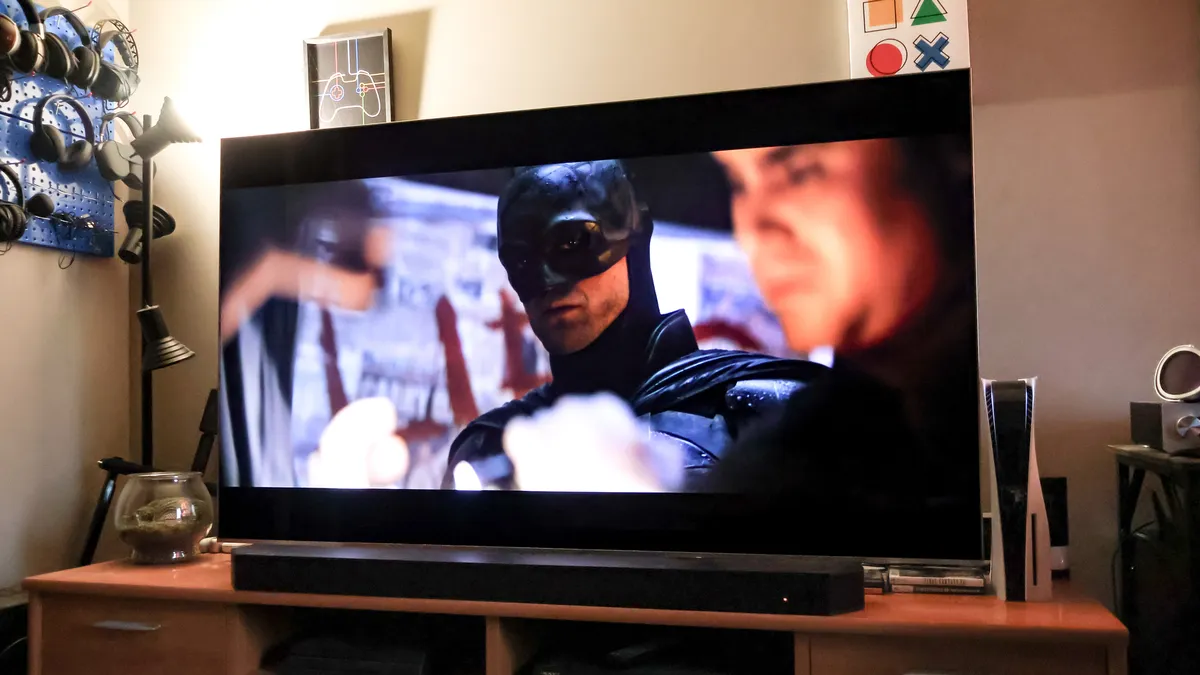
To test its gaming chops, I played a few hours of Final Fantasy XVI on PS5. The game’s fast-motion action sequences looked great at 4K/60 — and keep in mind that it’s possible for the QM9K to hit refresh speeds of 144Hz when connected to a gaming PC. The downside is that its input latency (the time it takes for a signal to come in, be processed and reach the screen) is a bit high at 13ms.
I mostly play single-player games where input latency really doesn’t affect the gameplay, but gamers who want to shave every millisecond off their reaction times might want to go for an OLED instead.
How we test TVs
We follow a standard testing protocol for every TV we review at Tom’s Guide. Our benchmarks include a series of technical and subject tests designed to rate the set’s performance.

For our technical tests, we use a Jeti spectraval 1501-HiRes spectroradiometer, a Klein K10-A colorimeter, a Murideo 8K-SIX-G Metal pattern generator, and Portrait Displays’ Calman TV-calibration software to take measurements. We also use a Leo Bodnar 4K Input Lag Tester for determining the TV’s gaming prowess.
Subjective tests vary based on the reviewer, but usually feature anecdotes from a diverse selection of movies, TV shows, and other content reflecting the types of things you may actually want to watch on the TV.
TCL QM9K review: Test results
| Header Cell - Column 0 | TCL QM9K |
Hisense U8QG |
Samsung QN90F |
LG C5 OLED |
TCL QM8K |
|---|---|---|---|---|---|
SDR Brightness (10%, in nits) |
4802 |
2908 |
347 |
705 |
3476 |
Delta-E (lower is better) |
1.82 |
2.44 |
1.83 |
1.25 |
2.71 |
Rec. 709 Gamut Coverage |
99.44% |
99.79% |
99.16% |
99.67% |
99.03% |
HDR Brightness (10%, in nits) |
5413 |
3685 |
2109 |
1179 |
4437 |
UHDA-P3 Gamut Coverage |
97.16% |
97.55% |
94.5% |
99.3% |
97.2% |
Rec. 2020 Gamut Coverage |
80.29% |
83.71% |
77.44% |
76.31% |
79.22% |
Input latency (in milliseconds) |
13 |
9.7 |
9.5 |
9.1 |
13 |
When it comes to Mini-LED TVs, the QM9K is really the pinnacle of performance. It’s bright in SDR (4,802 nits in Vivid mode) and even brighter in HDR (5,413 in Standard). Comparable models from Hisense and Samsung have a hard time keeping up here.

Now, I should note that the QM9K doesn’t produce a wall of light every time you turn it on. What our tests look for is the peak brightness in a 10% window — basically one small portion of the screen that could represent, say, a sunrise or an explosion. The only real competition the QM9K has in that category right now is the $8,000 TCL X11L that we measured at over 6,000 nits.
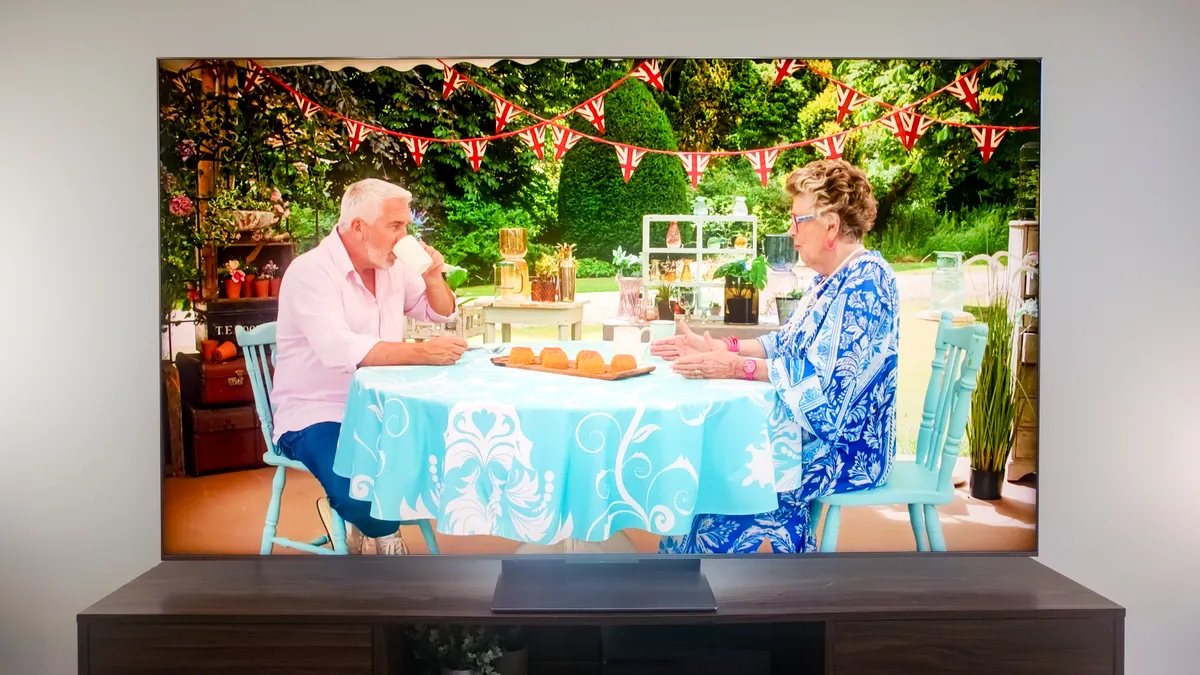
While peak brightness is the real highlight here (pun absolutely intended), the color volume and color accuracy of this TV — measured by the Gamut Coverage percentages and Delta-E score, respectively — are also top-notch. The QM9K’s Delta-E score of 1.82 is the lowest of any Mini-LED TV we tested in 2025. It doesn’t beat the LG C5 OLED’s nearly perfect score of 1.25, but it’s still incredibly impressive. (Keep in mind, of course, that any score under 3.0 is almost imperceptible to the human eye.)
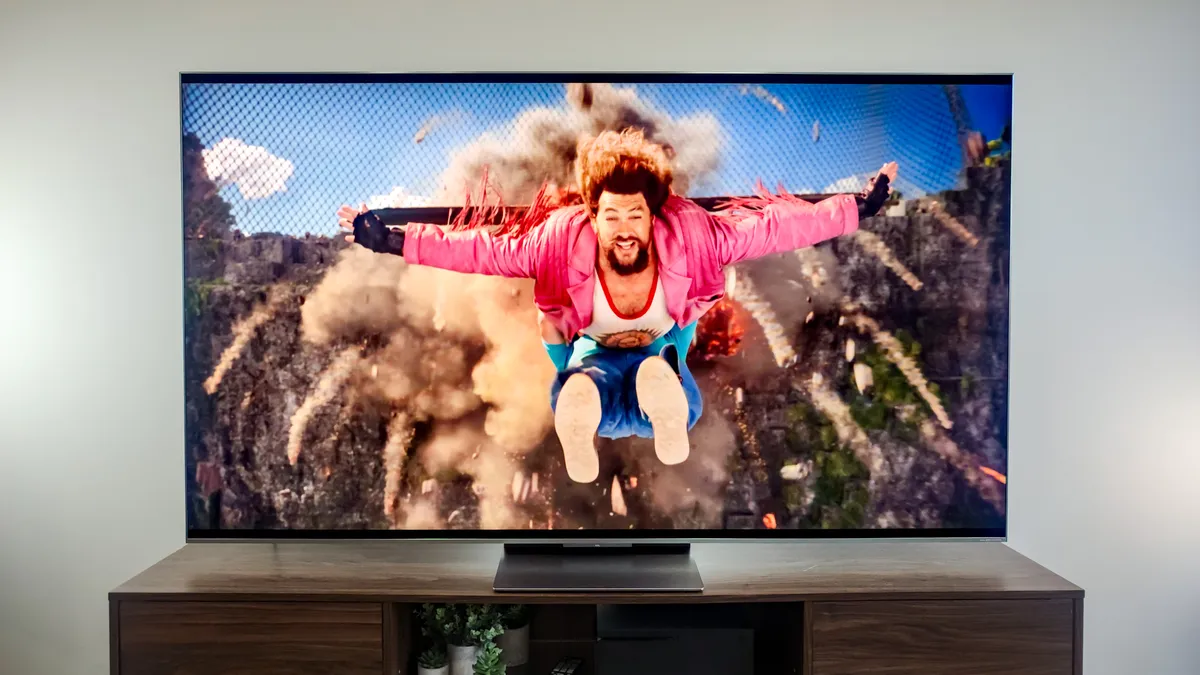
But — and you knew this was coming — 2026 models are nearly here and they’re both brighter and more colorful than what we’re seeing with the QM9K. The newest Mini-LED TVs like the Samsung MR95F, LG MRGB95 and Hisense UR9/UR8 use Mini-RGB backlighting systems that simply produce purer colors and have Rec2020 scores in the 90% and up range and actually output 8,000 nits (again only in small portions of the screen). The QM9K still offers flagship performance… just at a very inconvenient time.
TCL QM9K review: Audio
To make the QM9K sound the best it can, TCL teamed up with Bang & Olufsen. The result is a multi-channel Dolby Atmos that sounds pretty good … under most circumstances. Calmer scenes, like ones with ongoing dialog between two characters, or action sequences without any dialog in it all, sound totally fine.

But the QM9K’s audio performance takes a hit when there’s a lot of audio overlapping. Take, for instance, the fight with Spot near Miles’ school in “Spider-Man Across the Spider-Verse.” Spider-Man is tussling with a villain, so we’ve got the sound of two teleporting around plus the dialog between the characters. While that’s happening, Miles’ father is chasing them on the street, which has its own set of sounds — traffic noise, footsteps pounding on the pavement and his dad’s reactionary dialog — while chaos ensues all around him. Scenes with this much happening struggle to separate all the different sounds. Dialog might make it through OK, but the rest of what’s happening blends together in an amalgamation of noise.
The good news? The TCL QM9K is one of the only TVs that currently supports Dolby Atmos FlexConnect, which allows you to place compatible speakers anywhere in your room and get calibrated spatial audio sound tuned to wherever you want to sit. I wasn’t able to get a pair of TCL’s new FlexConnect home speakers to try it out for this review, but I’m currently testing the LG H7 FlexConnect Soundbar in a different room of the house and it’s great.
TCL QM9K review: Interface and apps
The QM9K uses the latest version of Google TV with Gemini. It’s one of the first TVs to host Google’s AI agent and while I didn’t find it all that helpful on a day-to-day basis, I could see it being handy to have down the road as AI continues to integrate into our everyday lives.

Google TV works supremely well here. Everything loads quickly and there’s no real negatives to speak of. It’s one of the best smart TV platforms for a reason. It’s well-stocked with all the major streaming services and, thanks to the Play Store integration, there’s even a few game streaming services like Nvidia GeForce Now and Boosteroid. (Sadly, Google TV doesn’t have Xbox integration yet, but that’s likely to appear at some point in the future.)
The only real issue I have with it is that the QM9K has a built-in microphone for voice support. There’s a physical switch at the bottom of the TV to turn it off — which I really appreciate — but I know some folks are adamantly (and rightfully) against having a microphone built into their TV.
TCL QM9K review: Remote
There’s nothing to dislike, aesthetically, about the QM9K’s silver-and-black remote. It looks premium when it’s sitting on the table and feels weighty in the hand.
Practically, however, there are a few places for improvement. For starters, the remote has a lot of empty space that could’ve been used to include more quick access buttons. You’ve got three of the main players there — Netflix, YouTube and Prime Video — as well as the company’s own TCL TV channel, but it wouldn’t have hurt to have buttons for Hulu/Disney+ or Max… or even Peacock and Paramount+. You’ve got the space, you may as well use it.
The other issue I have here is that the remote is still using regular batteries instead of rechargeable ones. Not every remote needs to be equipped with a rear solar panel like Samsung’s SolarCell remotes, but having USB-C rechargeable batteries seems like a more sensible, planet-friendly option.
TCL QM9K review: Verdict
The TCL QM9K is under siege from all sides. There’s TCL’s own QM7K and QM8K models from 2025 that aren’t quite as bright but deliver most of the same performance for almost half the price, and new models that use Mini-RGB tech arriving shortly. There’s also the LG C5 OLED to consider — it’s Tom’s Guide’s 2025 TV of the Year for a reason.
With all that in mind, there’s still a case to be made for the QM9K. It’s incredibly bright with wonderful specular highlights that help to make it a better fit for rooms with lots of ambient light. Its four HDMI 2.1 ports mean that it’s well-equipped for the future, and its Google TV smart platform runs effortlessly thanks to the TV’s advanced processor. It’s simultaneously smooth and sharp when it comes to performance, and that’s not something I say about a TV very often.
It’s going to be up against some tough competition throughout the rest of the year, but if you’re someone who wants an ultra-bright screen for a sun-drenched living room at a decent discount, you’ll find something special with the QM9K.