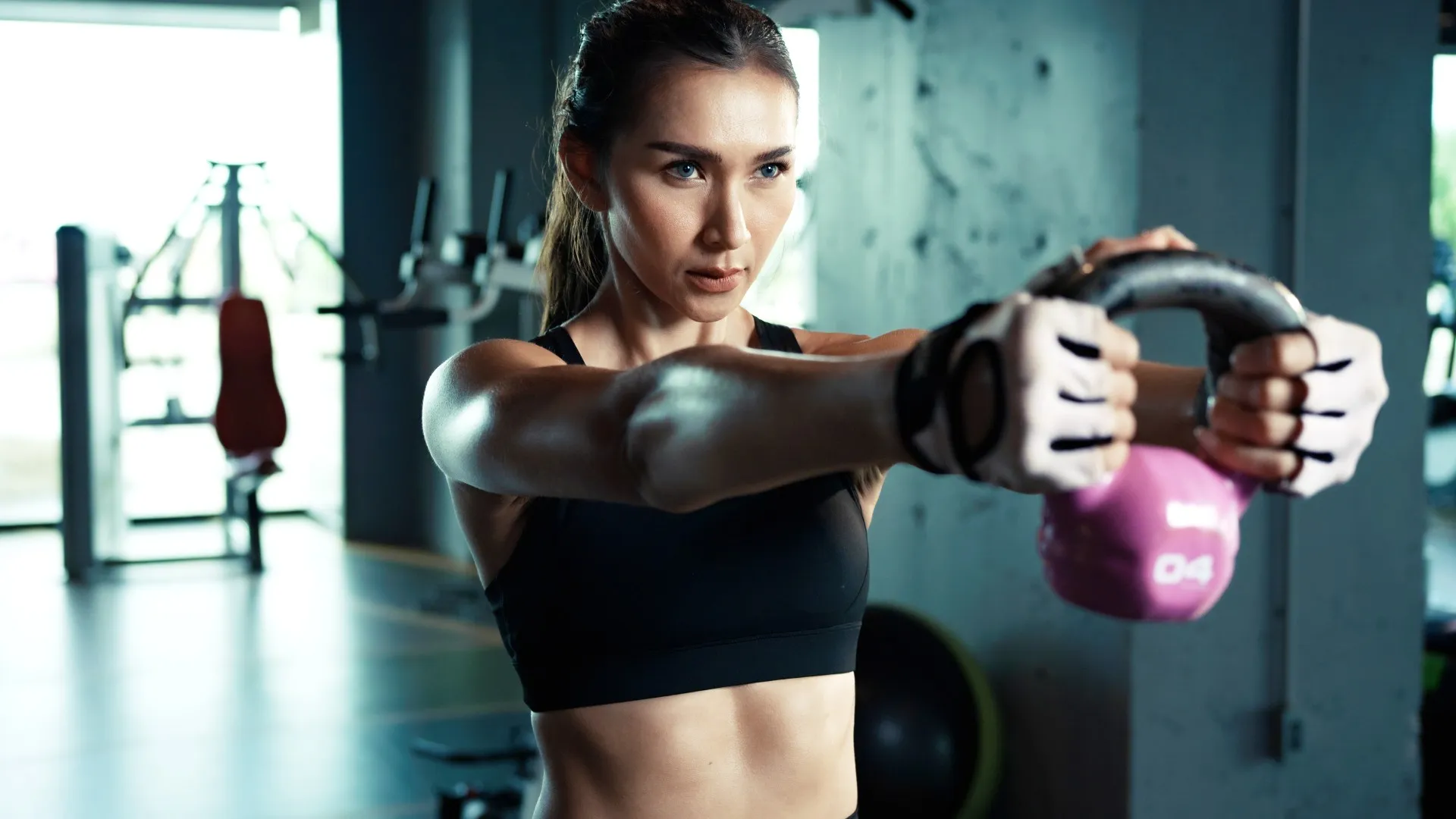
Exercises like planks, sit-ups, crunches, and Russian twists all serve a purpose: they hit various muscles to build a stronger core. However, there are a variety of functional, full-body compound exercises (multi-muscle moves) that use your core in an equally functional way, for stability, balance and power.
These are the types of exercises you're going to experiment with in today's workout: exercises that still challenge your core muscles while working other powerful muscle groups like your legs, glutes and shoulders. But don't be fooled, your core is still working hard to support you, which is why you only need these four moves and one of the best kettlebells to build strength and stamina.
Watch: 4-move routine you can try with a kettlebell
This workout lasts 20 minutes and requires one or two kettlebells, depending on whether you want to work one side at a time, known as unilateral training, or both sides together.
Both sides at the same time will allow you to load heavier, plus coordinate both sides of the body. Unilateral training is effective at creating instability and teaching your body to recruit both sides of the body independently to balance. If you have imbalances or a noticeably weaker side, I encourage more unilateral training in the future.
It will also depend on the equipment you have available, so if you only have one kettlebell, just work one side at a time for the same number of reps. You can halve the total reps between left and right or experiment with a number that works for you.
This workout is an EMOM, which means Every Minute On the Minute. You'll perform 8-12 reps of the first exercise, then rest for the remainder of the minute; on the next minute, you'll perform 8-12 reps of the next exercise and so on. One round is four minutes, and the total of five rounds will take you 20 minutes.
1. Kettlebell swing
Swings use your core, glutes and hips for power as you snap your hips forward and thrust the weight away from the body. It's not a squat, so try to keep a soft bend in the knees while hinging at the hips. As you send your hips back, imagine using your butt to close a car door behind you; as you send your hips forward, fully extend them and squeeze your glutes and core muscles to drive the weight up to your eye line.
Your arms should remain pretty much weightless, with all the work powering through your torso, hips and glutes.
- How to do kettlebell swings step-by-step for beginners
2. Kettlebell thrusters
Thrusters are a full-body blaster because they combine a weighted squat with an overhead press. Load one or two kettlebells at your shoulders and draw your elbows forward to create a stable shelf. Engage your core, then sit deep into a squat while keeping your back straight and chest lifted. As you stand, immediately drive the weight overhead in one fluid motion, keeping your arm or arms close to your ears.
Again, this takes core power and stability to balance and control the weights as you move from low to high and back down again. Of course, your shoulders, upper chest, legs and glutes are working too, making it an effective conditioning tool for engaging many muscle groups together.
- How to do thrusters step-by-step for beginners
3. Kettlebell sumo squats
The sumo squat is a wide-leg squat that helps target your outer glutes, known as the gluteus medius. These muscles support actions like moving sideways and lifting your leg away from the body.
Point your toes outward and take a wide stance as you perform the squat with your chest up and proud. Keep the weight close to your chest using both hands, and load as heavy as you can.
Again, you're working your legs and glutes, but your core is helping to drive this movement, so focus on engaging your stomach and using a powerful exhale as you stand, pushing your breath down toward your diaphragm and stomach rather than high in your chest. Better core engagement, better activation, better strength.
- How to do sumo squats step-by-step for beginners
4. Kettlebell American swings
You might be wondering why we're doubling up. Haven't you done enough swings? Well, this one hits different.
American swings require more control and stability as you take the weight past your eyeline and overhead. Your shoulders, upper back, upper chest and core work harder as you pause for a moment in the top position, then you'll need to control the descent of the weight down between your legs.
It takes plenty of snappy swing power and a good, healthy thrust of the hips and glutes. From the hamstrings up, you're working many muscle groups, but remember to keep your arms light; if your arms are working the hardest, you're not engaging your glutes and core muscles enough. Think "brace."
- How to do American kettlebell swings step-by-step for beginners
The 'why'
Strengthening your midsection helps you stabilize, balance and move better. It can reduce lower back pain, boost posture and protect you from injury, whether you're training for a marathon or hitting the weights in the gym.
You're not working for long, so keep the rest short. You should aim for 15-20 seconds maximum before the next minute begins. If you're taking less than that to rest, consider reducing your weight or reps.
If you're new to workouts, I recommend taking it slow and checking your form with a personal trainer. You can also learn the difference between abs versus core muscles to help you understand which muscles you are working, where and why.
And remember, just because you've honed a strong set of abs, it doesn't necessarily mean they'll show. Your body composition plays a huge role in how much muscle definition you have, which is why learning about body recomposition is useful if this is a goal of yours.
Want more fitness ideas?
Follow Tom's Guide fitness below!

Follow Tom's Guide on Google News and add us as a preferred source to get our up-to-date news, analysis, and reviews in your feeds.
More from Tom's Guide
- I'm a personal trainer — the candlestick roll is the best bodyweight exercise for your barbell squats
- You only need a kettlebell and this 30-minute workout to build full-body muscle and boost your metabolism
- 4 reasons you’re not building muscle in the gym — according to a strength and conditioning coach