As we get older, strength training becomes more important than ever when it comes to reversing the physical signs of aging. After the age of 30, you naturally lose 3-5% of your muscle mass per decade, an age-related process called sarcopenia. This dramatically accelerates once you turn 60, and the best way to slow this down or reverse it entirely is to do regular strength workouts.
Strength training doesn’t have to mean lifting heavy weights in the gym. Just using your bodyweight for resistance can help maintain and build muscle, boost your metabolism, and protect your bones from conditions like osteoporosis.
Yet if you’re returning to exercise following an extended break, or you’re a complete beginner, it can be tricky to know where to start. To find out more, I asked personal trainer Jen Rulon for some advice.
Rulon has 20 years of experience, is a 15-time Ironman finisher, and specializes in strength training for women in midlife. I asked her for five bodyweight exercises I could give my parents, who are both in their 60s. Here’s what she said.

Jen Rulon has a master's degree in Kinesiology (Exercise Science), 20+ years of coaching experience, is a 15-time Ironman finisher and Kona qualifier, TEDx speaker, and author of Self-Motivation Strategies for Women. Strength training for women in midlife and beyond is core to her coaching practice.
5 bodyweight exercises to focus on in your 60s to build strength and stability
Rulon recommends starting with a warm-up to get the joints moving. This could be a quick five-minute walk, or just standing up and walking on the spot for a few minutes, pumping the arms and legs.
Then focus on doing the following bodyweight moves:
1. Bodyweight squats

The squat is an important functional movement to master after 60, as it’s a physical pattern required for everyday activities like sitting down and standing back up again.
Here’s how to do a bodyweight squat:
- Start with your feet hip-width apart.
- Bend your knees and hinge at your hips as if you’re sitting back in a chair. If you need the extra support, do this exercise in front of a chair and lower your glutes down till they touch the chair.
- Don’t let your knees track over your toes; keep your chest up and your eyegaze forward.
- Push through your feet to return to your starting position.
- To progress this exercise, add weight — holding one of the best adjustable dumbbells in front of your torso increases the intensity.
2. Wall or incline push-ups
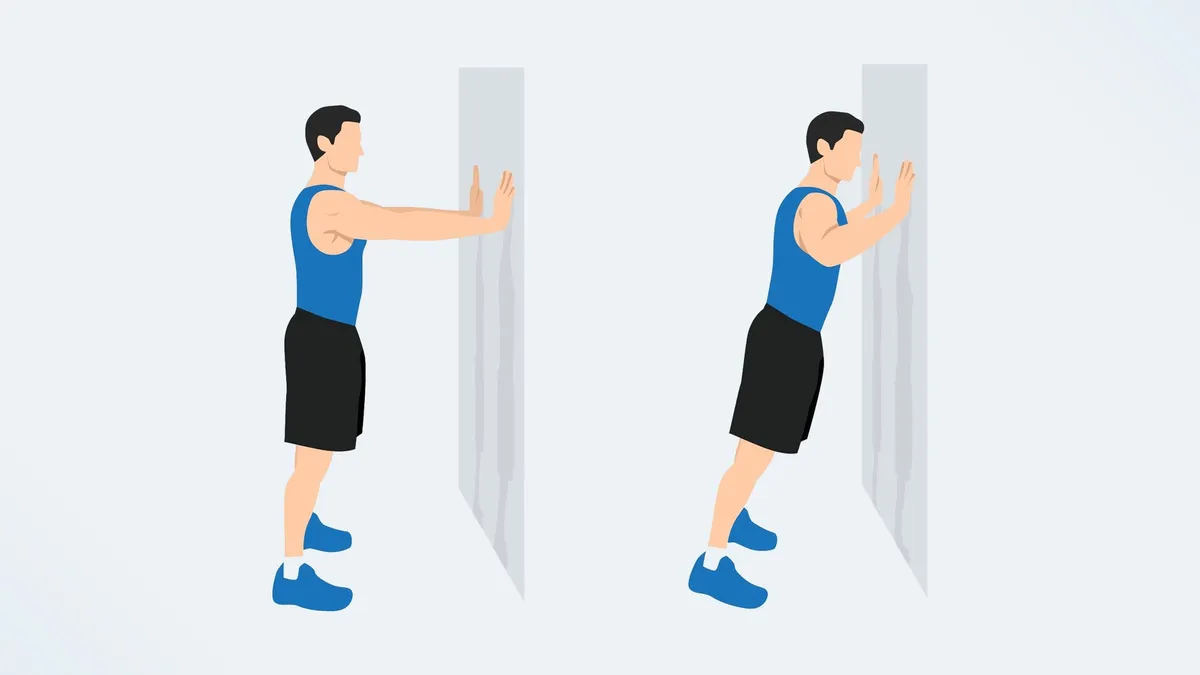
The push-up is a great functional upper-body movement. You’ll be working your chest, wrists, forearms and shoulders.
- Stand facing a sturdy wall or counter about arm's length away.
- Place hands on the wall or edge of the counter slightly wider than shoulder-width apart.
- Bend the elbows to lower the chest toward the wall or counter.
- Pause when the chest is close to the surface, then smoothly push back up to the starting position.
- To progress this exercise, increase the distance between your feet and the wall. Alternatively, if you can, get down on the floor and do the push-ups on your knees.
3. Glute bridge

If you feel unstable in squats, the glute bridge is a fantastic way to build your lower body. You’ll be working your glutes, hamstrings, and core, but because you’ll be lying on your back, this exercise is stable and low-impact.
- Start lying on your back with your knees bent and your feet flat on the floor.
- Engage your core, thinking about sucking your belly button into your spine.
- Squeeze your glutes and lift your hips toward the ceiling. Keep lifting until your body forms a straight line from your shoulders to your knees.
- Squeeze your glutes as hard as you can at the top for a couple of seconds, slowly lowering back down to the floor.
- An easy way to progress this exercise is to add a weight, holding it with both hands across your hips.
4. Step-ups

The step-up is a single-leg movement pattern you do every single day as you climb stairs or step up onto a curb. As you’ll rarely train one leg at a time, this is a great exercise to work on any imbalances in your body and reduce your risk of falls.
- For this exercise, you’ll need a stair, sturdy step, or even the curb outside your home.
- Place your entire foot flat on the step, and if you need to, use your stairs at home and hold the handrail lightly for balance.
- Push through the heel on the step and lift your body, tapping the other foot on the step, then reverse the movement to lower back to the ground.
- To progress this exercise, increase the size of the step.
5. Modified planks

Rulon recommends doing these planks on your knees or against a wall or counter for support. The plank is a core exercise that helps protect your lower back from injury and improves your overall balance and stability.
- To do a plank on your knees, start by lying on your exercise mat face-down.
- Prop yourself up onto your elbows, ensuring your elbows are positioned directly under your shoulders and bent at a 90-degree angle.
- Keeping your knees on the mat, lift your torso and hips. There should be a straight line from your head to your knees.
- Squeeze your glutes and engage your core, thinking about sucking your belly button in towards your spine.
Aim for 10-12 reps of all of the exercises above, or a 30-second plank. Repeat the circuit a couple of times for a longer workout, and build as you get stronger.
Follow Tom's Guide fitness on Instagram for more workouts, routines, tips, and tricks.

Follow Tom's Guide on Google News and add us as a preferred source to get our up-to-date news, analysis, and reviews in your feeds. Alternatively, you can read our content on the Tom's Guide app available now for iOS and Android.
More from Tom's Guide
- I'm a personal trainer who works with clients over 50 — these are the 3 mobility exercises I never skip
- After 60, this is the 10-minute routine I use with my clients to stay strong, mobile and independent
- 'I’m a Pilates instructor, and I recommend these 5 core exercises to help older clients build strength and improve posture'