




If you want to improve your sleep habits and potentially add years to your life, the 7:1 sleep rule can help with both, and a huge part of it is focused on sleep regularity.
A 2026 study from Vitality and The London School of Economics and Political Science (LSE) found that going to bed within the same 1 hour window (sleep regularity) and getting 7+ hours of sleep (sleep duration) can significantly lower mortality risk and add increase life expectancy by up to four years.
For Sleep Awareness Week 2026, we're delving into why and how you can improve sleep regularity, and therefore better stick to the 7:1 sleep rule, by optimizing your circadian rhythm. The key to this? Circadian rhythm anchors.
I spoke to three sleep experts to find out more about these anchors, as well as to get their insights on the 7:1 sleep rule and why sleep regularity is so important. Plus, we even have a '3-day circadian rhythm anchor challenge'. Curious about that? Read on...
Key takeaways
- The 7:1 rule, from a recent large study, means falling asleep within a 1 hour window and getting 7+ hours of sleep at least 5 nights a week
- Following this sleep rule can add up to 4 years to your life, the study found
- The '1' of the 7:1 rule is focused on sleep regularity, sticking to a consistent bedtime
- Overall sleep regularity means going to bed and waking at the same time each day, which helps regulate hormone release and with the build up of sleep pressure
- Sleep regularity and a healthy circadian rhythm (internal body clock) are intertwined, with one driving the other
- Circadian rhythm anchors help your body clock function optimally, which can help sleep regularity
- They include waking at the same time, getting morning sunlight, exercise, eating a regular times and a nighttime routine.

6 expert-backed habits to improve sleep regularity
What we're calling habits here are also known as circadian rhythm anchors. "Circadian rhythm anchors are consistent daily cues that keep your body’s internal clock synchronized to a roughly 24-hour schedule," explains Dr. Greg Jones, NMD, ABAAHP, and longevity keynote speaker.
Jordan Weiss, PhD, Assistant Professor in the Division of Precision Medicine and Optimal Aging Institute at NYU Grossman School of Medicine, shares a simple, creative way to look at it: "If you imagine your body as an orchestra, these anchors are the conductor’s cues. Light, meals, movement, and temperature tell every section of your biology when to peak and when to rest.
"When cues are consistent," he continues, "the performance flows. When they’re erratic, the system can fall out of tune."
So if you're looking to improve your sleep regularity, and master the 7:1 Sleep Rule, introducing the following six expert-recommended habits or anchors can help...
Anchor 1: A consistent wake up time
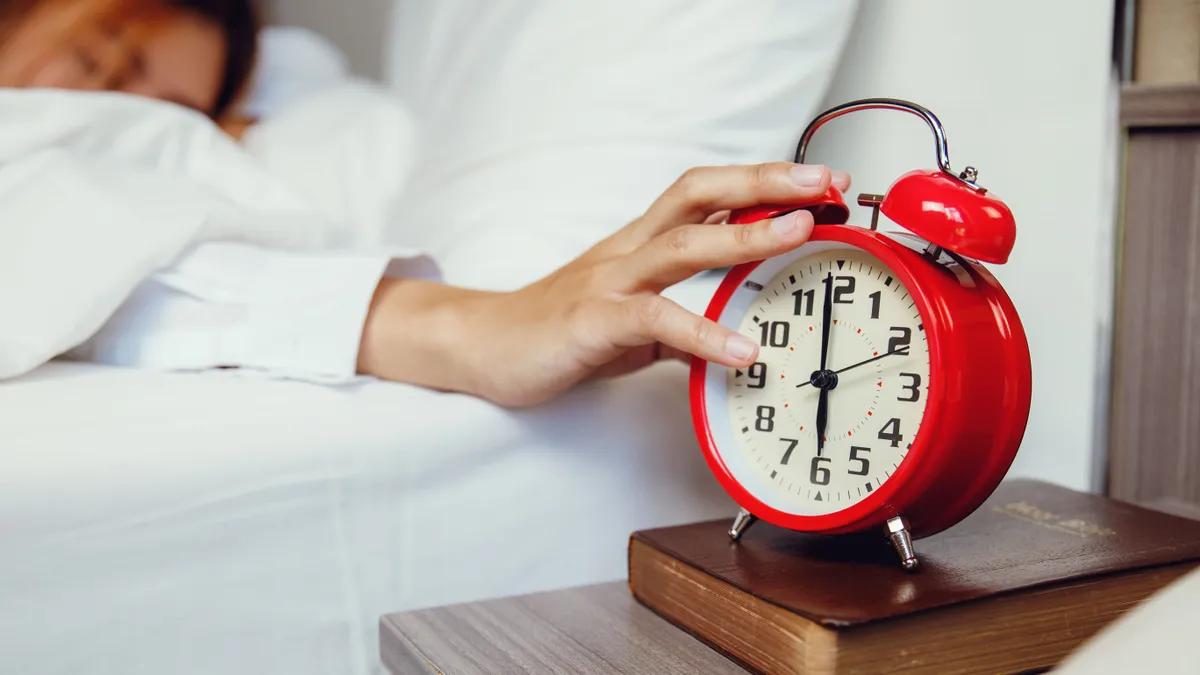
If you're looking to fall asleep at roughly the same time each night, start with the circadian rhythm anchor of waking up at the same time each day, all three experts agreed.
"Your body gradually warms up and releases alerting hormones in anticipation of waking. If you keep that wake time consistent (including weekends!) your body learns when to start that process, making mornings easier and helping pull your bedtime into sync," Weiss says.
According to Dr. Jones, this "single habit strongly anchors your circadian clock, stabilizes your sleep-wake cycle, and helps your body release hormones like melatonin at predictable times each night."
That stabilized melatonin release will make it easier to feel sleepy at night, Dr. William Lu, Medical Director at Dreem Health, adds.
Anchor 2: Morning light exposure

"Natural light in the morning signals your brain to suppress melatonin, helping reset your circadian rhythm and boosting alertness," says Dr. Lu of this circadian rhythm anchor.
Dr. Jones recommends aiming to get outside for 10-30 minutes of natural sunlight in the morning, and Weiss adds that doing so within an hour of waking tells your body clock it's daytime.
He describes how doing so effects your sleep regularity: "This sets a timer for melatonin release roughly 14 to 16 hours later, so your body starts winding down at the right time."
But if you think switching on your bedroom light on a dark morning is going to do the trick, be warned: "Indoor light generally doesn't provide the same effect," Weiss says.

Anchor 3: Regular meal times
It's strange to think that having your morning meal might impact how easily you can fall asleep at the same time each night, but Dr. Jones experts explain that "having meals at regular times helps synchronize metabolic rhythms with your sleep-wake cycle," says Dr. Jones, who suggests eating your first meal and last meal at consistent times each day.
You might, like me, be surprised to learn that some organs have what Dr. Lu explains are "peripheral clocks" and eating at consistent times synchronizes them, "supporting overall circadian stability."
"Organs like your liver and gut have their own internal clocks set by when food arrives rather than by light. Eating late or at irregular times sends conflicting signals. Keeping meal times consistent and finishing eating a few hours before bed helps everything stay in sync," adds Weiss.
Anchor 4: Physical activity

"Exercise acts as a timing signal for the body. Regular workouts, especially earlier in the day, can help reinforce the rhythm of sleep and wakefulness," says Dr. Jones.
This circadian rhythm anchor is best timed for the morning or afternoon, with Dr. Lu explaining that it will "signal your body that its active time, reinforcing sleep timing and improving nighttime sleep quality."
Weiss adds that exercising at either of these times also "builds sleep pressure throughout the day, making it easier to fall asleep at a consistent time.
However, keep in mind that timing is important, as he adds that "intense exercise too close to bed can keep your body too activated to wind down."
Anchor 5: A consistent bedtime routine

A simple and particularly pleasant way to anchor your circadian rhythm and help with sleep regularity is to have a wind down, or nightime, routine that you are able to maintain night after night.
"Repeating the same evening cues, such as shutting off screens, dimming lights, reading, and stretching, tells your brain that bedtime is approaching and allows melatonin to rise naturally," explains Dr. Jones.
Your nighttime routine should include relaxing activities that suit (and calm) you. Something I always include in mine is a warm shower. Weiss recommends taking a warm shower or bath an hour or two before bed.
"Your body loses heat afterwards, nudging you toward sleep," he explains. This is because, "your body needs to drop its core temperature to fall and stay asleep."

Anchor 6: Reducing evening light and screen use
This circadian rhythm anchor is bad news for those who like to scroll their smartphone in bed, but can be an effective way to help with sleep regularity.
"Reducing bright and blue light in the evening prevents circadian delays and protects natural melatonin release. Aim to turn off your phones, iPads, tablets, and TVs about an hour before bedtime," says Dr. Jones.
While blue light has been shown to negatively impact sleep, it might not be as significant as once thought (a recent study showed it only delayed sleep onset by 2.7 minutes). However light does supress melatonin release and screen use in bed can increase insomnia risk.
Weiss adds that "dimming lights and putting screens down in the evening is one of the simplest things you can do to fall asleep on time."
The '3-day circadian anchor challenge': How to reset your body clock fast
The tips above should help regulate your circadian rhythm, and in turn, help improve your sleep regularity. Experts say that if you implement all of them, youn can reset your body clock quickly and get your sleep back on track.
Ultimately, the two are inextricably linked and making healthy choices when it comes to waking, eating, exercise, how you prepare for sleep and your screen use and light exposure mean your body, brain and sleep consistency will benefit.
So, whether you're trying out the 7:1 sleep rule and aiming for a 1 hour bedtime window every night (or at least 5 nights a week), or simply trying to improve your sleep regularity, why not try a '3 day circadian anchor challenge'?
Give as many of the above tips above a go for three days, and see if you notice an improvement in your sleep regularity — if it's easier to fall asleep within the same 1 hour window of the 7:1 sleep rule.
What is sleep regularity?

In simple terms, sleep regularity is to going to bed at the same time each night, and waking at the same time each morning, and doing so consistently.
Aside from the latest Vitality study, other recent research found that higher sleep regularity was associated with a "20%-48% lower risk of all-cause mortality" and was a stronger predictor of mortality risk than sleep duration, while regular sleep patterns were linked, in another study, to lower depression and anxiety risk
The 1-hour sleep rule part of the 7:1 rule focuses on sleep regularity — but instead of asking you to go to bed at exactly the same time each night, it focuses on having a 1-hour bedtime window, which creates less pressure to be 'perfect' with your sleep time.
How much does sleep regularity rely on a healthy circadian rhythm?
Since such a key part of the 7:1 rule is sleep regularity, I wanted to understand how much should we focus on keeping our circadian rhythm (our internal body clock) regulated if we want to go to bed in the same one hour window each night.
I asked the experts how much sleep regularity relies on healthy circadian rhythm, and the simple answer is: heavily.
Dr. Jones says that "sleep regularity and a healthy circadian rhythm are closely intertwined — like two gears in the same clock."
"One drives the other. The circadian rhythm acts as the body’s internal 24-hour timing system, regulating essential processes such as sleep and wake cycles, hormone release (including Melatonin), body temperature, and daily patterns of alertness and energy.
"The body naturally becomes sleepy at roughly the same time each night and wakes around the same time each morning."

Weiss explains that a consistent sleep schedule (sleep regularity) trains this clock to anticipate sleep onset, triggering melatonin release, a drop in core body temperature, and the right hormonal conditions for rest at the right time.
On the flip side, "irregular sleep patterns — such as late nights, weekend schedule shifts, or rotating work hours — can disrupt this timing and contribute to 'social jet lag', a state where the body’s internal clock drifts out of sync with daily demands."
One of the effects of social jet lag can be trouble with falling asleep, which can make sleep regularity more difficult.
Ultimately, says Dr. Jones, when it comes to our internal body clock and sleep regularity, "the relationship works as a feedback loop: a well-functioning circadian rhythm supports consistent sleep, while regular sleep timing strengthens the circadian system."

Follow Tom's Guide on Google News and add us as a preferred source to get our up-to-date news, analysis, and reviews in your feeds.
