I must admit, as a wearable tech writer, I predicted that Fitbit would die under Google, which acquired the brand in 2021. I was wrong.
So, when the opportunity arose to sit down and chat with Jonah Becker — design director for wearables at Google — about the recently debuted Fitbit Air, I was a tad embarrassed. Fortunately, Jonah didn’t take my doomsday predictions personally, which is a relief given he’s been working on Fitbit products for over a decade.
Jonah started at Fitbit in 2016 and moved over to Google during the 2021 acquisition. He currently leads the industrial design teams behind the Pixel Watch, Pixel Buds, and, of course, Fitbit.
Our chat touched on the inspiration and design process behind the Fitbit Air (i.e., one of the best fitness trackers in 2026), the reason it doesn’t have onboard GPS, and the possibility of other Google-built screen-free wearables. I also got his candid thoughts on the outcome of the Google x Fitbit acquisition, five years on.
Inspired by his children's friendship bracelets
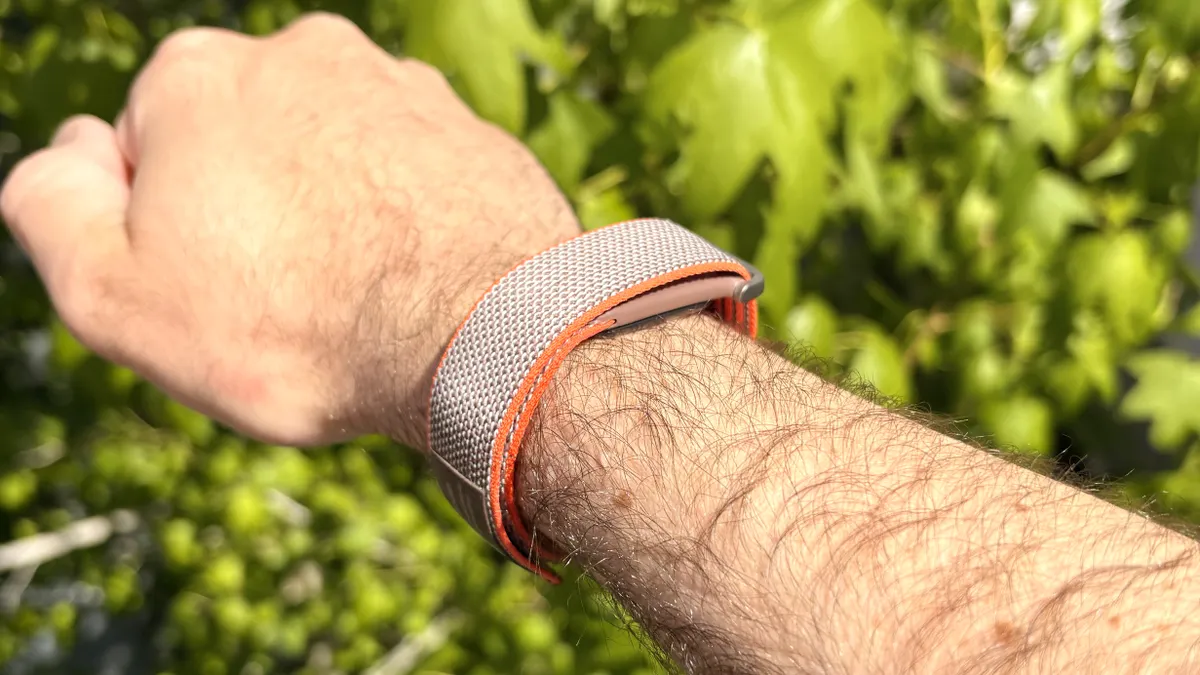
"The inspiration we had from the start was the friendship bracelet."
The Fitbit Air is a $99 screen- and button-free fitness tracker that doesn’t require a subscription and works with both Android and iOS devices. Incredibly lightweight and comfortable, it barely even looks like a piece of wearable tech, and that’s the point.
“The inspiration we had from the start was the friendship bracelet — the idea that you have this thing that is super lightweight, comfortable — it's not a typical fitness watch or fitness tracker,” says Becker. It’s “something that has a more casual, all-hours-in-the-day vibe. I would see my kids at summer camp; they'd put on a friendship bracelet and wear it for months on end until basically the threads went bare and they fell off.”
The beauty of the Fitbit Air is that all of the tracking technology is condensed into a small, bean-like object that can easily be popped in and out of bands for maximum customization. Google even released a hardware development kit allowing DIYers to design and 3D-print their own bands for the Air.
“There are a lot of creative people in the world who have unique situations, and the idea that it becomes something that people can have fun with," says Becker on the subject of creating your own straps for the Air. "You know, as long as it's working in a way that it's supporting their health, that's what's most important.”
A Whoop alternative for you and me

"I see it as sort of the archetype of the ambient fitness tracker. We have so many devices around us demanding our attention all the time, and at the same time, health is every hour of every day, seven days a week."
Of course, the Fitbit Air is far from the only screen-free fitness tracker out there. Its primary competition is the Whoop 5.0, a subscription-based tracker that’s big on heady training stats and recovery insights. Perfect for hardcore athletes and pros, the Fitbit Air is essentially the exact opposite.
While Whoop-wearers are less likely to need daily motivation to work out, the rest of us, well, could probably benefit from it.
"You have your high-tier athletes, and then you have like the other 99.7% of the population. There are a lot of people who don't have that motivation and guidance. So for me, it's like, that's where the real opportunity is, this broad population health."
As I noted in my review of the Fitbit Air, the device is basically a “Whoop alternative for the rest of us.” And after chatting with Becker, it seems that was the intention behind its development.
"I see [the Fitbit Air] as sort of the archetype of the ambient fitness tracker, the displayless tracker that's not demanding your attention. We have so many devices around us demanding our attention all the time, and at the same time, health is every hour of every day, seven days a week."
No GPS, no problem... for most people

“The reality is that like 99% of people who might want to track a run or a hike or something like that are going to have their phones with them."
It's worth noting that the Fitbit Air lacks onboard GPS, something I critiqued in the review, but why? According to Becker, the size, cost, and battery implications of including GPS didn’t align with the overall design intent of the Air.
Moreover, “the reality is that like 99% of people who might want to track a run or a hike or something like that are going to have their phones with them. So, having the paired GPS with the phone is going to provide a great experience,” adds Becker.
On the longterm outcome of Google’s Fitbit acquisition
"To launch [the Fitbit Air] now feels in many ways like the first big move in delivering upon the promise of the [Google] acquisition."
Becker has the unique perspective of working on the Fitbit brand both when it was a standalone company and under Google. And much to my surprise, he revealed that Fitbit Air has been under development since shortly after the acquisition in 2021. That's a long time!
“To launch [the Fitbit Air] now feels in many ways like the first big move in delivering upon the promise of the acquisition,” admits Becker.
“I think one of the great things about Fitbit becoming part of Google is that Fitbit brings a ton of health expertise, history, brand recognition, and many years — a decade plus — of data collection, so an understanding of people's biometrics and behaviors,” says Becker. “And Google is a company that can probably do the best job in the world of making sense of all that data, and I think that's what it's really unlocked.”
What’s next for Fitbit?

"I think we are seeing a really great reception to Fitbit Air, so it gives us confidence that we made the right decision in pursuing a screen-free form factor."
All of this begs the question: Is the Fitbit brand actually here to stay? When I asked Becker, he was coy, but I picked up on a glimmer of excitement. So, I pushed further. "With word of a Samsung Galaxy Ring 2 under development, might we expect other screen-free wearables from Google in the near future?" I asked.
“I think we are seeing a really great reception to Fitbit Air, so it gives us confidence that we made the right decision in pursuing a screen-free form factor, and I, and I'll have to leave it at that.”

Follow Tom's Guide on Google News and add us as a preferred source to get our up-to-date news, analysis, and reviews in your feeds. Alternatively, you can read our content on the Tom's Guide app available now for iOS and Android. Subscribe to Tom's Guide on YouTube and follow us on TikTok. Finally, you can visit our dedicated Tom's Guide Savings Squad hub for expert help on getting the best products for less.
More from Tom's Guide
- Fitbit Air performance issues? 3 ways to make sure the Fitbit Air accurately tracks your next workout
- An ‘iPhone moment’ for your eyes — why Xpanceo is betting big on smart contact lenses as the future of AR
- I went to Sweden to watch bike helmets get smashed into anvils — 3 things I learned at the MIPS test lab