If you’ve heard anything at all about OLED TVs, it’s probably at least one of two things: their picture quality is incredible, and apparently, they’re not as bright as LCD TVs.
While both of these things can be true, it’s worth unpacking that second point. Yes, OLED TVs are, on average, dimmer than LCD-based sets. But many of the best OLED TVs are getting brighter every year, and depending on the model in question (and the viewing environment it resides in), an OLED TV could hold up just fine.
With this in mind, let’s get to the bottom of OLED brightness once and for all. These marvelously designed TVs deserve to be understood if you’re shopping for a proper living-room upgrade. Here are three things to remember.
1. Affordable, entry-level OLEDs are often the dimmest

As mentioned, great strides have been made in the area of OLED brightness in recent years, but due to their reliance on organic material, OLEDs are still dimmer than LCD/LED, relatively speaking. It oughtn’t come as a surprise that, with few exceptions, the more affordable an OLED TV is, the lower its peak brightness.
LG’s latest entry-level model — the B6 OLED — is a fantastic avenue for folks who want to lock down OLED-driven performance without spending oodles of cash. The 65-inch LG B6 is $1,699 at Best Buy, which is one of the lowest prices you’ll see on a 2026 OLED TV in this size.
But there’s a catch. According to our test results, the B6 tops out at around 800 nits of brightness — and that’s just for small, concentrated highlights that flash on the screen. As an OLED TV, its presentation is still eye-poppingly good in dimly lit and darkened rooms, but in a sun-soaked environment, your eyes probably won’t pop.
If you do most of your TV-watching during the day (or in a room that produces a ton of ambient light), you might be better off spending roughly the same amount of money on an LCD/LED TV that specializes in a bright, punchy picture.
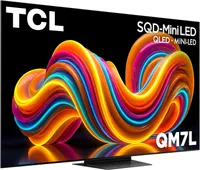
The TCL QM7L is a souped-up, mid-range Mini-LED TV with a ton of horsepower under its hood. We clocked this TV’s peak highlight brightness at around 2,300 nits, but crucially, it’s full-screen brightness is far greater than that of LG’s entry-level OLED.
Now, the QM7L isn’t perfect, and the B6 is priced higher for a reason. The QM7L can’t render perfect black levels, nor is it entirely free of haloing when bright objects collide with dark backdrops. There is a visual texture to the B6 (and all OLEDs) that even the best Mini-LED TVs can’t quite replicate.
But it’s important to remember that there are many ins and outs when comparing a mid-range LED TV like the QM7L to an entry-level OLED. The same can be said when comparing high-end LED TVs to mid-range and flagship-level OLEDs.
2. High-end OLEDs are the brightest

The Samsung S95H is one of the brightest OLEDs we’ve ever tested. In HDR, we clocked the S95H at an impressive 2,700 to 2,800 nits. When combined with the inky-black patina OLEDs are known for, this sort of brightness practically crackles across the screen.
But remember: These measurements reflect highlight brightness. In other words, they’re communicating the level of brightness you might see during a night sequence in a movie where street lights are punctuating a dark city street, or the sparkling dapples of sunlight dancing on a body of water.
If you plop down on the couch to watch the news or an episode of “SportsCenter,” the S95H you won’t be watching 2,000+ nits of brightness. Despite its flagship-level pedigree, the S95H’s average picture brightness (that is, the amount of brightness produced by the entire screen) is nowhere near what you’d experience on a similarly priced, flagship-level LED TV.
Nevertheless, the S95H is a brightness beast compared to the modest trappings of LG’s entry-level B6. In between these two models lies the mid-range class, and these OLEDs might strike the proper balance for some people.
3. Mid-range OLEDs are bright enough for most rooms
Mid-range OLEDs like the LG C6 and Samsung S90H don’t dole out highlight brightness quite like a top-shelf model, but they tend to be significantly brighter than entry-level OLEDs. In terms of their average full-screen brightness, they unsurprisingly sit somewhere between low-end and high-end OLED TVs.
For most people, this is plenty bright for everyday viewing. As long as your living space isn’t drenched in sunlight during the day, a mid-range model like the LG C6 is likely to be just fine, regardless of what you’re watching and when.
This year, Samsung’s mid-range S90H comes with a feature that might make it a more enticing option if you’re still concerned about OLED brightness: a glare-free screen.
If you're especially concerned, seek out a glare-free OLED TV

All TV brands take measures to reduce the impact of glare on their TV screens, but matte-style displays are quickly becoming a highly sought-after feature among viewers who seek to lessen the impact of light on their precious OLED picture. Right now, Samsung is the only OLED-maker applying this heavy-duty, matte-style finish to its OLED TVs.
For a few years, this feature could only be found on Samsung's top-shelf, flagship-level OLED. This year, the feature has made its way down to the mid-range class.
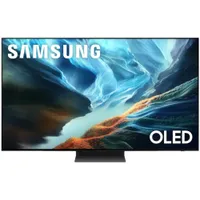
Samsung's Glare-Free display does a remarkable job at blunting the impact of direct glare, as it successfully squashes blobs of light into light smears of next-to-nothingness.
It's not everyone's cup of tea. You see, by scattering light so effectively, Samsung's Glare-Free finish tends to lift the picture's black levels in the presence of ambient light. Darker content often looks purplish-gray while the matte-style screen is doing its thing, and for some people, this can diminish the quintessentially inky appearance of an OLED TV. For this reason, I appreciate the less-intense look of LG and Sony's glare-fighting glossy OLED screens.
There's no formula for any of this decision-making, but a good rule of thumb is as follows: If you're really worried about the performance of an OLED in your living space — either because of the amount of daytime TV-watching you do or the level of lighting therein — you ought to consider an LED TV before diving into the OLED lifestyle.
If you're planning on shopping for a top-shelf OLED TV with tons of brightness, or even a mid-range model, you'll probably be fine unless your TV sits below a skylight or right next to several windows.

Follow Tom's Guide on Google News and add us as a preferred source to get our up-to-date news, analysis, and reviews in your feeds.
More from Tom's Guide