In tech, a 2x improvement is great and 10x is generational. So for Nvidia to claim its future gaming GPUs will be 1,000,000x better at path tracing sounds like pure science fiction. But that’s exactly what the company said at GDC 2026, and what’s even crazier is that I think it’s closer than any of us think.
Because today, Nvidia has confirmed you will see the “future of real-time rendering” in CEO Jensen Huang’s GTC 2026 keynote — I think a sneak peek is possible. The obstacle to this at the moment is current GPU hardware is hitting a physical wall where we can’t just throw more electricity at the problem. And the fix? Well, it’s Nvidia’s bread and butter: AI.
Catch the future of real-time rendering in Jensen’s keynote tomorrow👀 https://t.co/KFv1JoTsDuMarch 15, 2026
What is Path Tracing?

This has been the new hotness in PC gaming. I tested it in Resident Evil: Requiem, and it’s rather incredible. But what it is and how to get there is an impossible-level challenge if using the old ways.
Put simply, it’s physical accuracy. It’s not just a reflection in a puddle, it’s how light from a neon sign bounces off a wet pavement, hits a character’s chrome jacket and subtly tints their skin red. It’s not just the ray traced shiny surfaces of old; path tracing calculates how light interacts with literally everything in a scene in a realistic way.


The end result is probably going to be subtle in some games, but in others (like Requiem) where the finer details really matter in building up the fear, it can be a game changer.
The death of brute force
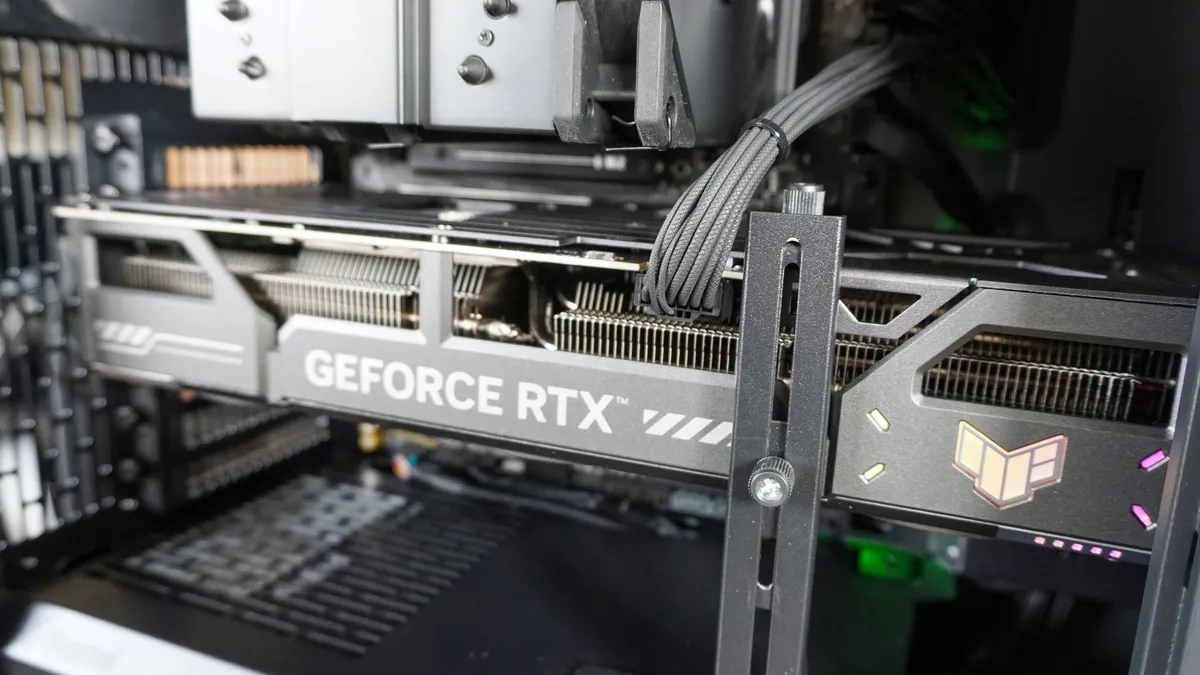
Like I said, it’s an impossible challenge through raw hardware power. If you had your GPU just brute force full path tracing, your PC would probably melt before it rendered a single frame of Cyberpunk 2077. But as you may have seen reading my Requiem test, Nvidia bridges that gap with DLSS 4 — AI trickery with Ray Reconstruction.
Basically, instead of making the GPU seriously sweat trying to track a single ping-pong ball thrown in a room filled with a billion mirrors, these neural rendering technologies bring in an expert who has seen billions of balls thrown into that maze. They can just look at where you threw it and draw exactly where it’s going to land.
By offloading that demanding task to AI, path tracing becomes much more efficient to do, and then that 1 million time jump starts to sound more possible.
Neural rendering is the whole thing

In our time speaking with Jensen Huang, it’s clear that DLSS is just the start of AI’s impact on PC gaming. The limits of how much more complex GPU hardware can get are starting to be reached, and neural rendering will be the thing that fills in the gap — turning your graphics card into less of a calculator and more of an imagination machine.
“In the future, it is very likely that we'll do more and more computation on fewer and fewer pixels. By doing so, the pixels that we compute are insanely beautiful, and then we use AI to infer what must be around it.” Huang said.
And the results in his words are “utterly shocking and incredible.” He talks about it looking like “basically a photograph interacting with you at 500 frames per second.” And this ties in with what John Spitzer, vice president of developer and performance, said when talking about the future of PC gaming graphics at GDC 2026.
"We're still not where we want to be. We want the real-time images to look indistinguishable from reality. We want them to look like a film,” Spitzer commented.
GTC 2026 is the starting pistol

And as these stars align around everything Nvidia is saying, that brings me back around to this “future of real-time rendering” promise for Huang’s keynote today. To be clear, this is not going to mean new gaming GPUs.
We already know that much from the supply issues around the current RTX 50-series, as Nvidia’s attention is being turned to building the picks and shovels for the AI gold race (or bubble…whichever way you look at it). But Team Green continues to march on in the gaming space, and this announcement should get PC players hyped.
I don’t think it’ll be a finish line, it’ll be a look at the next steps where we could go. After all, Vera Rubin is an architectural glimpse of what gains we may see in RTX 60-series, and that could fuel these big ideas.

Follow Tom's Guide on Google News and add us as a preferred source to get our up-to-date news, analysis, and reviews in your feeds.
More from Tom's Guide