We've come to believe that the only way you can build a strong body is by lifting heavy weights. But did you know that a yoga block can still give you a fiery full-body workout and get you results? I'm here to show you that you don't need heavy weights or a gym to torch your body, and this sequence is proof.
Typically, yoga blocks are used in yoga and Pilates classes to either increase activation in certain poses or improve alignment and positioning in others if you have limited mobility or flexibility. For that reason, blocks can make moves harder or easier, depending on your needs.
Today, we're making it harder, but don't worry, these five exercises are beginner-friendly, and work your upper and lower body and core using just one yoga block.
It's all in the creativity, I promise. Let's get started.
5 yoga block exercises you can do anywhere
Before we get stuck into the exercises, let's talk about effort over load. Of course, if you want to build muscle, there's a principle called progressive overload that is important to follow, which means gradually increasing or adapting volume to stimulate change in your muscles. Without this, the stimulus isn't ideal for creating growth. It also follows that to build strength, you'll need to gradually make exercises more challenging to avoid a plateau in gains.
But did you know that effort, close to failure, is a key requirement for progression? So while you might not be lifting the heaviest weights in the gym, your effort makes a huge difference in terms of stimulus on the body.
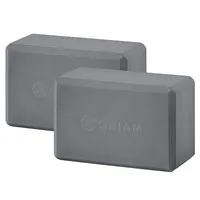
In short, you will need to progress this routine over time, either with sets, reps, or progressions on the exercises themselves, but you don't always need to add weights like dumbbells or kettlebells to make them challenging for your body. If you don’t have a block, use a small, firm cushion or a book instead.
Remember to keep your stomach braced and maintain a neutral spine without hunching or rounding your back. When working with your back supported on the ground, press your lower back gently into the mat to maintain neutrality; slightly tilt your pelvis toward you.
1. V exchanges
This mimics the V-sit, but instead of simply lifting and lowering your arms and legs, you'll exchange the yoga block between your hands and feet with every rep. Your stability, balance and control will all be tested here, so move slowly and don't rush your reps.
The move hits your core, including your abs, obliques and hip flexors, plus the adductors, quads and lower back. It will also test hamstring flexibility as you aim to keep your legs extended, but a bend in the knees is fine if you are particularly tight.
If you struggle to keep form, scale by bending your knees as you lift your legs, drawing both knees toward you as your arms reach overhead. I recommend slightly lifting your upper body before your legs as you start each rep, and remember to reset with arms and legs touching the ground after every rep.
- Place the yoga block between your feet on the narrowest setting and squeeze your legs together to activate your inner legs
- Lie on your back with your arms reaching behind you and legs extended
- Press your lower back into the mat and brace your stomach as if you're about to sneeze
- As you breathe out, lift your upper and lower body off the mat and draw your hands and feet to touch overhead
- Exchange the block into your hands, then lower your body to the floor again
- Repeat, this time exchanging the block back to your feet.
2. Deficit push-ups
Creating a deficit on one side of the body allows you to hone in on your left and right sides independently while challenging your range of motion, allowing your shoulder to travel further with every rep; this maximizes time under tension and increases the stretch in the working muscles, namely the pecs, anterior deltoids and triceps. It's a great way to increase tension and challenge without using weights.
Your core will work to stabilize your body, but it's not the main focus of this move; an active core should prevent your hips from dropping and your lower back from taking strain.
- Start in a push-up position with your shoulders stacked directly over your hands. For extra support, bring your knees down to the ground
- Place the block beneath your right hand, palm flat
- Engage your core
- As you inhale, bend your elbows and lower your chest toward the ground as far as you can
- Pause at the bottom, ensuring your butt is still aligned with your shoulders
- As you exhale, extend your elbows and push the ground away to return to the starting position
- Complete reps on one side, then move the block to the other side.
3. Prisoner squat to good morning
The prisoner squat improves thoracic mobility by requiring you to squat with your hands behind your head, reinforcing an upright torso position. It'll also open your chest and activate your upper back, but remember not to tilt your body forward as you squat down, and focus on pulling your elbows back and knitting your shoulder blades together.
At the bottom, you'll transition into a good morning, while the block helps activate the inner thighs and maintain proper leg positioning. The good morning activates the posterior chain, including your lower back, glutes and hamstrings; the combination of the two will test your lower-body mobility, so be patient and focus on your form.
Inhale as you lower into the squat and tilt forward, then exhale as you press to stand.
- Stand with your feet slightly wider than shoulder-width apart and place a block horizontally between your thighs. Give the block a squeeze
- Slightly turn your toes out and place your hands behind your head. Draw your elbows back to open your chest, and stand tall
- Engage your core
- Sit your hips back and lower into a squat until your thighs are roughly parallel to the ground. Keep your chest lifted and press through your heels, little toes and big toes
- At the bottom of the squat, lift your hips and tilt your chest forward until almost parallel with the ground. Keep a soft bend in the knees until you feel a stretch along your hamstrings
- Drive up to stand, extending your hips and knees and squeezing your glutes.
4. Heel raised squats
Raising your heels makes your squat more quad-dominant, transferring a little more emphasis to the front of your body. Place the block on a narrow setting between your thighs and give it a squeeze during the entire squat to help engage your inner thighs and increase squat intensity.
Doing this also taps into the mind-muscle connection, creating conscious activation of the working muscle groups during movement. Inhale as you lower into the squat and exhale as you press upward to stand.
- Place your feet roughly hip-width apart and position the block behind you
- Step your heels onto the edge of the block and turn your toes slightly outward
- Engage your core and stand tall through your spine, shoulders back and down
- Sit your hips back and bend your knees to lower into the squat
- Keep your chest lifted and pause at the bottom
- Drive up to stand, extending your hips and knees.
5. Glute bridge with squeezes
The glute bridge hits the posterior chain with a particular focus on the glutes. For this variation, we will focus on isometric contraction of the muscles, meaning you will hold the bridge position, contracting muscles without moving them through any range of motion.
From here, focus on creating small squeezes into the block with your inner thighs, activating your glutes and adductors. It's crucial to keep your glutes and core active as you extend through the hips to protect your lower back. Think about creating a straight line from the shoulders to the knees.
- Start on your back with your knees bent and your feet planted on the ground
- Place the yoga block between your thighs, engage your core and press your legs into the block
- Inhale, then as you exhale, peel your butt and back away from the ground and press your hips upward toward the ceiling. Squeeze your glutes at the top and hold
- Extend your arms overhead or keep them lightly pressed into the ground for support. Begin creating tiny pulses by squeezing and releasing the block with your inner thighs
- Slowly lower to the ground, starting with the upper back and slowly rippling down to your butt.
- Follow Tom's Guide fitness on Instagram for more workouts, routines, tips, and tricks.
What is the yoga block workout?
Work for 50 seconds, then take 10 seconds to rest. Complete 5 rounds. As you are working for the same amount of time each round, try to count your reps during the first round, then maintain those reps throughout the remaining ones; for example, if I manage 10 squats in 50 seconds, I will aim for 10 squats again.
It’s good to remember that you can apply subtlety to your training regime and still get results. Although it’s easier to default to heavy weights, using just a block and your body weight can be challenging if you apply good form and move slowly and with control. Here are a few tips for building muscle without lifting heavier weights.

Follow Tom's Guide on Google News and add us as a preferred source to get our up-to-date news, analysis, and reviews in your feeds.
More from Tom's Guide