Lower back pain is one of the most common injuries or health conditions you see cropping up, and managing back pain through movement involves assessing your options and finding the best low-impact exercises for your spine.
If you've been cleared to exercise and you struggle with your back, then low-impact core exercises can help you strengthen your core while minimizing the risk of pain or strain. That might mean popular abs exercises like sit-ups or Russian twists aren't for you, and you could be on the market for some new moves.
I've recently been testing this for myself, and I'm currently swapping well-known core exercises for one in particular. Here's why I love it, and a step-by-step for how to perform it yourself.
If you are currently working with pain, an injury, or any health condition, I advise speaking with a qualified medical professional before starting any new exercises or workout programs. I'm not a qualified physical therapist and cannot diagnose a health condition.
How to do hollow hold pulses
The hollow hold exercise is one of my favorite core exercises to teach because it targets your deep core, builds stability, and encourages deep, expansive diaphragmatic breathing.
I don't know anyone who won't struggle with as little as 20 seconds of this move, and it's not uncommon to see a lot of trembling muscles.
I first really got to know the hollow hold when I did a lot of CrossFit, as this core exercise was often taught during warm-ups before any work on the bar; it's brilliant if you like to do pull-ups, muscle-ups, toes-to-bar, or any hanging exercises like L-sits, as it teaches you to engage your core muscles and hold one position with proper form and breathwork.
I don't know anyone who won't struggle with as little as 20 seconds of this move, and it's not uncommon to see a lot of trembling muscles.
For this version of the exercise, I want you to add little pulses up and down with your arms and legs, followed by pulses outward and inward with your legs. You can add one of the best resistance bands just above your knees to make this harder.
Here's how:
- Lie on your back with your arms and legs extended
- Slightly tuck your chin toward your chest, then peel your arms and upper back away from the mat so that your shoulder blades lift away. Keep your gaze forward and brace your core muscles, drawing your navel in
- Keep your arms alongside your ears and reach back with your fingertips. Lift your legs to hover above the mat. Point your toes and glue your legs together to activate your inner thighs
- Aim for a soft banana shape with your body and hold for 20 seconds, then relax for 10 seconds. Repeat for the desired number of rounds
- Once you feel confident, add little pulses up and down with your arms and legs, focusing on pressing your lower back into the mat. Add pulses in and out with your legs, too.
Benefits
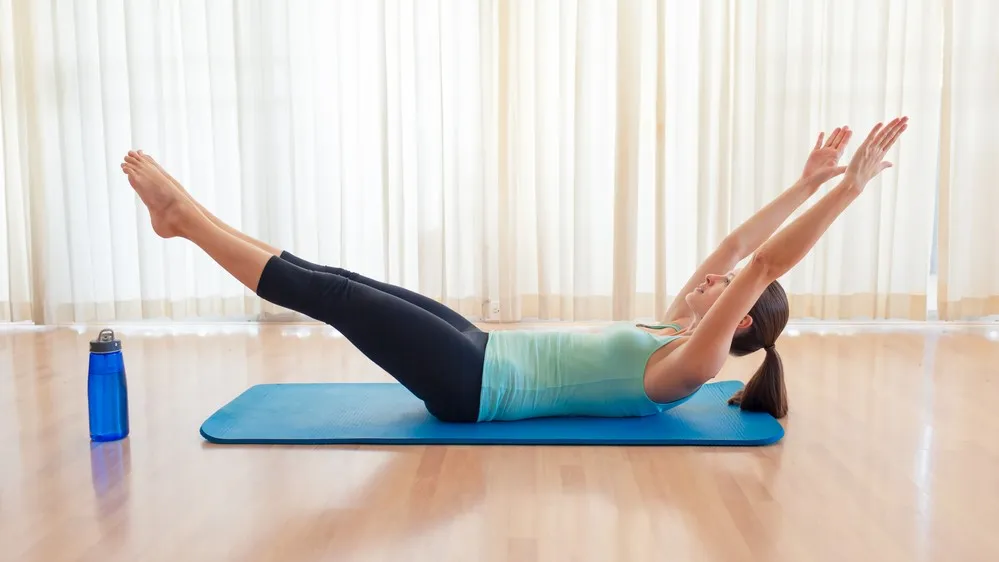
Here are some benefits and cues to help you with the hollow hold exercise.
Strengthens your deep core
Your core as a whole (namely, the diaphragm, transverse abdominis and internal obliques) works hard as you hold the position using something called isometric muscle contraction. You may also feel this in your hips, legs, arms and shoulders as you resist gravity, but they shouldn't take over the exercise.
Cue: Keep your arms glued to your ears and your legs glued to each other; this improves contraction and alignment.
Protects your lower back
Low-impact core exercises help protect your spine by supporting your back. The beauty of this move is that your lower back will press gently into the mat throughout so that only your upper back, arms and legs lift. It's very important to consciously contract your entire body and breathe toward your stomach. Holding your breath can increase blood pressure, which we don't want.
Cue: Focus on slightly tucking your pelvis toward you so that you can't slide a piece of paper under your lower back. If that doesn't help, consider placing both hands beneath your lower back for extra support.
Translates to other exercises
It might not seem like the type of exercise you'd do in other areas of your life, but building deep core strength and stability does translate, as you need your core to safely drive movement like lifting a heavy box or climbing a steep hill without hurting your back.
Moreover, this exercise teaches you to understand where your body is in space and encourages you to consciously contract as many muscles as possible; I find this improves overall mind-muscle connection.
Cue: See if you can add pulses or maybe a rocking motion while holding the soft banana shape; this mimics the first stage of getting off the floor from a lying position.
What happened when I added it to my weekly routine?
This move never gets easier, but I love that.
This move never gets easier, but I love that.
Every time I add it back into my routine and swap out more common core exercises, my back loves me. I also find it helps me re-engage with my core muscles, which I have to (constantly) remind myself exist for a reason, and that's to protect me from injury.
Pilates has been brilliant at strengthening my core, but this move is one that I keep returning to time after time. It's simple and can be scaled to your ability, and if it ever feels too much, you can simply focus on lifting just your arms or legs or alternating between the two.
I like adding pulses to work my core a little harder, but the leg pulses in particular help engage the outer glutes and get the inner thighs working, too.
Play around with it and have some fun, but never neglect your breathing. I want you to think about blowing up a balloon and funneling your breath to your stomach while bracing. This will also help protect your back.
Follow Tom's Guide fitness on Instagram for more workouts, routines, tips, and tricks.
Obviously, I'm not suddenly sporting a rippling six-pack, but this is about deeper core strength rather than the more superficial gains.
Why not add it to your routine and let me know what you think?

Follow Tom's Guide on Google News and add us as a preferred source to get our up-to-date news, analysis, and reviews in your feeds. Alternatively, you can read our content on the Tom's Guide app available now for iOS and Android.
More from Tom's Guide
- Not sit-ups, planks, or crunches: I do this simple Pilates exercise every single day to build a strong and stable core and work on my hip flexor mobility
- I'm a weightlifting coach — 3 exercises I prefer over lunges for building strong, stable legs and knees over 40
- I tried a 7-day standing core routine. Here are the differences I noticed in my strength and posture