When a neurosurgeon gives you advice on reducing back pain using your feet, you sit up and take note. And that's exactly what I did when Anthony Ghosh provided a simple foot exercise you can do to improve alignment and posture and reduce pain.
Many people aren't aware that back pain doesn't necessarily originate at the back and can be caused by weakness, instability, under- or over-firing, or tightness in other muscles and joints, including the feet, glutes, hips and hamstrings.
Within your body, you have anatomical sling systems, which basically mean a connection between muscle groups. There are four main sling systems, creating a network of fascia and muscles that recruit together across the body. For this reason, it's very important to view your body holistically rather than just focusing on one specific area when you experience pain or injury.
I learned this the hard way, as years of issues with my left shoulder threw up issues in my neck and traps that I wasn't even aware of.
You barely need any equipment to do the exercise below, just a chair and a few minutes to spare. Learn how to do it from a leading neurosurgeon, and why I've been adding it to my routine to fix desk posture.

Anthony Ghosh MBChB, MD, FRCS (Neuro.Surg) is a consultant spinal neurosurgeon and leading UK authority in spine care. With advanced fellowship training in both neurosurgical and orthopaedic spine surgery, he specializes in the treatment of back and neck pain, degenerative spinal conditions, sciatica, spinal deformity and minimally invasive surgery. He also leads and collaborates with physiotherapists, osteopaths, pain specialists and rheumatologists.
Watch:
"When the intrinsic foot muscles are weak, this causes some instability of the foot arch, therefore causing the foot to slightly rotate inward under load (pronation)," explains Ghosh.
"This creates a biomechanical cascade, which causes some internal rotation of the lower half of the leg and, therefore, a small amount of internal rotation up at the hip, forcing the pelvis into a forward tilt and increasing the lumbar lordosis as a result," says Ghosh.
That means an issue that originated at the foot has crept up the knees to the hips, pelvis and spine.
"This is the natural backward curvature of the lower bit of the spine, which can increase in such conditions, therefore putting more load on the facet joints, causing pain. For this, a seated short foot exercise can be really helpful for back pain," he recommends.
If you experience pain at any time, stop and rest. If you're working with an injury or health condition, I recommend seeking advice before starting these exercises, especially if you have lower-body joint or muscular issues.
"If you feel any extremely sharp pain, always consult a medical professional."
How to do a seated short foot exercise
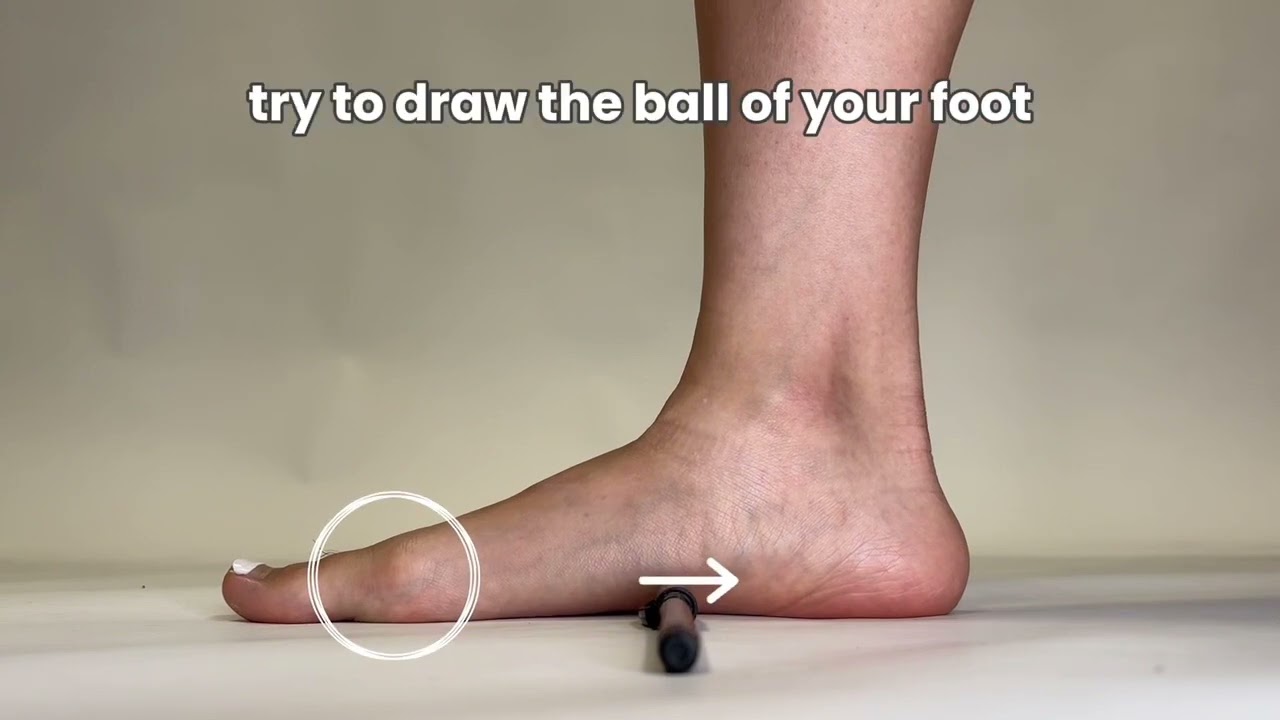
- Sit on a chair with your feet flat on the floor in front of you.
- Without curling your toes, try to draw the ball of your foot toward your heel. You will feel the arch lift slightly off the floor.
- Hold for around 5 seconds.
- Slowly lower back to a relaxed state.
- Repeat for several rounds or up to 60 seconds, then switch sides.
Here's what happened when I tried it
As Ghosh mentions, any tightness or limited range of motion in the feet and ankles can have a cascading effect higher up the body, especially along the joints. That's why it's important to zoom out when looking at injuries and health conditions and look holistically at the issue and where it might originate.
I've been experiencing a little low back pain recently, and I have horrifically tight ankles and sensitive feet, not to mention I spend more time than I'd like sitting at a desk, not always paying attention to my posture.
I wanted to find a solution for fixing desk posture, and while this exercise alone isn't a cure-all, it has certainly helped me relieve tension in my feet and ankles using dorsiflexion of the foot, which has actually helped relieve tension in my back.
Foot exercises are great for stability and balance and help improve foot-ground connection during exercise, whether that's playing sports or lifting heavy weights. It can also feel grounding (quite literally), which is useful for reducing anxiety and stress, not to mention feeling more stable during squats and lifts.
I love this move because it's functional, moving your body in a natural movement pattern. Relieving tightness and building range of motion here can translate to other activities like climbing or running, and spending some time working on the feet can help proprioception, neuromuscular control and joint stability, too.
Will I continue doing this exercise? Absolutely. Give it a try and let us know how you get on in the comments!
Follow Tom's Guide fitness on Instagram for more workouts, routines, tips, and tricks.

Follow Tom's Guide on Google News and add us as a preferred source to get our up-to-date news, analysis, and reviews in your feeds. Alternatively, you can read our content on the Tom's Guide app available now for iOS and Android. Subscribe to Tom's Guide on YouTube and follow us on TikTok.
More from Tom's Guide
- I teach people how to be more mobile: 3 low-impact back and shoulder moves that build stability and strength after 40
- According to a personal trainer, this exercise is 100 times more effective than crunches. I tried it and was humbled
- I teach people over 50 to be mobile: 3 low-impact moves that build more stability than a 30-minute walk