So many of my personal training clients suffer from rounded posture, tight pecs, and poor shoulder range of motion. Desk jobs are usually the major culprit, made worse by lots of bench presses and not enough mobility work.
Sometimes I’ll give my clients a few common chest and back stretches, but there’s actually one move I prefer over stretching: quadruped thoracic rotations. This exercise opens up the entire upper body, reducing overall stiffness and enhancing spinal alignment. It’s a movement that almost anyone could benefit from, but especially those who are stuck behind a computer all day.
Below, I’ll go over how to do quadruped thoracic rotations, their benefits, and common form errors to keep in mind. Roll out your yoga mat and give them a try for yourself.
How to do quadruped thoracic rotations
Consult with your doctor before trying any new activity. This exercise can be done by most people, but beginners should consider meeting with a trainer for guidance on proper form.
You’ll just need a yoga mat to do quadruped thoracic rotations. If you have sore knees, you can place a rolled-up towel or pillow underneath them for extra cushioning.
Start by doing 5-8 rotations on each side, 3-4 times a week. As your upper body mobility improves, increase to 10 reps on each side. Gradually work your way up to doing this exercise for at least one set, 5-7 times a week.
Quadruped thoracic rotations make a great addition to your warm-up routine. They can also be done after work or long periods of sitting.
Here’s how to do them:
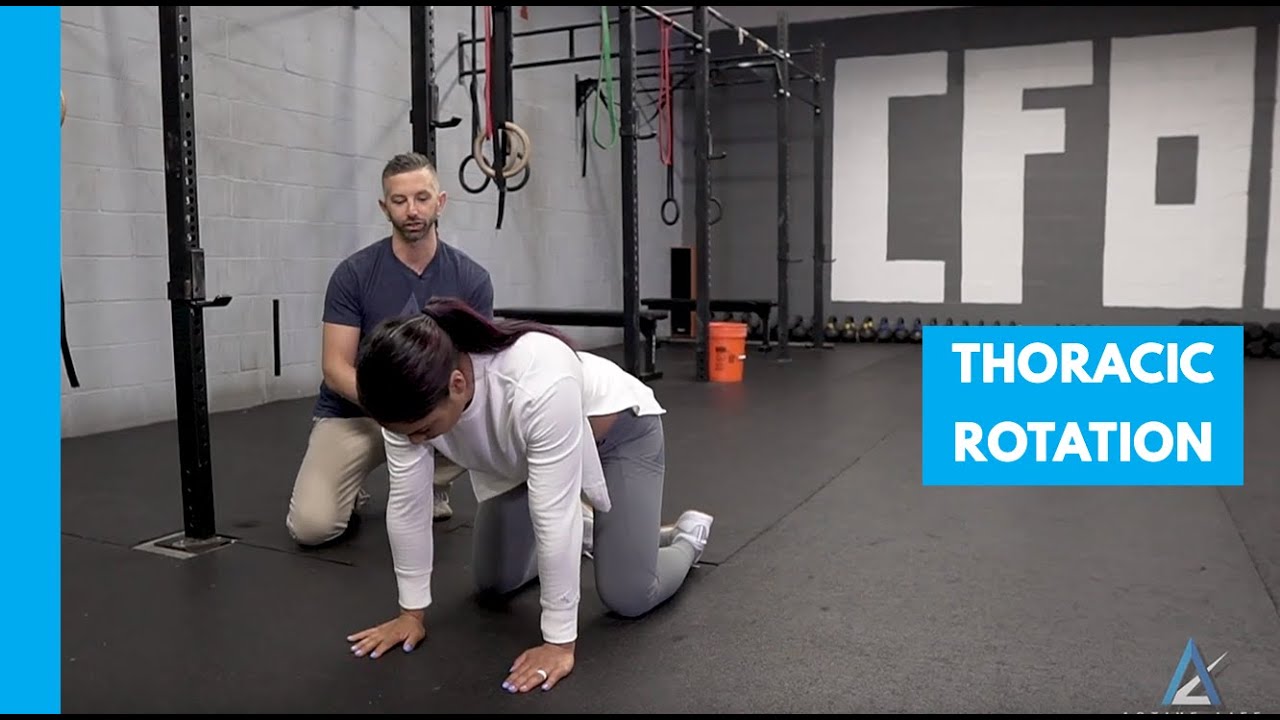
- Come to all fours on the mat.
- Sink your hips back towards your heels.
- Place your right hand behind the back of your head.
- Place your left hand underneath your right shoulder.
- Rotate your torso and lift your right elbow towards the ceiling.
- Slowly return to the starting position.
- Continue for 5-10 reps, then repeat on the other side.
Benefits of quadruped thoracic rotations
Most of our daily life is forward, from sitting on the computer to texting on our phones. All that time spent in front of us can tighten certain muscles and weaken others. In turn, this can degrade posture, cause chronic pain and stiffness, and make us more susceptible to overuse injuries.
Quadruped thoracic rotations open up the chest, shoulders, and back in a transverse plane of motion. Sitting the hips back towards the heels stabilizes the often vulnerable lower back area, while the “rotation” increases mobility and flexibility throughout the thoracic spine.
Additionally, the “quadruped” formation engages deep core muscles like the transverse abdominis and internal obliques, which help to stabilize and support the pelvis and spinal column.
Done regularly, quadruped thoracic rotations can counteract the negative effects of sitting for long periods, promoting better range of motion in the spine and enhancing overall posture.
Common quadruped thoracic rotation form errors
Quadruped thoracic rotations aren’t hard to learn, but there are a few common mistakes that can make the exercise less effective.
Not setting the hips back towards the heels
While this may seem like a minor part of the movement, making sure you set your hips back is super important. This portion of the exercise stabilizes and protects the lower back as you rotate the torso.
If injury or mobility concerns prevent you from sitting back onto your heels, try seated thoracic rotations instead. Sit tall in a chair, engage your core muscles, cross your arms across your chest, and gently twist your torso to each side.
Moving too fast
I see it all the time: clients use quadruped thoracic rotations as a warm-up, then speed through the exercise so that they can get to the main part of their workout. But going too quickly can mean that you’re relying on momentum, not reaching the ends of your range of motion, and even setting yourself up for injury through uncontrolled movement.
Rotate through your spine slowly, and hold at the ends of your range for at least 2-3 seconds. Towards the end of each set, you can even challenge yourself to go a bit further or hold for an additional second.
Over rotating
You may not get a lot of rotational range at first, and often, beginners will try to compensate for that by shifting their hips instead of keeping them square to the mat. However, that twists the lower back, not the thoracic spine. If your lower back is tight or you’re dealing with disc issues, this can lead to pain or a worsening of your condition.
When performing quadruped thoracic rotations, focus less on the degree of rotation and more on the “stretch” you feel. Even if you’re not moving that much, if you feel the chest, shoulders, and back opening up, you’re getting the benefits of the exercise.

Follow Tom's Guide on Google News and add us as a preferred source to get our up-to-date news, analysis, and reviews in your feeds. Alternatively, you can read our content on the Tom's Guide app available now for iOS and Android. Subscribe to Tom's Guide on YouTube and follow us on TikTok. Finally, you can visit our dedicated Tom's Guide Savings Squad hub for expert help on getting the best products for less.
More from Tom's Guide
- Not sit-ups, planks, or crunches: I do this simple Pilates exercise every single day to build a strong and stable core and work on my hip flexor mobility
- I'm a weightlifting coach — 3 exercises I prefer over lunges for building strong, stable legs and knees over 40
- I tried a 7-day standing core routine. Here are the differences I noticed in my strength and posture