Training smarter, not harder, is the key to longevity as you age. It's a lesson that comes to most of us at some stage, but I wish someone had told me sooner.
Working your key major muscle groups several times per week can help counteract the natural loss of muscle mass and strength that occurs through the decades, but there are some muscle groups I really want you to focus on later in life, and those are your glutes, hips, legs and shoulders.
Strong glutes help stabilize your pelvis and keep your lower back safe; robust legs will allow you to stay balanced and active; mobile, active shoulders support proper posture and allow you to lift, push and pull your own weight.
You don't need to get down on the ground to do these exercises, and for most people, they're low-impact. Give these moves a go, and let me know how you get on in the comments section below.
2 moves I recommend as a personal trainer
I highly recommend Bulgarian split squats and scapula push-ups as part of a wider exercise routine. Bulgarian split squats strengthen your hips, legs and glutes, while scapula push-ups work the shoulder blades through protraction and retraction, strengthening the stabilizing muscles that support shoulder movement.
1. Scapula push-ups
During scap push-ups, you'll protract and retract the scapulae (shoulder blades). Drawing the shoulders apart is protraction, as you push your chest away from the floor, whereas retraction involves pulling the shoulder blades together and drawing the shoulders back.
You’ll start in a push-up position on your toes or knees. Keeping your arms straight, perform a push-up without bending your elbows. You could also perform this against a wall while standing.
Here's how to do scapula push-ups:
- Start in a push-up position with your shoulders stacked over your wrists and hips aligned with your shoulders. Use your knees if you prefer
- Brace your shoulders, core, glutes and quads
- Press through your hands and slightly rotate your shoulders outward to help engage your back
- Keep your arms straight, then push your chest away from the floor, pulling your shoulder blades apart
- Pause, then draw your shoulder blades together and lower your chest toward the ground
- Continue for 8-12 reps and 3-4 sets.

In life, the shoulders spend a lot of time protracted as we tend to live quite hunched over. Retraction is key to developing healthy, balanced shoulders, so this move will help you build stability and better posture. It’s also a great way to safeguard your shoulders from injury.
Aim to move slowly, as taking your time helps strengthen the mind-muscle connection and will prevent you from rushing. Try to pause and squeeze your shoulders at the top and bottom of the movement to help maximize activation.
There are a bunch of muscle groups that contribute to shoulder stability, including the rotator cuff muscles — a group of four muscles surrounding and supporting the scapulae — and the rhomboids and serratus anterior (muscles that help flatten your shoulder blades and pull them in).
Moving between the two positions is incredibly important for shoulder health, especially if you enjoy push-and-pull workouts for your chest and back, where both the frontal and posterior deltoids are working.
If you have winged scaps (shoulder blades that stick out) or struggle to engage your shoulders properly during movements like the row or bench press, this one is for you. If you would like to progress the exercise, wrap a resistance band just below your shoulder blades and secure it under your hands to increase resistance overall.
If you have a shoulder-related injury, any pre-existing health conditions, or injuries, or you experience pain when performing scapula push-ups, speak with a qualified personal trainer or physician first.
2. Bulgarian split squats
You should feel this mostly in your standing leg and glutes, but you could position your back leg against a wall instead of supporting it on a bench or chair; pressing into the wall activates the back leg more, and you'll feel a deep stretch down the hip flexor and quad.
The exercise is unilateral, which means focusing on one side of the body at a time; this will build balance and stability alongside strength. When you feel confident, see if you can add weight in the form of dumbbells, kettlebells, or even barbells.
Here's how to do Bulgarian split squats:
- Stand with your feet hip-width apart
- Position your right foot onto a bench or chair behind you. Square your hips to the front of the room. You can tuck the toes or position the top of the foot flat
- To begin with, place your hands on your hips. When you feel comfortable, hold a weight (more on this below)
- Hinge at the hips and lean slightly forward, keeping your spine long and chest proud
- Bend your front knee and lower toward the ground, sending your back knee toward the bench in an arcing motion
- Pause with the weight in your front leg, then drive upward to stand
- Continue for 8-10 reps per side and 3-4 sets.
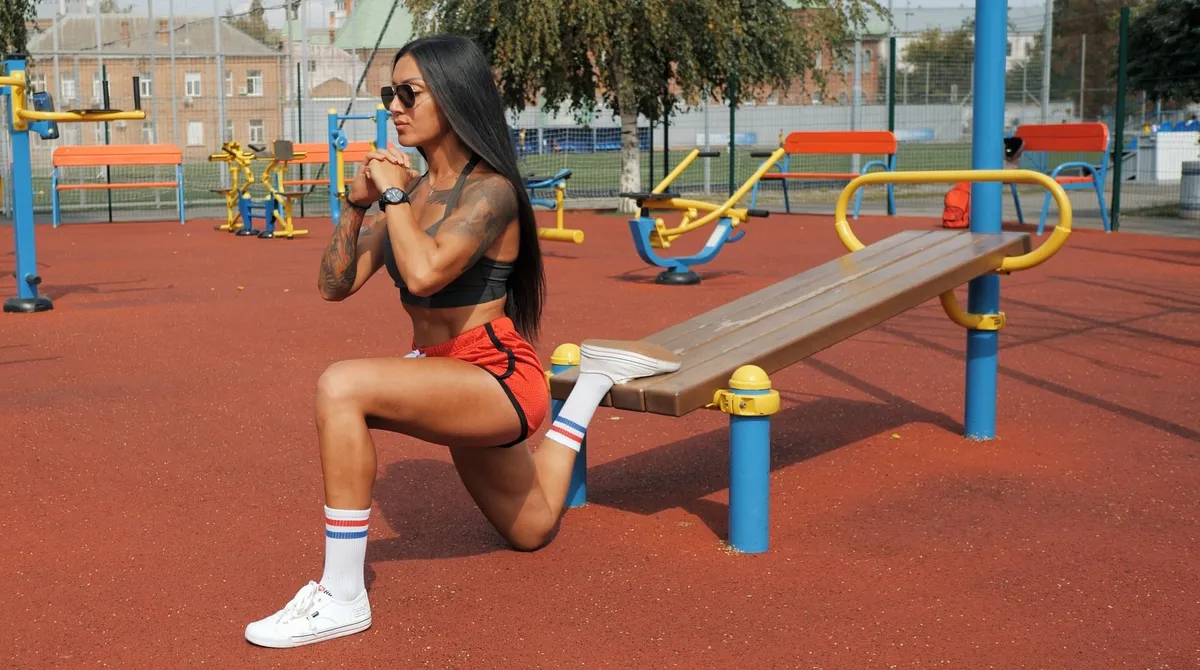
By hinging forward, you'll engage your gluteal muscles more, which can turn an exercise like this from quad-dominant to glute-dominant.
For more quad focus, hold the weight in the same hand as your front leg (this means ipsilateral). For glute and core focus, hold it in the opposite hand (contralateral), as this will require your hips to stabilize. Holding two weights will allow you to load heavier.
Think about actively engaging your core by bracing your stomach and drawing your navel in while sending your breath down from your chest to your stomach.
Move with control and focus, not speed. As you lower into the split squat, arcing the back knee behind toward the bench will also allow you to reach further into your glutes and develop more of a stretch along the hip flexors. Dealer's choice!
Follow Tom's Guide fitness on Instagram for more workouts, routines, tips, and tricks.
As you lower into the split squat, arcing the back knee behind toward the bench will also allow you to reach further into your glutes and develop more of a stretch along the hip flexors. Dealer's choice!
Don't feel pressured to add weight. And if you struggle with any knee conditions, pain, or injuries, I strongly recommend getting guidance from a physician or physical therapist first.
While Bulgarian split squats are more of a typical "leg day" exercise, scap push-ups are more of a warm-up technique, and I wouldn't replace regular push-ups with them; instead, add them in before upper-body workouts as a drill to prepare your shoulders for movement.
I sit behind a desk for multiple hours during the day, so I find both of these exercises brilliant additions for stretching out my hips and getting my shoulders moving again.

Follow Tom's Guide on Google News and add us as a preferred source to get our up-to-date news, analysis, and reviews in your feeds. Alternatively, you can read our content on the Tom's Guide app available now for iOS and Android.
More from Tom's Guide
- I'm a personal trainer who works with clients over 50 — these are the 3 mobility exercises I never skip
- After 60, this is the 10-minute routine I use with my clients to stay strong, mobile and independent
- 'I’m a Pilates instructor, and I recommend these 5 core exercises to help older clients build strength and improve posture'