Apple versus Google: Which brand makes the better smartwatch for tracking fitness? To find out, I strapped the best smartwatch model from each to opposite wrists and embarked on a 6,000-step walk around my neighborhood.
As a control for step count data — the primary metric we'll use to determine our fitness tracking accuracy champion — I manually counted my paces; a click of my trusty, old-school tally counter marked every hundred taken.
So, which top-shelf smartwatch, the Apple Watch Ultra 3 or Google Pixel Watch 4 XL, proved victorious in my comparison? Read on.
Apple Watch Ultra 3 vs Google Pixel Watch 4 XL
| Header Cell - Column 0 | Apple Watch Ultra 3 |
Pixel Watch 4 XL |
|---|---|---|
Price |
$799 |
$399 |
OS compatibility |
iOS |
Android |
Battery life (tested) |
42 hours |
60 hours |
Water resistance |
100 meters |
50 meters |
Speaker/mic |
Yes |
Yes |
Cellular |
Yes |
Optional |
Unlike Apple and Samsung, Google doesn't offer an 'Ultra' model in the brand's current smartwatch lineup. This means that the Pixel Watch 4 XL (45mm), with superior battery life but a higher price tag than its smaller (41mm) sibling, is Google's most capable and exspensive model.
Starting at $399 for the non-cellular model or $449 for LTE connectivity, the Pixel Watch 4 is notably cheaper than the $799 Apple Watch Ultra 3. Despite this, you get better battery performance from the Google option, along with support for Google's AI-powered virtual assistant Gemini, while Ultra 3 owners are stuck with a dated, non-AI version of Siri.
That said, the Ultra 3 is a tougher-built device, with 100 meters of water resistance and a titanium case, compared to 50 meters and aluminum. Ultimately, though, none of these differences should impact either model's ability to count my steps accurately.
With that, on to the walk test!
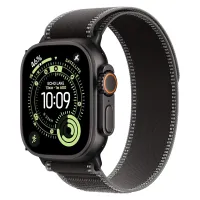
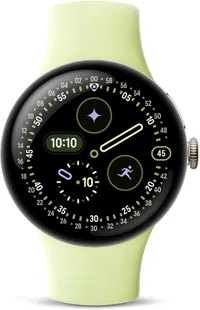
I walked 6,000 steps with the Apple Watch Ultra 3 vs Google Pixel Watch 4 XL

For this walk test, I wore the Apple Watch Ultra 3 on my right wrist and the Google Pixel Watch 4 on my left wrist. For additional data to compare the results to, I ran Strava on my iPhone 16 Plus.
With Seattle's cherry blossoms in full bloom and cheery blue skies overhead, I made my way up and down steep hills, past perfectly manicured lawns, quaint bakeries, and no fewer than a dozen 'Little Free Libraries. '
At exactly 6,000 steps, I parked myself on a park bench, ended tracking on all three devices, and catalogued the data. Find the results of my Apple Watch Ultra 3 vs. Pixel Watch 4 XL walk test below.
Apple Watch Ultra 3 vs Google Pixel Watch 4 XL: Walk test results
| Header Cell - Column 0 | Apple Watch Ultra 3 |
Pixel Watch 4 XL |
Control |
|---|---|---|---|
Step count |
5,896 steps |
6,016 steps |
6,000 steps (manual count) |
Distance |
3.2 miles |
3.2 miles |
3.24 miles (Strava) |
Elevation gain |
356 feet |
370 feet |
305 feet (Strava) |
Average pace |
17 mins 18 secs per mile |
17 mins 47 secs per mile |
16 mins 50 secs per mile (Strava) |
Average heart rate |
119 bpm |
112 bpm |
n/a |
Max heart rate |
148 bpm |
144 bpm |
n/a |
Total calories burned |
439 calories |
459 calories |
n/a |
Device battery usage |
2% |
1% |
n/a |
The Apple Watch Ultra 3 undercounted my efforts by a mere 104 steps, an impressive result and certainly within a reasonable margin for error. However, the Pixel Watch 4 was even closer, with a tally that's just 16 steps over my actual count. Strava, for what it's worth, noted an even closer total of 6,012 steps.
All three tracking methods measure a distance of roughly 3.2 miles, but both Apple and Google noted greater elevation gain than Strava. Assuming, for a moment, that Strava's climb data is correct (the app tends to be on the money in this regard), Apple overcalculated by 51 feet, and Google inflated the climb by 65 feet; neither being an insignificant amount.
Moving on to pace, Strava registered a faster overall speed, but this is likely due to the app's aggressive tendency to pause tracking during even very short breaks in movement. Apple and Google also autopause during stoppages, just less often than Strava.
In terms of heart rate, Apple measured a slightly more elevated average and max compared to Google, but the Pixel Watch 4 noted a tad more calories burned than the Ultra 3. Finally, the Apple Watch used 2% battery to track my roughly 55-minute walk compared to 1% for the Pixel Watch.
Apple Watch Ultra 3 vs Google Pixel Watch 4 XL: And the winner is...

As is often the case with these walk tests, this showdown was a close one. Ultimately, I'm impressed anytime a watch's step count is within a few hundred steps of my actual count, as was the case for both the Apple Watch Ultra 3 and Pixel Watch 4 XL here.
However, let's give credit where due: With a step count total of 6,016 — well within a reasonable margin for error — the Google Pixel Watch 4 wins this fitness tracking accuracy showdown.
Does this make the Pixel Watch 4 a better fitness tracker than the Apple Watch Ultra 3? Certainly not! I've tested both of these devices countless times against their peers, and can say with confidence that both are extremely accurate and dependable at monitoring not just your workouts, but your sleep and fitness recovery, too.
Which smartwatches should I test head-to-head next? Let me know in the comments below.

Follow Tom's Guide on Google News and add us as a preferred source to get our up-to-date news, analysis, and reviews in your feeds.
More from Tom's Guide