
Somewhere between my chaotic mornings with the kids, work meetings, deadlines and everything else throughout the day, productivity started feeling like survival. Whatever sense of accomplishment and creativity I had was overshadowed by "what's next." In other words, I'd quietly started approaching every task like it was urgent.
Honestly, it was exhausting. So, instead of asking ChatGPT for another generic productivity tip, I tried something different. I asked it to apply Lewis Howes’ philosophy of “greatness” to my actual life.
Lewis Howes is known for his popular "School of Greatness" podcast and his philosophy around sustainable success, confidence and purpose-driven achievement. Instead of glorifying burnout and endless hustle, his advice tends to focus more on mindset, emotional resilience and building a life that actually feels meaningful.
I wanted more of that mindset rather than whatever I was struggling with daily. Because I had Memory Mode enabled and ChatGPT knows enough about my daily routine, the response completely changed the way I think about work, stress and even everyday tasks.
The 'Greatness' prompt I used
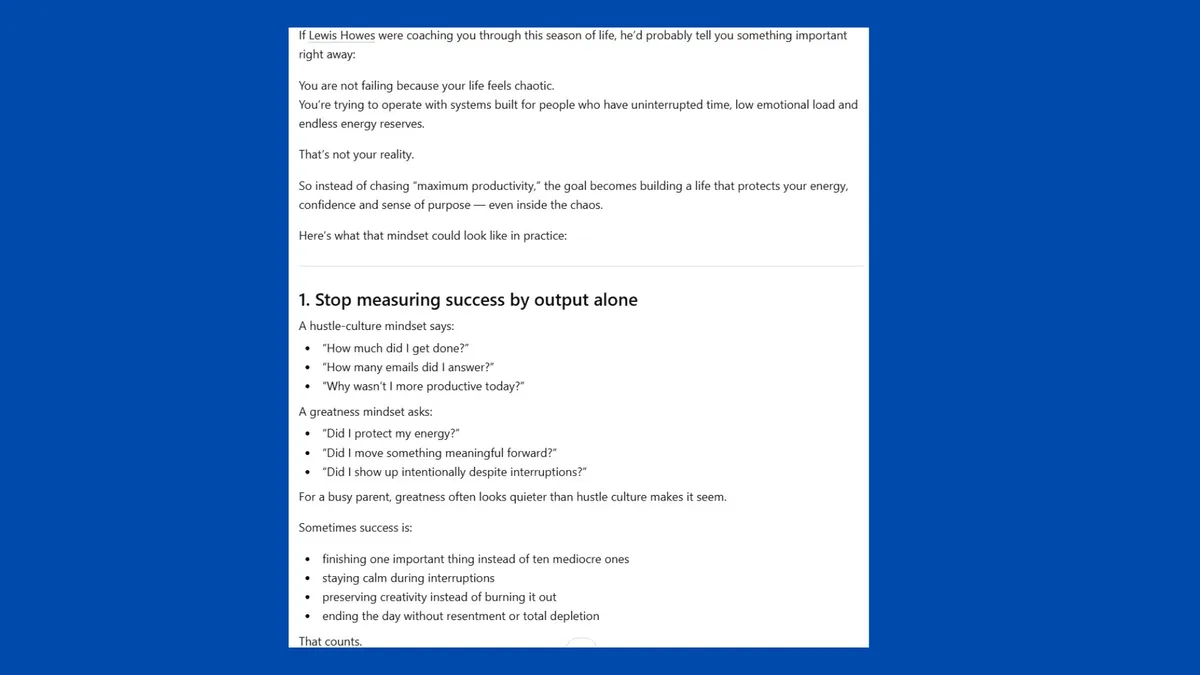
Here’s the exact prompt: “Act like Lewis Howes coaching a busy working parent with constant interruptions, high stress and limited uninterrupted focus time. Apply the principles from ‘The Greatness Mindset’ to help me approach work, creativity and daily tasks differently. Focus on sustainable success, confidence, energy and purpose instead of hustle culture.”
What surprised me wasn’t just the advice itself, which was certainly interesting, but how differently ChatGPT framed the problem. Most productivity tools assume your issue is organizational in nature, but by writing the prompt as I did, I ensured that ChatGPT was aware that my problem was mindset. And that's the distinction that changed everything.
ChatGPT immediately reframed how I think about productivity and pointed out that I was treating every task like an emergency. Every email felt urgent, and every Slack message felt like I needed to drop everything to respond. And, here's a big one, every unfinished assignment carried emotional weight far beyond what it deserved.
But ChatGPT's response suggested that “greatness” isn’t about doing everything faster, but about deciding what actually deserves your energy. Sure, it sounds simple enough, but it fundamentally changed how I approached my day.
A mindset shift that truly felt 'great'

Instead of asking: “What do I need to finish immediately?”
I started asking: “What actually matters here?”
That one shift alone reduced a huge amount of mental noise and pushed me away from hustle culture. Another interesting part of the experiment was how strongly the advice rejected the “optimize every second” mentality that dominates most productivity content online.
Instead of building the perfect schedule, ChatGPT emphasized protecting energy, reducing emotional overload, creating sustainable routines and eliminating guilt-driven productivity.
At one point, the AI essentially argued that exhaustion isn’t proof of ambition, which hit harder than I expected. Because the problem is, much of the productivity advice we hear treats pushing ourselves like a badge of honor. But the “greatness mindset” approach framed burnout as a system failure, essentially a sign that your approach isn’t sustainable.
That’s a very different philosophy than the constant “do more” pressure most people are drowning in right now.
Consistency is key to productivity

When I asked ChatGPT how someone should approach chaotic days full of interruptions, the answer was surprisingly realistic and has stuck with me. ChatGPT didn't recommend an elaborate system or waking up before sunrise like billionaire CEOs. Instead, it emphasized consistency during imperfect conditions.
It told me that greatness isn’t performing well when everything is calm, but continuing to move forward when life is messy. That's a solid takeaway, especially as a parent. It felt far more useful than anything I’ve read in years.
The idea that success should survive chaos rather than requiring perfect conditions, genuinely changed how I approach tasks now.
AI becomes much more useful when you give it a philosophy

This experiment also reinforced something I’ve noticed more and more while testing AI tools. ChatGPT performs dramatically better when you give it a worldview instead of a simple command. Adding a framework changes the depth of the response entirely. In other words, give the model a mindset before you give it a task.
When I asked ChatGPT to think through the lens of Lewis Howes’ philosophy, the answers became more nuanced, more emotionally intelligent and honestly more practical.
The takeaway
The Greatness Mindset is a powerful mindset technique. And by using ChatGPT to help me apply the philosophy of sustainable greatness instead of endless optimization genuinely changed the lens I was using to approach work.
This prompt helped me to start focusing more on clarity, energy and consistency instead of constant urgency.
What do you think? Would you try this prompt to help with productivity? Share your thoughts in the comments.

Follow Tom's Guide on Google News and add us as a preferred source to get our up-to-date news, analysis, and reviews in your feeds. Subscribe to Tom's Guide on YouTube and follow us on TikTok.
More from Tom’s Guide