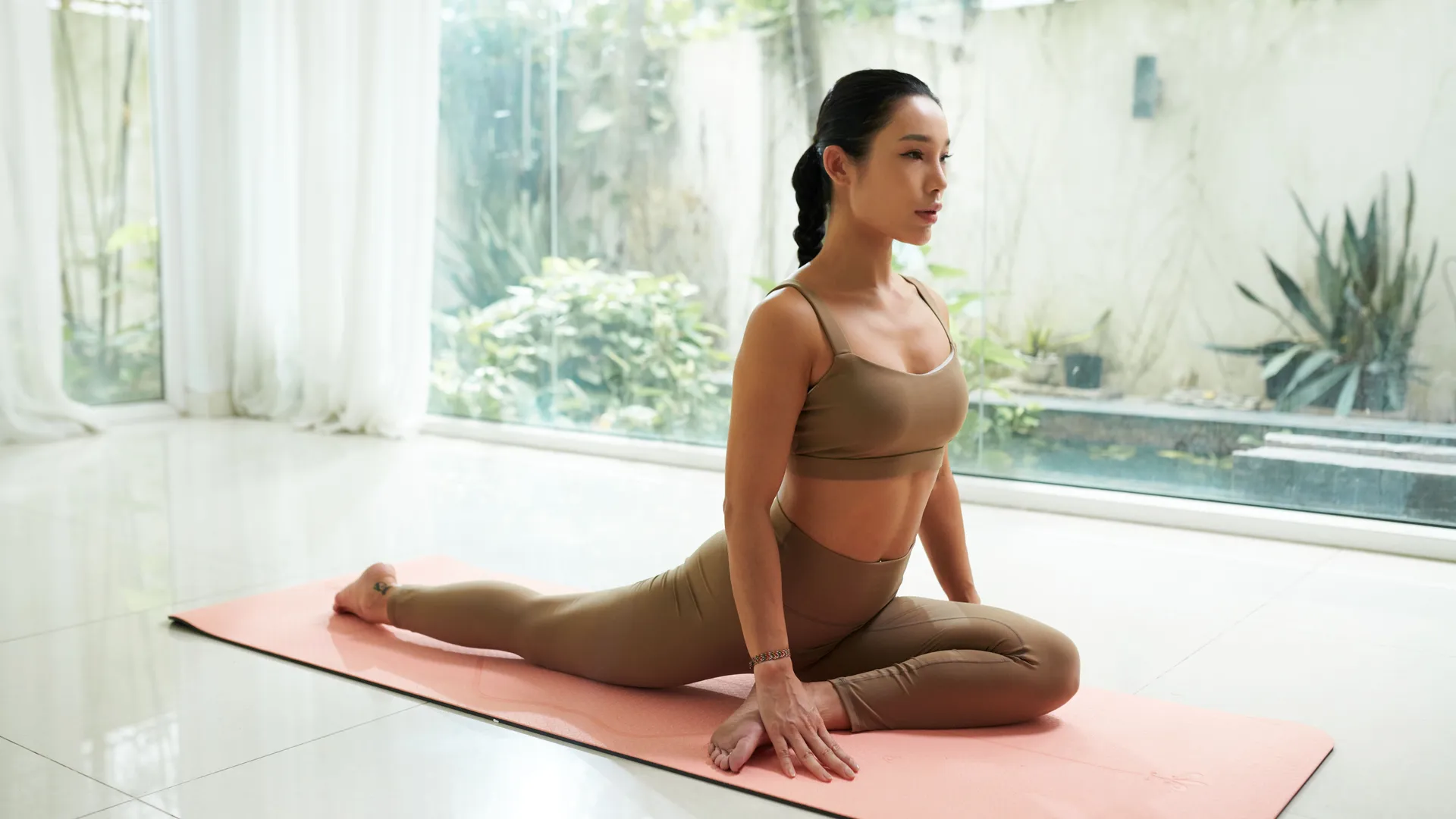
Like a lot of Americans, I spend a lot of time sitting behind my laptop. Yet pair this with marathon training, and you’ve got some seriously tight hip flexors.
Recently, my tight hips (and my 17-month-old son) have been keeping me up at night, so I tried this doctor-approved routine to relieve the tension. Read on to find out more.
What causes tight hip flexors, and what are the symptoms?
Your hip flexors are the group of muscles responsible for bending at the hip. If you spend a lot of time sitting down, these muscles can get tight, which can cause discomfort in your lower back, around your hips and potentially in your knees.
If your hips are tight, they’ll pull your pelvis down and forward, referred to as an anterior pelvic tilt. This causes your lower back to arch, and can leave you feeling stiff and uncomfortable.
Another reason you might suffer from tight hip flexors is if you do certain types of repetitive exercises, including running and cycling. You use your hip flexor muscles to pull your thigh up as you run, so over time, this repetitive motion can lead to tightness.
Finally, having a weak core can lead to tightness in your hips, as if your deep abdominal muscles aren’t stabilizing your spine when you move, your hip flexor muscles will take over.
As well as causing tightness and discomfort, weak hip flexors can cause foot and ankle issues and injuries, as the misalignment can travel down the leg, leading to issues like over-pronation and bunions.
Here’s the exact, doctor-approved routine that saved me
I stumbled across this doctor-approved routine for tight hips and decided I had nothing to lose. The results after a couple of days shocked me.
The exercise, known as the corkscrew stretch, shared by Chiropractic Doctor Michael Rowe, helps you “unlock tight achey hips in seconds.” Here’s how to do the exercise:
- Start by lying on your back, with your knees bent and your feet flat on the floor.
- Take the ankle of the leg on the opposite side to the hip you have pain in, and cross it over the knee of the leg with the hip tightness.
- Keep your glutes flat on the floor, and use your bent leg to pull your knee towards the other side. Think about lowering your top knee to the floor.
- As you do this, you should feel a deep stretch in the tight hip.
- Go as far as you can until you feel the stretch and hold here, taking some slow, deep breaths.
- To increase the intensity, raise the arm on the side of your tight hip towards the ceiling, then rotate your head and upper body towards the painful side.
- Hold for 20-30 seconds.
- Relax, and return to your starting position, then repeat this three to five times in total.

After a few days of adding this deep stretch to my routine, my hips felt a lot more comfortable. I hadn’t realised how tight my glutes had gotten as I got back into running postpartum, and how this tightness was affecting my hips as I returned to work, spending hours sitting behind my desk.
As a reminder, if you’re experiencing severe hip pain, or hip pain that’s lasted for weeks or is stopping you from doing your daily activities, it’s always worth seeing a doctor or physiotherapist. If at any point during this exercise you feel stabbing pain, stop and seek medical advice.
More from Tom's Guide
- Doctor says these are the 3 core exercises you need to relieve sciatica symptoms and boost ab strength
- Sciatica? These are the exercises to avoid, says an expert
- I’m a personal trainer — this one-minute lower body stretch builds flexibility and improves sciatica