




As VPN Editor at Tom's Guide, I've covered just about everything surrounding the software in my near-six years in the role. One thing I hadn't done, though, was visit a data center. As a service usually associated with the "cloud," this is about as close as you can get to actually seeing one of the best VPNs in the flesh.
So, my team and I took the trip to Amsterdam to meet up with PrivadoVPN – a smaller VPN company that currently sits at the top of my rundown of the best free VPNs. After sitting down and chatting about all things privacy for an hour or two, I was taken on a tour of their server farm, located in a huge data center in the city outskirts. And let me tell you, it was quite the experience.

Papers please

Unsurprisingly, the data center's security was strict. A member of staff had to buzz us through two sets of large metal gates, and upon entry, we had to hand over our passports to identify ourselves and fill in a fairly long visitor's form. The guard was stern. I felt reassured.
This all took place in a small lobby, at the end of which was an airlock-looking entry tube. One at a time, we entered the tube with our personal keycards and were subsequently spat out into the main body of the building.

Rather than just adding to the sci-fi aesthetic, this tube weighs every person who passes in and out of the complex. With your identity tied to your keycard, it can sense if you're trying to smuggle anything out that you didn't arrive with. I couldn't tell you how sensitive it is, but it certainly put me off loading up on free coffee.
From there, things were a little simpler. Along with the PrivadoVPN team, we were accompanied by two members of staff from the data center who led us to PrivadoVPN's server farm. Despite arriving in different vehicles, it was clear that both teams knew each other well and had a good relationship – understandable considering PrivadoVPN's whole enterprise relies on the performance of these servers.
It's getting hot in here
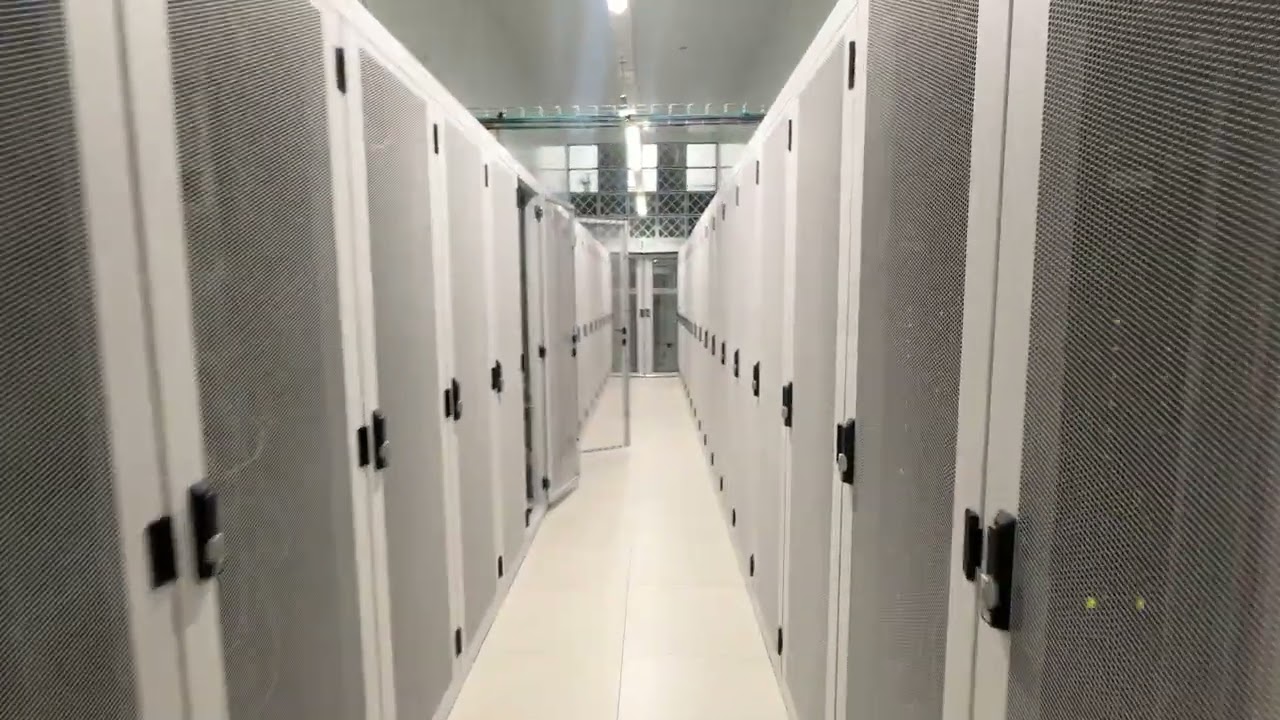
A heavy white metal door opened, and we were hit with a blast of dry heat – a change from the frosty temperatures we'd become used to in the depths of the Dutch winter. In front of us were four massive banks of server racks – 17 in each bank, to be precise. Despite being fully temperature-controlled, the farm sat at a steady 27 degrees Celsius – roughly 81 Fahrenheit.

In the video below, you can hear just how loud the servers and cooling system are. When we briefly tested the volume with an Apple Watch, it sat at around 84dB – not somewhere you'd want to spend a whole lot of time without ear protection.
We were told that in years gone by, the room typically sat at around 23 degrees, but with the massive increase in demand for data centers – and therefore power usage – the Dutch government has implemented energy-savings methods to make sure servers are running as efficiently as possible. Therefore, less cooling.

Between the banks were two "hot" aisles. These aisles, which are enclosed and house the backsides of the server racks, were positively Saharan. Averaging at around 45 degrees Celsius – 113 Fahrenheit – they isolate most of the heat produced by the servers, and keep it separate from the cooler, conditioned air. This is a method called "hot aisle containment," and is generally thought of as the most efficient way to run a server farm.

After swiftly escaping the hot aisle, we were shown in the inner workings of each rack. Each server is meticulously wired, and in this server farm, runs off a large bank of HDDs. While I couldn't extract quite as much information from the staff as I'd have liked – privacy is top priority here – we can assume that each of these servers functions as a selectable server within the PrivadoVPN app. Also, while many VPNs are moving toward RAM-only setups, the physical presence of these disks was a reminder of just how much data passes through these halls.

In our testing during our PrivadoVPN Free review, we found that the India, Argentina, Brazil and Germany locations in-app are Amsterdam-hosted "virtual servers."
This means that despite delivering an IP address in that particular country, they're actually based in the very data center that I visited – commonly done to ensure security and privacy in regions where local infrastructure might be unreliable. So, in this server farm, some of the servers were likely running IP addresses from overseas as well as local ones.
Nothing comes for free
With the AI boom and rising costs, how much energy cloud-based products and data centers use has come under huge scrutiny. As I mentioned above, steps have been taken to reduce the amount of energy this data center uses – but the figures are still astounding.
I was told that each rack of servers in this particular server farm is rated at 3000W, which means it consumes 3kWh (kilowatt-hours) of energy every hour – roughly equivalent to running a heavy-duty clothes dryer constantly. PrivadoVPN's farm consists of 68 racks, which works out at a staggering total power draw of 204kW.
According to energy comparison site Overstappen, the average price of electricity in the Netherlands is €0.23 per kWh. If we presume the data center is paying an average rate – while it may get a government discount, I can find no data to prove this – this means each rack costs around €0.69 per hour to use. Multiplied by 68, this means that PrivadoVPN's Netherlands servers cost €46.92 to run per hour, accounting for energy costs alone.
Per day, this costs €1,126.08, and per year an astonishing €411,019.20. Factor in the massive amounts of cooling, replacing failed drives, rental of the space, staff pay, and other expenses, and you could reasonably expect this single server farm to cost PrivadoVPN €1M per year. Multiply this by the 30 or 40 other smaller server farms used to provide locations around the world, and we can estimate that it costs PrivadoVPN tens of millions of dollars per year to simply keep its product up and running.
There was at least one other server farm I caught a glimpse of in the building – not used by PrivadoVPN – and probably many others tucked away in areas I didn't visit. This really put into perspective the massive energy requirements of data centers, and the drain on resources that other cloud-based software like AI and web hosting impose. However, in this case it's worth noting that this data center operator runs entirely on renewable energy – which makes the environmentalist in me a little happier.
What I learned
I always knew how VPNs and data centers operated, but exploring a server farm first-hand put into perspective the infrastructure necessary to support a top-tier product. One of the staff said "we're in the cloud," and it cemented in my mind that no matter how nebulous and ephemeral tech feels these days, there's always something physical at its core.
I'd also challenge anyone who questions why VPNs are expensive to buy – or why free VPNs are so limited – to take a look at the figures above and try to justify whether any company should feel obliged to spend that money for no return.
Overall, the trip was a fascinating insight into the inner workings of a VPN, and anyone with an interest in networking should jump at the chance of a similar visit – if, of course, you're allowed to enter in the first place.
We test and review VPN services in the context of legal recreational uses. For example: 1. Accessing a service from another country (subject to the terms and conditions of that service). 2. Protecting your online security and strengthening your online privacy when abroad. We do not support or condone the illegal or malicious use of VPN services. Consuming pirated content that is paid-for is neither endorsed nor approved by Future Publishing.

