Functional strength and stability can be built at any age, which means you can continue doing the activities you enjoy for longer, and you don't always need to lift heavy weights to make improvements. As a level 3 personal trainer, I encourage you to try this 15-minute routine with a light set of dumbbells and three exercises, and see how you get on.
During the workout, you'll also recruit your core muscles to keep your body stable and balanced while you move. A strong core doesn't mean you have a sculpted six-pack; it means your body is more resistant to unwanted force and injuries, and that you can control your movements while protecting your posture and lower back.
I want to challenge you to try these three dumbbell exercises; they test your strength, stability and mobility, strengthen your core and can be scaled to most abilities. You don't need to use weights, but a set of dumbbells is useful. Check them out.
Watch: This is the 3-move workout
Here are the three exercises:
- Plank knee taps: Start in a high plank position with your shoulders stacked over your wrists and hips aligned with your shoulders. Brace your core, glutes and quads. Lightly bend your knees and tap them to the ground, then straighten your legs and push your heels back to the plank.
- Dumbbell push-up with downdog taps: Hold a dumbbell in each hand and start in a high plank position as above. Bend your elbows and lower your chest into a push-up, then drive the ground away and extend both elbows as you push up and back into a downward dog. Keep a soft bend in your knees. Holding the weight, twist and tap your left hand to the right foot, then return to downdog and repeat on the other side. Move forward into your plank, then repeat.
- Eccentric goblet squats: Stand with your feet hip-width apart or slightly wider. Hold your weights close to your chest, engage your core and maintain a tall spine. Sit your hips back as if lowering into a chair, squatting to the count of four seconds. Pause at the bottom of your squat with your chest up and back straight. Draw your navel in. Push the ground away to stand for the count of one second.
The workout consists of four rounds. On the first round, complete each exercise for as many reps as possible in 50 seconds, taking 10 seconds of rest between. On round two, complete 45 seconds of work and 15 seconds of rest. For round three, 40 seconds on and 20 off. Round four is 20 seconds on and 10 seconds off.
You can decide how long you rest between rounds, but no more than 30 seconds if possible. You can also add rounds if you'd like a further challenge.
Weight options are personal. You can work with your bodyweight until you feel comfortable, but as a guideline, I recommend two sets of weights ranging from 2-6kg for beginners, 6-10kg for intermediate and 10+kg for advanced.
How to modify this workout
- Plank knee taps: Perform your plank on your forearms, or take extra rest in the kneeling position.
- Push-up to downward dog taps: You can use your bodyweight rather than weights. Alternatively, place your knees down for your push-up. Bring more of a bend to your knees in downward dog, and either take the taps out or only tap to your thigh or knee for less intensity.
- Eccentric goblet squat: You can scrap the weights, take a slightly wider stance, or adjust the depth of your squat depending on your ability. Try to aim for thighs parallel to the ground at first. If this feels like too much too soon, a wall squat hold is a great alternative for building strength.
What are the benefits?
The routine challenges deeper stabilizer muscles in your core, including the hips and muscles along your waist known as the obliques, as well as other larger muscle groups like the quads, glutes and hamstrings in your legs, the shoulders, triceps, chest and upper back.
As we get older, balance can be more challenging to maintain, so exercises like downward dog taps, where you must balance on one hand, are great for improving stability and control. Planks encourage full-body engagement and improve core strength and squats strengthen your lower body, which can improve balance and power.
I encourage people to move for their future selves. Rather than focusing just on how heavy you can lift or how far you can run, I say focus on how well your body moves and how efficiently you can perform exercises — this is called functional fitness. If you can stay injury-free, strong and stable, you can do the activities you enjoy for longer.
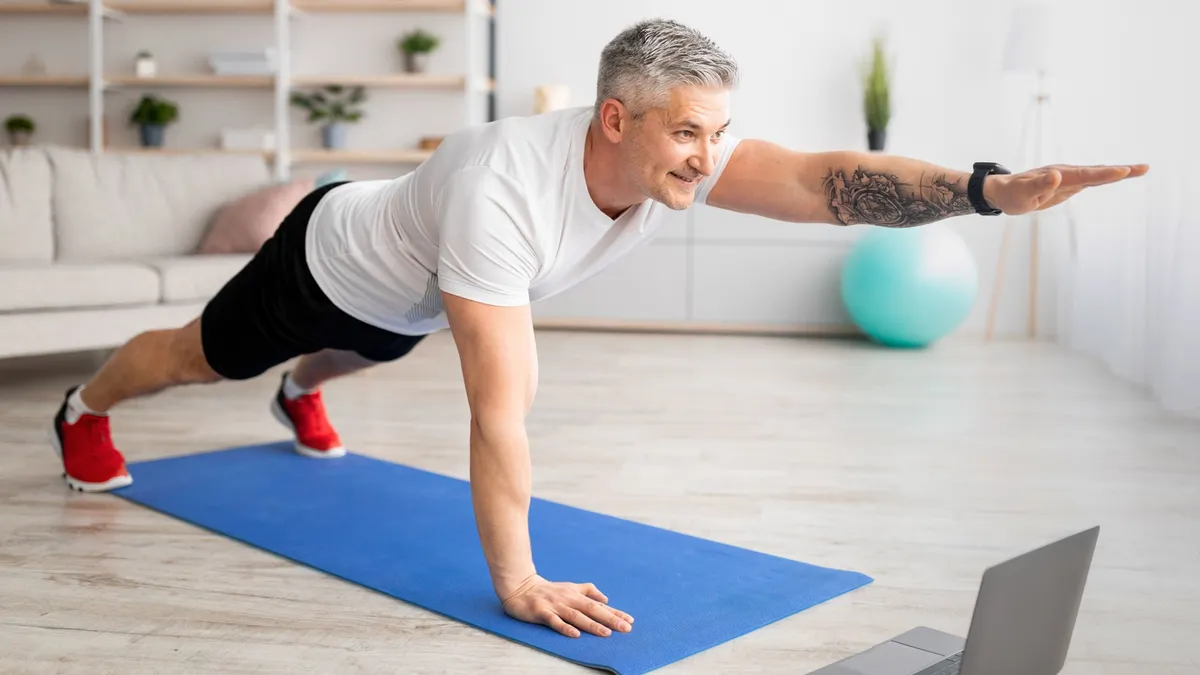
Try to remember to move with your core muscles, which are really the powerhouse of your body. A strong core helps your torso move properly and protects your hips and spine. If you feel unsure about how to engage your core properly, check out this 5-minute bracing routine.
I advise some form of resistance training during the week, alongside posture-building exercises and simple breathing exercises for beginners, as they teach you to use your diaphragm during exercise.
Remember: even as a beginner, small and consistent efforts are the best approach, so anything (even one or two strength workouts a week) could help you see results. Think functional compound exercises that help you do your daily activities better, like lunges, squats, planks and push-pulls.
Follow Tom's Guide fitness on Instagram for more workouts, routines, tips, and tricks.

Follow Tom's Guide on Google News and add us as a preferred source to get our up-to-date news, analysis, and reviews in your feeds.
More from Tom's Guide