The best plank variations depend on you and your body, but of all the ones I've tried over the years, the gymnastics plank is still my favorite for building stability, endurance, and strength. It doesn’t just strengthen your core; it also works your shoulders, arms, wrists, quads, hips and glutes.
I've been including them in place of standard planks for a few months now, especially for my clients over 50 who want to build a strong core and reduce back pain. Here's how to do it, and why I recommend giving it a shot next time you hit the gym.
How to do gymnastics planks
One of the best yoga mats is handy but not essential. Follow these steps:
- Start in a high plank position with your shoulders stacked over your wrists, hips aligned with your shoulders and a straight line from heels to head
- Brace your core, glutes and quads, creating as much tension through your body as possible while breathing toward your stomach
- Push your hands into the mat to broaden your upper back and create a soft hollow through your torso
- Roll forward over your wrists, keeping your arms straight, onto the tops of your feet. Your shoulders should pass in front of your fingertips
- Avoid dropping your hips, arching your back, or pushing your butt up to the sky
- Hold. Continue breathing.
I recommend trying for a 20-second hold and building from there. Slightly tucking your hips and pushing through your upper back will help you create the hollow shape through your upper body.
You’ll feel your forearms and wrists working a lot harder; if this causes pain, drop to your elbows or stop completely. It may feel uncomfortable and challenging, but it shouldn't be painful.
Gymnastic planks benefits: 3 reasons why I use them with clients
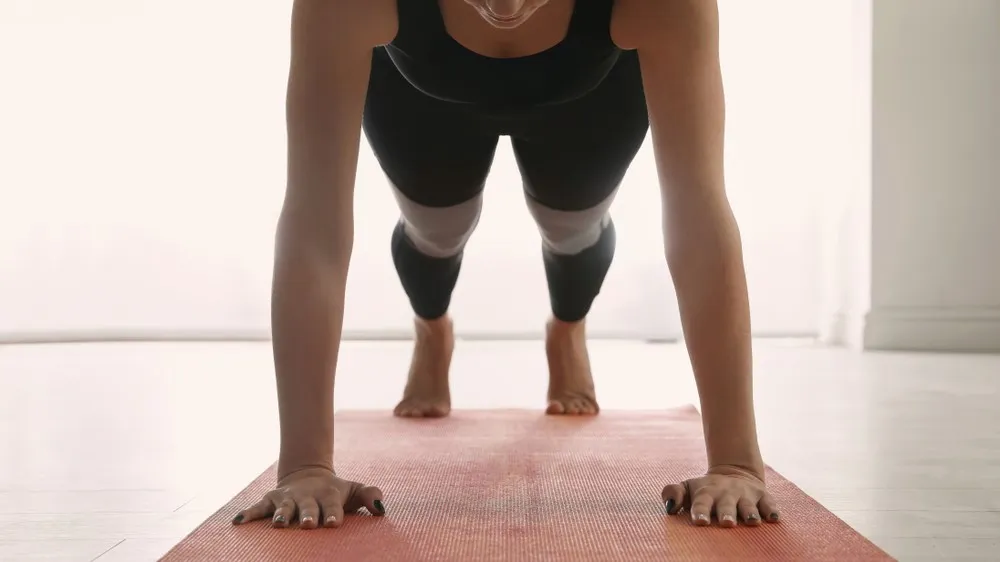
Gymnastics exercises focus on building functional strength and require a strong and stable core. They also build relative strength and power, and many "holding" exercises like planks, hollow holds, or handstands require endurance, stability and balance using isometric contraction, meaning your muscles are neither shortening nor lengthening.
Reasons enough right there.
Like a regular plank, the exercise is a full-body one, but for this variation in particular, focus on consciously contracting as many muscles as you can, especially the three Bs: belly, butt, back.
Gymnastics exercises focus on building functional strength and require a strong and stable core.
Your shoulders, arms, forearms, wrists, core, hips, quads, lower back, glutes, and ankles will get stronger, but shifting forward with your body places emphasis on the upper body, namely the shoulders, arms, and wrists. Rolling further onto the tops of your feet will activate more of your front body, like the hips and quads, rather than backloading the glutes and hamstrings.
Grip strength, which comes from your hands, forearms and wrists, has been shown to be a key factor for longevity, which is why everyone should include wrist-strengthening exercises in their routines as they get older, especially when muscle and strength begin declining, which accelerates in your 50s.
Yes, planking strengthens superficial muscles like the rectus abdominis (the six-pack), but also the deeper transverse abdominis (a stabilizing belt of core muscle), hip flexors and the obliques. These muscles support your spine and pelvis, so keeping them strong can protect you from injury.
The next time you decide to level up your planks, why not make it this one?
Follow Tom's Guide fitness on Instagram for more workouts, routines, tips, and tricks.

Follow Tom's Guide on Google News and add us as a preferred source to get our up-to-date news, analysis, and reviews in your feeds. Alternatively, you can read our content on the Tom's Guide app available now for iOS and Android. Subscribe to Tom's Guide on YouTube and follow us on TikTok.
More from Tom's Guide