The Apple Watch Series 12 is expected to be announced at today's 'Surprise and Shine' event, and insiders report several upgrades that will benefit sleep tracking. As a sleep tech writer, my heart should be aflutter (a problem the Series 12 will pick up on). So why am I feeling... underwhelmed?
The best sleep trackers offer detailed insight into your rest and there's no doubt the Apple Watch is among the best for accuracy. But the sleep tech market is fast evolving and the bulky, passive Apple Watch is starting to look like yesterday's news.
We're still learning just what the Series 12 will encompass (alongside the Apple Watch Ultra 4) and perhaps nestled somewhere in the metrics will be something that will completely change my mind. Until then, here's why the new Apple Watch Series 12 won't be at the top of my Christmas wish-list.
Apple Watch 12 improves sleep tracking features
The Apple Watch 12 rumor mill suggests several upgrades are coming that might benefit sleep tracking capabilities. Including better battery life, meaning you won't miss out on data because your watch drifted off before you did.

We're also expecting to see a readiness score — a new way of exploring and understanding your data. Readiness scores bundle several data points to assess how prepared you are for the day. It's a feature we're seeing from many fitness trackers already. My Oura Ring always (and accurately) notes I should ease back on physical activity when my sleep score is low.
This comes alongside (rumored) improved Siri AI voice support and (possibly) a wellness concierge. So the Series 12 should be putting your sleep score to good use.
Sleep tracking has moved beyond bulky wearables
Watches were once the first word in sleep tracking. (Okay, second after doctor-approved PSG.) But in recent years have these cumbersome devices started to look, whisper it, out of date?
The future of sleep tracking isn't on your wrist. It's on your finger, or perched on your head, or sitting on your nightstand — a sleep tracking sunrise alarm clock, anyone? And it doesn't just track your sleep. In some cases, these smart devices can intervene, in real time, to improve your sleep quality.
That's a step beyond the passive tracking of the Apple Watch Series 12. And what's more, this bulky watch might have missed the mark when it comes to sleep comfort.
The Apple Watch Series 11 weighs between 34.6 and 43.1 grams, sits nearly 1 cm away from the wrist and measures at least 42 mm high. We don't know the exact measurements for the Series 12 just yet, but it's unlikely to be significantly smaller.
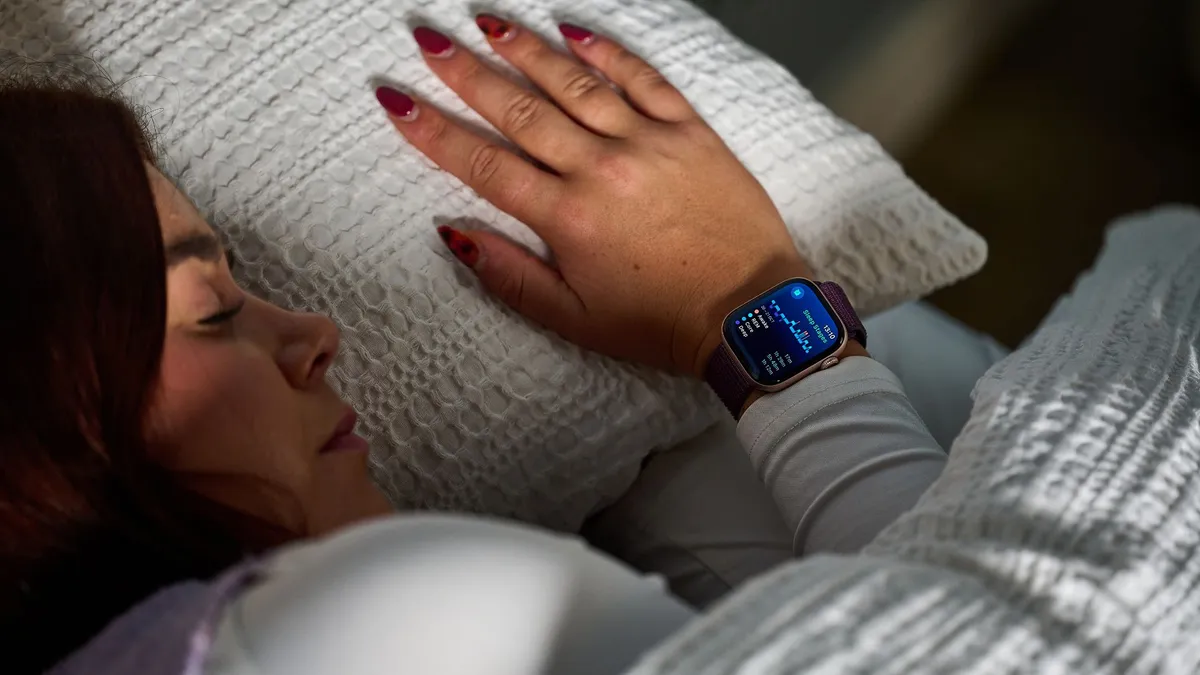
A watch that big stops being a passive sleep tracker and becomes a sleep hinderance. Two members of my team have found they lost sleep data after removing the Apple Watch while half-awake at 3 a.m. That's inaccuracy and intrusion, in one bulky package.
With devices like the Oura Ring 5 and Fitbit Air getting increasingly slimmer, do we need our sleep to be weighed down by a watch?
It's not the end for Apple Watch Series 12 sleep tracking
I'm not writing off the Apple Watch Series 12 just yet. These wearables still appeal to those who prioritize fitness tracking or want all-round health tracking in one convenient package.
And smartwatches, like the Series 12, offer the at-a-glance sleep check that screenless wearables can't provide. If you don't want the hassle of an app, a quick look at you Apple Watch screen can provide you with the latest info on your night's sleep.
If that sounds like you, then you'll want to keep a close eye on our Apple Event live blog.