





What classes as a small phone these days? Basically every new phone you can buy today is over six inches in size, which not too long ago would have seen them described as “phablets.” But now the phablet is just the default shape and size for smartphones. Take a look at our overall best phones guide and you'll see that half of them measure 6.7 inches or over.
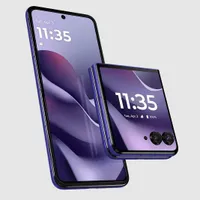
But you can still find smaller phones on sale. Many of the biggest phone companies still make compact versions of their flagship phones for users who aren't bothered about having the most possible screen space or an extra camera sensor shoved in the back. There are also flip foldables to consider. While these are the same size as other phones when unfolded, when closed up they're much easier to pocket, with outer displays that offer at least some of the same functionality as the inner screen.
With 6.7 inches and up now being the standard size for new phones, we're classing anything under 6.5 inches as a "small" phone, plus flip-style folding phones. While these may not match up to the properly palm-sized handsets that were available only a few years ago, the devices on this list are still the best small phones around.

Best small phone overall

To get the most phone in the smallest body, the iPhone 17 Pro is the way to go. Apple's smaller pro iPhone has less display space and battery capacity than the Pro Max edition, but it is otherwise identical. That means you're getting some of the best cameras, performance and battery life available in smartphones right now.
With its new aluminum design that helps keep the phone cool, the power of Apple's new A19 Pro chip means the iPhone 17 Pro can run games or other demanding apps even harder and for longer. Photography remains a particular strength, especially with the addition of the Center Stage front camera that helps keep everyone in frame during selfies and a new 4x telephoto camera that can zoom up to 8x without losing detail. Apple's even upgraded the charging speeds — to 35W wired and 25W wireless — so you can refuel the phone more speedily when required.
Apple still isn't all-in on AI like some other phone makers, but Apple Intelligence is here on the iPhone 17 Pro for you to try out, like the Visual Intelligence camera mode or Call Screening for the Phone app. It's also expensive, having increased in price by $100 from last year to $1,100. But while the the amount you'll have to pay isn't small, this phone is as compact as you can go without losing all the capabilities that larger phones can offer.
Read our full iPhone 17 Pro review.
Best small Android phone

A well-deserved second place on this list goes to Google's current pint-sized Pro Pixel. The Pixel 10 Pro is the same size as the iPhone 17 Pro and offers almost all of the same strengths, and certainly beats the rest of the Android pack
Having shown good battery life and camera performance in our testing, as well as one of the brightest screens we've ever seen thanks to Google's Super Actua display tech, the Pixel 10 Pro will make a wide variety of users happy. Budget-conscious shoppers will be happy that the price hasn't increased from previous generations (unlike Samsung and Apple's latest offerings), and anyone who loves magnetic wireless charging and accessories will be delighted about Google's addition of "Pixelsnap."
It's not as well-rounded as the iPhone 17 Pro, hence why it receives the silver medal. Weaker performance and battery life may not be enough to put you off, but it marks the Pixel 10 Pro as a less complete product, even if it's still the top choice of the Android options in this category.
Read our full Google Pixel 10 Pro review.
Best value small phone

Google's a-series phones are masterclasses in giving users what they need from a smartphone for the smallest possible cost. And that's why the Pixel 10a gets to add another award to its collection by being the best cheap small phone.
At 6.3 inches, the Pixel 10a is still on the large side for a small phone, but at $500, it's a lot cheaper than other phones on this list. It's still stuffed with Google's AI features, has benefitted from improved battery life and charging speeds, and features a simple but clean design, and with a nice selection of colors. It's also a phone you can lay flat on a table without it rocking - a rarity among modern phones - thanks to its perfectly flat back.
That said, we have to address the fact that little of the Pixel 10a has changed from the Pixel 9a, including the cameras, display and chipset. It's not going to be worth upgrading if you already have a recent Pixel. Plus Google's Tensor G4 chipset isn't the most powerful around. But this remains the best value phone you can buy, and the best cheap small phone accordingly.
Read our full Google Pixel 10a review.
Best small phone for AI

There's a lot of AI in modern phones, but for the best and smartest features, you need to look at the Samsung Galaxy S26. Between its Google Gemini features and Samsung's own Galaxy AI features, there's a lot to make use of.
Highlights include the Horizontal Lock ability for video recording which keeps your shot stable even as the phone shakes and rotates, or text-based image editing with Photo Assist.
If that's still not enough, you can set Gemini to complete tasks on your behalf with automated app actions, use Perplexity AI search via Bixby, and get timely suggestions of files and appointments with Now Nudge in your keyboard.
And there's still more to like. This 6.3-inch Galaxy has a bright and colorful display and one of the most powerful chipsets we've ever tested in the form of the Snapdragon 8 Elite Gen 5 for Galaxy. Excellent news for anyone who loves mobile gaming or running demanding apps, although watch out for the different Exynos 2600 chip you get in markets outside the U.S.
Unfortunately, Samsung gave the S26 series a price increase over previous generations. It's also got rather underwhelming battery life, even for its size, and no camera hardware upgrades compared to previous generations, unlike other phones in this price bracket. There's no denying this is one of the smartest smartphones available right now though, and Samsung's generous 7-year update schedule means its toolkit will only grow over time.
Read our full Samsung Galaxy S26 review.
Best small foldable phone

It's hard to beat a foldable phone for fitting a whole device into a small space. The Samsung Galaxy Z Flip 7 is the best option for this right now. At just 0.26 inches thick when opened, it’s even slimmer than last year’s model, while the new 4.1-inch edge-to-edge Super AMOLED outer display makes it easy to check notifications, reply to messages, or control music without fully unfolding the device.
Open the Z Flip 7 and you get a bright 6.9-inch AMOLED main display that topped out at 1,989 nits in our display benchmarking. You can comfortably use the phone outdoors, and colors pop whether you’re watching videos or flipping through photos. Under the hood, Samsung’s Exynos 2500 chipset and 12GB of RAM keep performance smooth for everyday tasks and quick app switching, as well as keeping camera operations responsive.
Durability stands out for the Flip 7. With its new Armor Frame Aluminum design and IP48 rating, the phone shrugs off daily bumps, resists dust, and handles water splashes with no fuss. The hinge feels solid with every open and close, and in our hands-on testing, it gave us confidence this foldable is built for everyday use, not just special occasions.
Compared to other compact phones, the Z Flip 7 stands out for its foldable form factor and larger outer display, which set it apart from the iPhone 17 Pro's power, camera loadout and battery life, or the Pixel 10 Pro if you prefer an Android point of reference.
You’ll get better pocketability and the unique versatility of a foldable screen here. Those who want maximum raw speed or the very best camera hardware might prefer the iPhone or Pixel we just mentioned, but the Flip 7 is about convenience and both literal and metaphorical flexibility.
The 4,300 mAh battery is a step up for all-day use, but you’ll still need to top off nightly, and charging speeds remain unchanged from last year. If you want the most compact phone with a truly useful foldable design, the Galaxy Z Flip 7 remains unmatched. Just be ready for the trade-offs that come with prioritizing size and style over battery life or brute-force power.
Read our full Samsung Galaxy Z Flip 7 review.
Best thin small phone

Sometimes when you want a small device, what you really need is a skinny one, and if that's the case, then the iPhone Air is where you need to look.
Measuring just 0.22 inches thick and 5.82 ounces, but with a durable titanium frame, the iPhone Air is thin and light, but still tough. With a 6.5-inch display, you actually get quite a lot of screen despite the pared-down design, and the A19 Pro chip means you don't lack in power.
However, being such a featherweight means that you lose out on a lot of things. There's only one rear camera, for instance, and the battery life is weak even among small phones. Plus Apple's iOS software, while refined and easy to use, lacks some of the AI powers that Android phones offer instead.
In a way, the iPhone Air feels like a phone from several years ago, back in the days when slim phones really were thin. As much as we'd like it to have at least one other rear camera, or more milliamp-hours in its battery, this is the most uncompromising small phone around.
Read our full iPhone Air review.
Also tested
How to choose the best small phone for you
Buying a small phone begins like buying any other - deciding what your budget is, and whether you want an iPhone or Android in particular, or if you're happy using either OS.
After that, you have to look both at the features you want to prioritize and deprioritize. Small phones tend to have more extreme trade-offs than larger phones. The smallest of the small, like the foldables or the super-thin iPhone Air, have limited battery capacity. The cheaper models typically have fewer cameras and less powerful chipsets compared to the more expensive ones, and the most complete small phone experiences are also the largest and most costly handsets. Only you know where to draw the line for your particular needs.
How we test smartphones
In order for a smartphone to make our best phone list, it needs to excel on several tests that we run on every handset. We perform some of these tests in our labs and some in the real world.
When it comes to performance, we rely on such synthetic benchmarks as Geekbench and 3DMark to measure graphics performance. These tests allow us to compare performance across iPhones and Android devices. We also run a real-world video transcoding test on each phone using the Adobe Premiere Rush app and time the result. (We unfortunately have to skip this test on some phones due to app compatibility issues, but we attempt this benchmark with each device we get in to review.)
To measure the quality of a phone's display, we perform lab tests to determine the brightness of the panel (in nits), as well as how colorful each screen is (DCI-P3 color gamut). In these cases, higher numbers are better. We also measure color accuracy of each panel with a Delta-E rating, where lower numbers are better and score of 0 is perfect.
One of the most important tests we run is the Tom's Guide battery test. We run a web surfing test over 5G (or 4G if the phone doesn't have 5G support) at 150 nits of screen brightness until the battery gives out. In general, a phone that lasts 10 hours or more is good, and anything above 11 hours makes our list of the best phone battery life.
Last but not least, we take the best phones out in the field to take photos outdoors, indoors and at night in low light to see how they perform versus their closest competitors. We take shots of landscapes, food, portraits and more, and also allow you to be the judge with side-by-side comparisons in our reviews.

