This has been an amazing year for foldables. Now more than ever, fierce competition is forcing phone makers to innovate at a rapid pace. With the iPhone Ultra poised to make its debut at Apple’s upcoming “surprise and shine” event in just over a week, it will no doubt go toe-to-toe against the Galaxy Z Fold 8 Ultra.
That’s why I’m exploring the iPhone Ultra vs. Galaxy Z Fold 8 Ultra matchup, breaking down what the latest leaks and rumors reveal about Apple’s upcoming foldable. Then, I’ll detail how it stacks up against what I’ve tested and experienced with the Galaxy Z Fold 8 Ultra — all to see which one truly deserves the title of best foldable phone.
A form-factor preference

The first and arguably biggest difference between them is the form factor. While the Galaxy Z Fold 8 Ultra sets a high bar with its remarkably thin, lightweight build, ergonomics often come down to aspect ratio. The taller profile of Samsung's foldable line contrasts sharply with the broader, passport-like shape rumored for Apple's debut.
Leaks and renders indicate Apple is embracing a wider footprint for the iPhone Ultra, which fundamentally changes day-to-day usability. When closed, that shorter, stouter profile should make one-handed operation far more comfortable, unlike the Galaxy Z Fold 8 Ultra, where reaching the top corners of the cover display remains a stretch. Unfolded, the iPhone Ultra’s rumored 4:3 main screen offers a natural, book-like canvas that excels for split-screen multitasking and reading.

Dimensions will play a major role as well. While Apple is tipped to make the iPhone Ultra roughly 4.8mm thin when unfolded with a weight between 8.1 and 8.5 ounces, the Galaxy Z Fold 8 Ultra holds the edge on raw numbers at 4.22mm thin and just 7.8 ounces.
Even so, I’d gladly trade a fraction of a millimeter and a few grams for the iPhone Ultra’s broader silhouette and superior everyday practicality.
Crease-less display: I'll believe it when I see it

Eliminating the display crease has long been the holy grail of foldable engineering. While Samsung has steadily refined the technology with each generation, the seam still persists. Frankly, though, the Galaxy Z Fold 8 Ultra’s crease doesn't bother me — it has never hindered me from watching videos, multitasking, or running apps.
Rumors suggest Apple is attempting to achieve the impossible with a virtually invisible crease on the iPhone Ultra. If Apple genuinely manages to deliver a completely flat, crease-free panel out of the gate, it would be an engineering triumph that instantly resets industry benchmarks and puts every other foldable maker on notice.

Still, I can’t help questioning the physics of bending ultra-thin glass thousands of times without wear and tear eventually leaving a trace. More importantly, the practical reality is that absolute perfection simply isn't necessary.
Samsung has refined the Galaxy Z Fold 8 Ultra’s hinge and teardrop display structure so effectively that its shallow crease disappears when viewing the screen straight on. Sure, I can still feel a subtle dip under my finger or catch a stray reflection off-axis, but in everyday use, it’s far from a deal breaker.
If Apple pulls off a miracle, kudos to them —but for most buyers, living with a minor crease is hardly a sacrifice.
Camera versatility

When it comes to cameras, the Galaxy Z Fold 8 Ultra holds the upper hand in both hardware and software. Leaks strongly suggest the iPhone Ultra will settle for a dual-camera system — a 48MP main sensor paired with a 48MP ultrawide — leaving out a dedicated telephoto lens entirely.
I know first-hand that Apple’s computational photography and color science are stellar. Time after time in my photo shootouts, iPhones prove to be front leading contenders for the best camera phone title. For effortless point-and-shoot reliability, Apple rarely misses.
However, the Galaxy Z Fold 8 Ultra offers the sheer versatility that serious photographers and mobile creators like me crave. Samsung didn't compromise on hardware, packing a triple-lens system headlined by a massive 200MP main sensor, a 50MP ultrawide, and a dedicated 10MP 3x telephoto lens.
That optical reach makes a noticeable difference when framing distant subjects without sacrificing clarity — something my colleagues demonstrated clearly in their Galaxy Z Fold 8 vs. Galaxy Z Fold 8 Ultra camera shootout.
Beyond the lenses, Samsung’s software ecosystem provides a deeper roster of creative tools. Features like Horizon Lock keep action shots level during rapid movement, while full Pro Video and Expert RAW modes grant granular manual control over shutter speed, ISO, and white balance. While I have no doubt the iPhone Ultra will capture gorgeous images, the Z Fold 8 Ultra is the clear winner for creative flexibility.
Power and battery

Foldable phones are simply more demanding than your average slab, so performance can’t be shorthanded. I’ve seen how incredibly finessed Samsung’s foldable is with a Snapdragon 8 Elite for Galaxy running under the hood. Benchmark performance scores prove it’s already a beast, which puts pressure on Apple to succeed with its rumored, next-gen A20 Pro chip that's supposedly using a 2nm manufacturing process. I don’t doubt that the A20 Pro will give the Snapdragon 8 Elite Gen 5 a run for its money, but history has shown me this isn’t a significant buying decision.
What I will say, though, is the class-leading performance of the Z Fold 8 Ultra’s battery life. Packed with a 5,000 mAh battery, it sets a high bar for the iPhone Ultra because the Fold 8 Ultra recorded a time of 14 hours and 33 minutes on Tom’s Guide’s battery drain test. That’s more than 2 hours longer than what we recorded with the Galaxy Z Fold 8.
Apple’s reportedly going to lean on a split-battery design totaling around 4,883 mAh. While that capacity is slightly smaller than Samsung's cell, it’ll ultimately come down to Apple’s unmatched silicon efficiency and aggressive iOS background power management could level the playing field.
The true dark horse is the software

While hardware upgrades often grab the headlines, software optimization remains the real battleground for foldables — and it’s where Apple could quietly land a major blow. Even after years of development, Google and Samsung still wrestle with app scaling across irregular foldable aspect ratios.
I know this first-hand from playing some of my favorite games. While a title might scale properly on the cover display, opening the main screen — or simply rotating the device — frequently produces stretched-out layouts that fail to showcase the true benefits of a foldable screen.
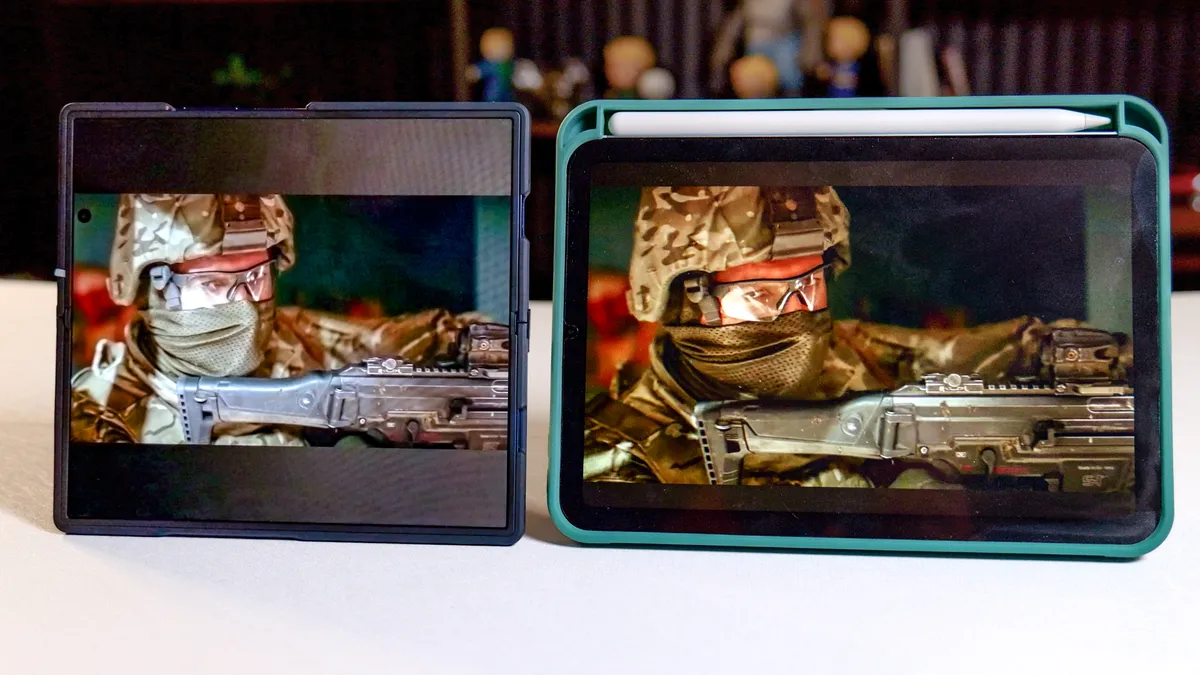
If Apple enforces its strict developer guidelines and leverages a familiar iPad-like aspect ratio, the iPhone Ultra could deliver seamless app scaling out of the gate, taking full advantage of every square millimeter.
Still, Samsung has proven that raw productivity remains its top priority. The Galaxy Z Fold 8 Ultra effortlessly runs up to four apps simultaneously, while Samsung DeX elevates the hardware into a true desktop-like workstation when connected to an external monitor. It sets a towering standard for mobile productivity — and I'm eager to see whether Apple can counter with a comparable multitasking solution.
Outlook

Price will ultimately be the elephant in the room for this matchup. While the Galaxy Z Fold 8 Ultra already commands a staggering $2,099 premium, early leaks and analyst projections suggest the iPhone Ultra could blow past that threshold—potentially landing anywhere between $2,000 and upwards of $2,500. That’s an eye-watering figure that's difficult to stomach for any smartphone, regardless of pedigree.
Yet, if Apple executes on its core hardware and software promises, the iPhone Ultra might just justify that astronomical investment over Samsung’s latest flagship.

Follow Tom's Guide on Google News and add us as a preferred source to get our up-to-date news, analysis, and reviews in your feeds.
More from Tom's Guide
- I've been testing Pixel 11 Pro XL for a week — here's why HiLight is the most disappointing new feature
- I tried this MagSafe game controller and it puts other Bluetooth gamepads to shame — plus it’s $20 off right now
- Samsung Galaxy S27 Ultra design leaked — and it could cause ‘the most intense wave of criticism in Galaxy history’