We have all received an email or text that feels unnervingly synthetic — polished, grammatically flawless and devoid of human warmth. But there is a distinct irony when the CEO of Snap, one of the world’s largest communication platforms, admits that AI-generated messages from his own wife, Miranda Kerr, drive him “a little crazy.”
It was one of those small moments of raw honesty during the course of a wide-ranging discussion with Snap CEO Evan Spiegel about the plans for Snap Specs. And specifically, to not risk inducing “AI brain fry” — a state where users passively outsource their own critical thinking, active listening and social presence to an algorithm whispering in their ear.
The problem of AI Brain Fry

Silicon Valley’s dominant vision for AI over the past two years has been aggressively generative. Tech giants have raced to build chatbots that write your emails, draft your replies, summarize your friends’ life updates and synthesize artificial personalities.
And after the past couple of years testing some of the best smart glasses, I must admit that, even though I’m ready for the generative AI bubble to burst, I’ve ironically had a few situations of bypassing key skills.
For example, I told Spiegel about my late-night phone call with my wife in New York — using the Even Realities G2's Conversate function to replace my need for active listening at 2am.

It presented an existential question that I had to take the chance to ask Evan on the precipice of launching this leapfrog product: Am I in a relationship with my wife, or are my glasses? With Specs Intelligence becoming an all-in-one proactive AI service for Specs, where is that line between them being genuinely useful and replacing critical skills that make us human.
“I don't think there's one right answer. I think it's really going to depend on what makes sense in each person's relationship,” Spiegel said.

“For me, for example, it drives me a little crazy when my wife sends me like AI-written text messages. But she's like, 'You know, honey, it's really helpful for me to gather my thoughts and think through it, helps me communicate ideas more clearly, and something that I really like as a useful tool.' Personally, for me, I like to write my own messages.”
That small marital friction captures the profound philosophical divide that I’ve been trying to wrap my head around. When communication becomes synthetic, it could rob human relationships of the very friction, vulnerability and effort that give them meaning.
What’s the counter attack?

The collateral damage of AI brain fry has been a slow degradation of active listening and independent thought. I’ve seen it in some friends, and especially in the folks who actively have to @ mention Grok to dictate their opinions — if an algorithm acts for you, your brain is no longer engaged; it is merely an output conduit for a language model.
Spiegel’s counter-thesis for Snap Specs is that glasses should be an antidote to digital complacency, and not its ultimate vehicle.
There is a really valuable change from AI being something you use as a chatbot where you're constantly asking for stuff all the time, to AI being something that really understands who you are, what your priorities are, and then can offer suggestions.
Evan Spiegel, Snap CEO
“There is a really valuable change from AI being something you use as a chatbot where you're constantly asking for stuff all the time, to AI being something that really understands who you are, what your priorities are, and then can offer suggestions,” Spiegel explained.
“You don't have to accept them, you certainly don't need to act on them, but I think that for us is an opportunity to make AI something that helps you spend more time in the moment, instead of again, taking your attention into a chatbot interface.”
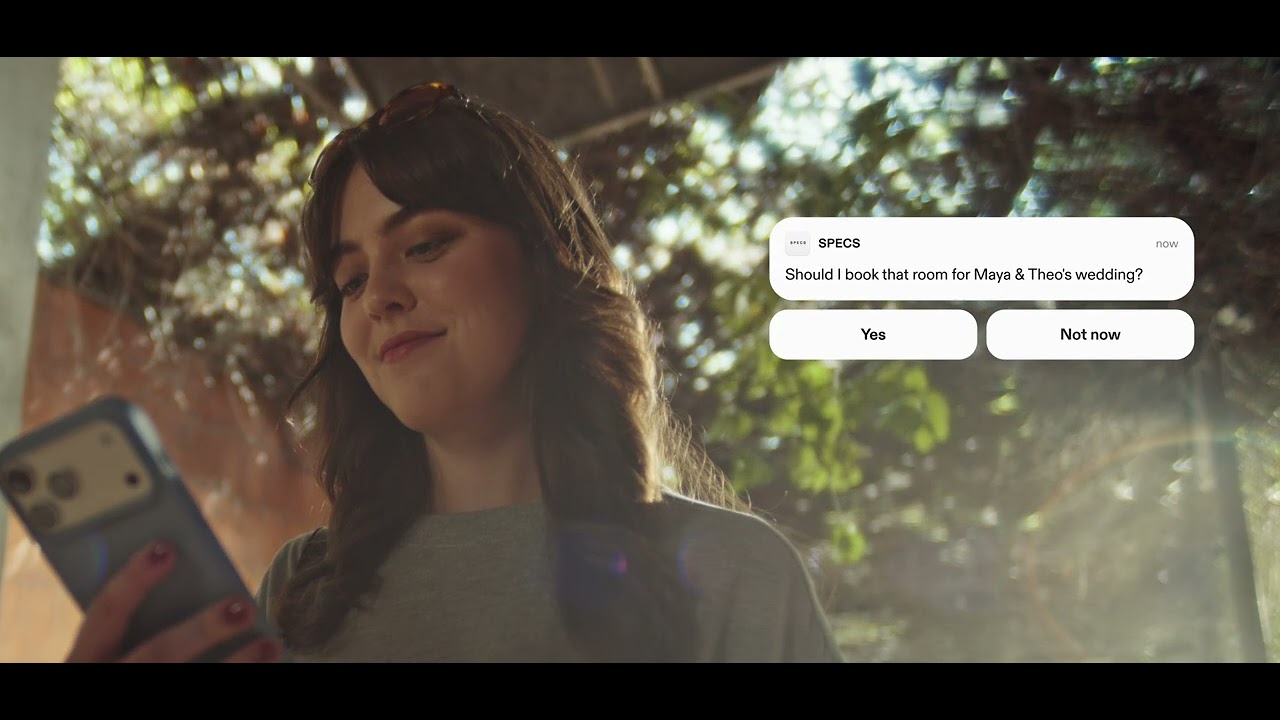
This philosophy forms the foundation of Specs Intelligence — the cross-platform context engine connecting iPhone, Mac and Specs. Rather than function as a chatty conversational companion, it’s engineered as an ambient logistical filter — organizing life into what Snap calls “Corners” (work, family, health) and tracks overarching “Goals.”
These interventions are supposed to be operational, not emotional, and eliminate administrative noise so your mind remains free to focus on the human beings in front of you. Of course, I’m keen to test it for myself to see whether it finds this right balance Spiegel mentions.
Analog skills in a digital world

The most compelling evidence of Spiegel’s resistance to cognitive outsourcing lies in how Snap curated the launch software for Specs.
Where rival headsets like the Apple Vision Pro lean heavily into virtual multi-window workstations and synthetic escapism, Specs’ flagship AR experiences are rooted in analog, real-world competencies:
- Kaia Gerber’s Library Science Lens does not summarize a novel with an LLM; it is calibrated to track and enhance the experience of reading a physical, paper book, allowing readers to pin definitions and annotate passages without losing their place on the physical page.
- Interactive NBA and WNBA Training Lenses do not let you play a video game; they use computer vision to track a physical basketball, projecting shooting arcs and dribbling drills onto a real-world court.
- Jimmy Butler’s Dominoes Lens turns any flat surface into a multiplayer table, forcing wearers to sit across from friends in the same physical room and read their body language.
“For me, that's something that's so important to the real vision of Specs,” Spiegel emphasized.
“Specs can help you become more creative, help you develop skills, rather than being something that outsources your creativity to a computer. And I think that's really where the difference is. And that's why so much of what we do is oriented around helping you build skills in the real world, right? Whether that's learning to play basketball or learning how to draw. These are all things that you're doing, not something that the computer's doing.”
One clear standout lens is the one created for Imogen Heap to create music live. As a musician myself, this looked so cool, and I can imagine how freeing it feels to get creative in an open space like this.
Improvised musical performance looks natural and intuitive with SPECS. Watch @imogenheap sing and play her own software instruments and effects live through gestures and movement with SPECS. pic.twitter.com/gRpeccI5CESeptember 18, 2026
For Spiegel, spatial computing is only defensible if it preserves human agency. A computer that practices free throws for you or reads a book on your behalf is a net negative; a device that trains your eye to shoot better or encourages you to sit down with a paperback is an enhancement of human capability.
The danger of the transparent screen

Spiegel’s distinction between assertive logistics and replacing key human thinking is a sharp one. But whether that line holds up in the messy reality of consumer adoption remains an open question. I struggled with it for a hot minute there — and Evan’s figuring it out.
The big paradox of smart glasses is that by putting a display directly between your pupils and the real world, the potential for distraction is way higher than it ever was on a smartphone.
An Apple Watch telling you to stand up every hour is a minor bugbear. But having an ambient AI flashing reminders, suggestions and real-time social telemetry across your retinas during a private chat risks destroying human connection entirely.

If an ambient system misjudges its proactivity by even a fraction, it doesn’t keep you “in the moment,” it turns real-world interactions into a surreal heads-up display where you’re half-listening to a companion and half-scanning your digital surroundings.
Yet, in my time sitting across from Spiegel, his core conviction feels authentic. In an era where most execs view human relationships as data pools to be automated by chatbots, Spiegel’s own personal red lines are clear.
Tech can map our world, streamline our schedules and track our physical progress. But the moment it begins telling us what to say to the people we love, we aren’t using a tool anymore — we are letting the machine live our lives for us.

Follow Tom's Guide on Google News and add us as a preferred source to get our up-to-date news, analysis, and reviews in your feeds.
More from Tom's Guide
- EXCLUSIVE: Snap CEO Evan Spiegel says smart glasses disguised as normal eyewear are 'creepy' — why Specs look bold on purpose
- Snapchat launches its own AI — and says Specs Intelligence will 'anticipate your needs'
- 'Pervert glasses' antidote? Meta reportedly launching camera-free smart glasses next week