At a glance
- The Conflict: Even Realities CEO Will Wang is calling out Meta and Google for forcing cameras onto smart glasses just to collect training data for future AI models.
- The Counter-Strategy: Even Realities' G1 and G2 smart glasses intentionally omit cameras and speakers, focusing instead on a text-based ambient HUD that prioritizes privacy, weight, and battery life.
- The Escalation: Even Realities has scaled its engineering team from 20 to nearly 400 people, gearing up to challenge Big Tech’s wearable AI dominance directly with its upcoming G3 hardware.
While Silicon Valley races to strap cameras, speakers and multimodal surveillance tools onto our faces, one smart glasses maker is picking a fight direct with Big Tech’s entire playbook.
Meta, Google and Snap want you to believe that a front-facing camera is essential for the future of AI wearables. Apple’s even rumored to be jumping in on this too. But according to Will Wang, Founder and CEO of Even Realities, their camera obsession isn’t about giving you a better device today — it’s about harvesting your personal life to train their future AI models.
Following a major $1 billion valuation round, I sat down with Wang to talk about the design choices behind the Even Realities G2 smart glasses. His message to the tech giants was loud, clear and strikingly defiant.
Editor's note: This interview has been edited for brevity and clarity.
The ‘endgame’ trap
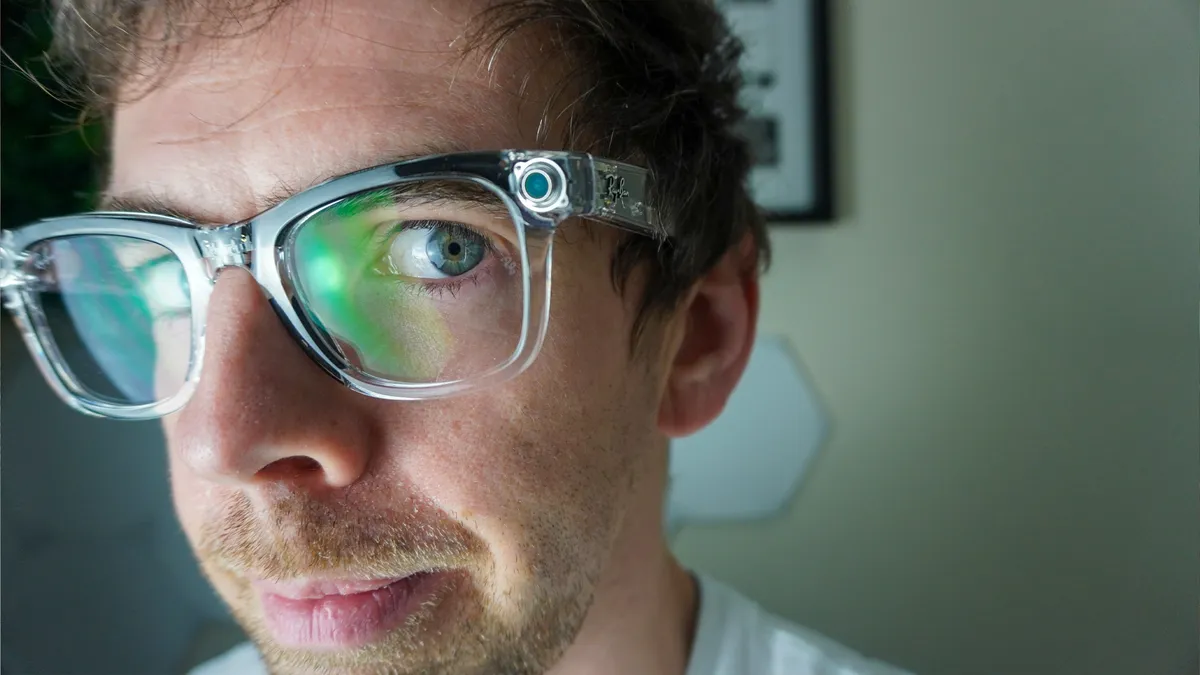
If you ask Meta why the Ray-Ban Meta glasses feature an ultra-wide camera, they will point to visual AI — the ability for your glasses to see what you see and help in real-time.
I feel these larger companies let their endgame thinking dictate their current products instead of focusing on making the perfect product for the present moment
Will Wang, Founder & CEO of Even Realities
Wang sees this differently. In his view, companies like Meta and Google are letting their long-term corporate ambitions spoil their current hardware.
"When you look at the strategies of Snap, Google, or Meta, their long-term vision often overly influences their current generation of products," Wang explained. "For Google and Meta, they include a camera because they believe visual data will be crucial for AI in the future, and to reach that endgame, they need to enable visual capabilities and start gathering data now."

The result? Heavy, power-hungry devices designed for future data gathering rather than present-day wearability.
"I feel these larger companies let their endgame thinking dictate their current products instead of focusing on making the perfect product for the present moment," Wang noted. "For a hardware company, it is crucial that each generation does not sell a dream or an expectation, but sells the product as it is."
‘We thrive on making good products, not selling data’

Even Realities took the opposite path with its glasses — completely stripping away cameras and speakers, and opting for a discreet heads-up display that delivers notifications, teleprompting, navigation and live conversation summaries in your field of view.
From day one, even with the first-generation G1, we never had a camera.
Will Wang, Founder & CEO of Even Realities
When I asked Wang if a camera prototype was ever on the table during internal testing, he shut the idea down immediately.
"From day one, even with the first-generation G1, we never had a camera," Wang said. "We feel that, at the current moment with the capability of AI, adding a camera onto a pair of glasses definitely introduces many more downsides than upsides."
Beyond the obvious hardware penalties (added weight, larger size and worse battery life), Wang pointed directly to the ethical and regulatory landmines that Big Tech seems content to ignore.

"The guardrails and regulations around how to properly use visual data with smart glasses have not been established," Wang pointed out. "So, we feel it's too early, too risky, and has too little upside for a company like ours that does not thrive on selling data. We thrive on making good products and making a profit from those products, so a camera was never in the discussion."
Instead of overpromising an invasive sci-fi feature set, Even Realities focused on what actually works today: crisp, text-based ambient computing that keeps you present in the real world without creeping out the people around you.
David vs. Goliath: the battle for G3

It’s easy to dismiss a startup taking anti-camera ideological stances against multi-trillion-dollar titans. But Even Realities is no longer just a niche player catering to early adopters.
We are on the radar of a lot of these bigger players; they are already buying our products and trying to analyze our roadmap.
Will Wang, Founder & CEO of Even Realities
While the original G1 was built by a scrappy skeleton crew, the company’s massive recent funding round has allowed them to quietly build a massive engineering war machine to prepare for their next generation of hardware: the Even Realities G3.
"To give you some context, when we built G1, our team was only 20 to 30 people," Wang revealed. "For G2, we had about 70 to 80 people... Now, for G3, we have 300 to 400 people globally working laser-focused on this single product line."

That headcount puts Even Realities on a similar dedicated engineering scale to the smart glasses divisions that Apple, Meta or Google have — but with one massive structural advantage. While Big Tech giants split their resources across dozens of spatial computing projects, AR headsets and ad platforms, Wang’s team is focused solely on perfecting one lightweight, ambient device.
"We are on the radar of a lot of these bigger players; they are already buying our products and trying to analyze our roadmap," Wang said with a smile. "We really need to accelerate faster than before, and this round of fundraising actually gives us that. We are very confident."
The war is on
The smart glasses war is dividing into two distinct camps. On one side, Meta and Google want to turn your face into a sensor array to fuel their AI algorithms. On the other, Even Realities wants to give you a clean, distraction-free HUD that respects your privacy and actually looks like a normal pair of glasses.
If Will Wang has his way with the upcoming G3, the winner of the smart glasses revolution won’t be the company that records the most video of your daily life — it will be the one that lets you look the world in the eye without a camera watching back.

Follow Tom's Guide on Google News and add us as a preferred source to get our up-to-date news, analysis, and reviews in your feeds.
More from Tom's Guide
- '136 grams is not for all-day wearing' — Even Realities CTO sounds off on Snap Specs, and gives details on the future roadmap
- 'It’s going to be that shift from phones to glasses': Snap Specs chief on design, target audience and that $2,200 price tag
- I praised Meta’s smart glasses privacy update yesterday — today, its ‘super sensing’ glasses proved me completely wrong