It’s easy to look at the new $449 Sonos Ace Ultra and wonder why anyone needs living room headphones when standard TV Bluetooth and other playback hand-off options already exist.
I’ll take it one step further. I’ve historically been skeptical of "at-home" headphones. I don't have kids sleeping down the hall or roommates to tip-toe around during a late-night movie binge, so headphones have always felt like a tool for travel, not my couch.
But after trying out the headset alongside the Beam Ultra in a living room setting, I believe it reveals a fundamental shift in flexible listening. The Ace Ultra bypasses traditional Bluetooth constraints entirely to operate in respect to the rest of a Wi-Fi-connected, whole-home audio system.
No, your Bluetooth headphones can’t do this
Connecting standard Bluetooth headphones to a smart TV comes with major trade-offs, including potential lip-sync latency, compressed audio, limited range and the general annoyance of digging through settings menus when you want to switch back to your TV speakers.
The Ace Ultra takes a different approach. With dedicated Headphone Engine 2 silicon, it can connect to your local Wi-Fi network rather than relying solely on a Bluetooth connection to your phone or TV. This enables uncompressed, zero-latency spatial audio.
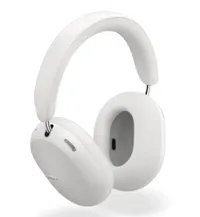
And instead of applying a generic virtual surround filter, TrueCinema room calibration uses living room spatial data to map audio to the exact physical acoustics of your room. Because it streams over Wi-Fi, you can walk throughout your entire house without audio stutters or range limits. This made the Ace Ultra feel less like a pair of headphones connected to a TV and more like another endpoint within the Sonos network.
No, the original Sonos Ace also couldn’t do this
While it’s true that the original Sonos Ace released in 2024 introduced TV Audio Swap, that feature was strictly a point-to-point link locked to a single soundbar. The Ace Ultra breaks out of that single-room boundary through the broader architecture of Sonos 27, what Sonos is calling the latest software version of its system.
Through new Headphone Linking capabilities, the headset interacts directly with your whole home setup. Walking up to virtually any Sonos speaker in your house and tapping the physical action button on the earcup instantly pushes or pulls whatever audio is playing in that room.
The TV does not need to be on, an app does not need to be opened and your phone can be completely turned off in another room.
I think Apple has the closest version of this kind of hand-off implementation between its Homepod speakers and mobile devices, but again, you still need to physically tap your iPhone to the speaker to initiate the switch even if using AirPlay. You also cannot directly hand off audio from a HomePod to AirPods with a button press on the headphones themselves. Sonos is doing something genuinely distinct by making the headset an independent network node.

Yes, you can use them outside of your house, too
Even if you think you’ll rarely use the direct system-linking in your living room, the Ace Ultra makes a strong case as a travel-first flagship. In a loud event space packed with overlapping audio demos, the physical hardware excelled where traditional commuters care most.
Powered by a 10-microphone array, the noise cancellation cuts through heavy ambient room noise while maintaining clean separation between vocal and instrumental layers.
Sonos re-engineered the custom 44mm driver with a lighter, stiffer diaphragm, optimizing the power-to-weight ratio to deliver crisp dialogue, broad dynamic range and deeper bass.
You get up to 35 hours of battery life with ANC enabled. And beyond Wi-Fi linking, the headset offers Bluetooth, USB-C and 3.5mm wired options, finished in new matte colors.
At $449, the Ace Ultra delivers the acoustic isolation, long-haul comfort and battery life required to go head-to-head with travel staples from Sony and Bose.
But by removing the phone as the middleman and turning the Ace Ultra into a physical extension of your home network, Sonos is making a compelling case for keeping its headphones on when you walk back in through your home’s front door.

Follow Tom's Guide on Google News and add us as a preferred source to get our up-to-date news, analysis, and reviews in your feeds.
More from Tom's Guide