I've tried more times than I can count to make my home office a productive work place. It's changed over the years but even with a nice desk and quality chair, it's all too tempting for my space to get cluttered by kids' toys and my own over consumption of journals, books and latest Staples haul. I'm a nut for office supplies.
The problem isn’t knowing what to do, it’s actually sticking with it. As a big fan of author and speaker, James Clear, I've read his book Atomic Habits (twice) and subscribe to his newsletter. I have found his tips for productivity and sticking to good habits really helpful.
I was recently thinking about something James Clear calls the “Plateau of Latent Potential,” the idea that real progress is happening, even when you can’t see it yet, and asked ChatGPT to help me apply it to my own routine. By asking ChatGPT to build me a simple, “Atomic Habits”-style routine for my home office, I discovered a habit (focused on small changes) that have actually made a difference.
Here are three specific changes that quietly reshaped how I work. Most importantly, I’m still doing them.
Leaning on ChatGPT to set my own 'Atomic Habits'
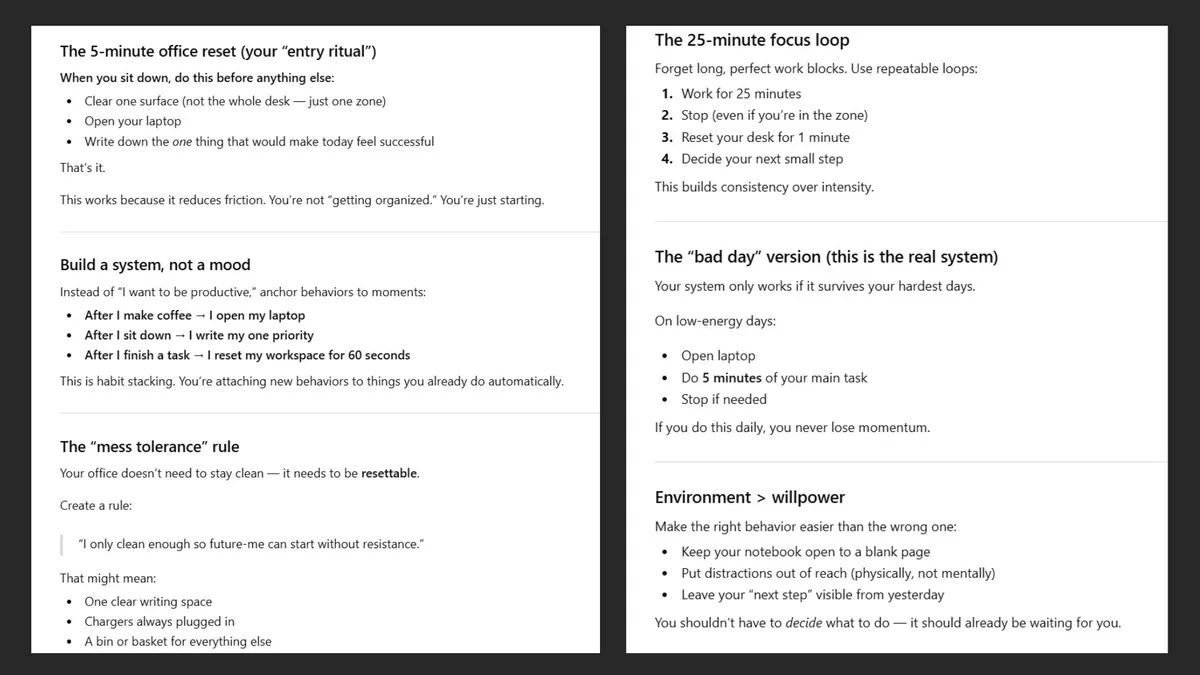
I started by giving ChatGPT structure with the following prompt: "Act like James Clear, author of Atomic Habits. Design a simple home office routine based on small, repeatable habits. Focus on systems over goals, reduce anxiety and suggest changes that are easy to maintain long-term."
Within seconds, it came back with a routine that felt much different than anything I could have come up with alone. The trick is, I've read and explored James Clear's tips, but ChatGPT personalized the experience for me. Thanks to Memory mode enabled, it knows me well enough to do just that.
Here's what AI suggested and why it worked for me:
I stopped "starting work" and built a trigger instead

Because I work from home it's easy to go in and out of my office at any time of the day or night. I'm guilty of going on my computer on the weekends, stressing over a story and then realizing I should be enjoying a day off.
Because of this, ChatGPT suggested I attach work to a specific trigger. For me, it became turning on my ring light. Now, if I don't turn it on, I'm not "working." I could be researching or just scrolling, but this shift keeps me from working too much outside of work hours and when the light is on, the kids know not to bother me.
I redesigned my desk to remove clutter and obstacles

My neighbors across the street aren't that interesting. My tree-lined street is normal and frankly, boring. But when I'm stuck on an idea or start to daydream, suddenly their Amazon delivery or landscapers become fascinating. In other words, I'm easily distracted and ChatGPT knows that.
That's how it flipped this habit completely. Instead of removing small obstacles, it suggeted habits such as keeping only one notebook visible (I used to have three going at once), closing unused tabs hourly and taking small breaks to give myself permission to look out the window without feeling guilty for losing focus.
As James Clear would say, these small habits lead to big changes. None of this is groundbreaking, but together it has created a workspace where the default action is working.
I've stopped chasing perfection

Okay, this one is still a work-in-progress, but ChatGPT's advice has helped me calm down and track consistency instead of perfection. The AI framed it in classic James Clear terms: Focus on the system, not the outcome.
So, now, rather than mentally beat myself up when something doesn't go as well as planned, I ask myself about my continuous goal of following a routine built for productivity and focus. Did I stray from it? Did I do my best for the day? If the answer is yes, than the rest is out of my hands. Surprisingly, not chasing perfection has made me more productive. Because consistency compounds, even when it doesn’t feel like it’s working yet.
Why creating 'Atomic Habits' in this way helped

I've improved my productivity a lot this year. I used to think that "being productive" meant "doing it all," but by exploring proven ways to be more successful, I've noticed a huge shift in my happiness. My way was essentially punishing me for failing and asking myself to become a different person overnight.
This "hack" was all about exploring new habits, which has ultimately made things easier, remove steps (that didn't matter anyway) and repeat small actions daily. The small changes quiletly stack up over time.
As James Clear discusses in his book, the bad habits stack up, too. So by creating new, helpful habits in small steps, you're more likely to stick with them. This strategy has certainly worked for me.
The takeaway
Using ChatGPT like a productivity coach isn’t new. But with this prompt the AI didn't become a generic coach, it thought more like James Clear to help me make clear changes in a meaningful way. Because the AI is familiar with how I work, my busy life (three young kids is endlessly chaotic) and my goals.
Rather than attempting to make sweeping changes all at once, ChatGPT offered me a system based on proven strategies. And in my case, those systems are still working.
Are you a fan of James Clear? Just need help gaining focus? Give this prompt a try. Let me know in the comments what you think.

Follow Tom's Guide on Google News and add us as a preferred source to get our up-to-date news, analysis, and reviews in your feeds. Subscribe to Tom's Guide on YouTube and follow us on TikTok.
More from Tom’s Guide