
I’ve always understood the logic behind the “Eat the Frog” rule: do your hardest, most dreaded task first and the rest of the day gets easier. This could be a tough workout, a difficult conversation or uncomfortable meeting.
The problem for me, is that first thing in the morning, everything seems hard and knowing which task I’m avoiding has never magically made me want to do it. I used to be a morning person, but lately, easing into the day with a huge cup of coffee feels like the most productive thing I’m capable of before 9 a.m.
In fact, the more important the task is, the more likely I am to circle around it with smaller jobs that feel productive but don’t actually move anything forward. I answer emails. I tidy up a document. I check Slack. I convince myself I’m warming up, when really, I’m procrastinating. While the Jeff Bezos' 'Day 1' rule has helped big time, I still need a boost first thing in the morning.
So this time, I tried the rule with a twist. Instead of forcing myself to simply “eat the frog,” I asked Gemini to help me figure out what the frog actually was, why I was avoiding it and how to make the first step feel small enough to start.
What is the ‘Eat the Frog’ rule?
The “Eat the Frog” rule is a classic productivity idea built around one simple principle: do your most important or most unpleasant task first.
The “frog” is the thing you’re most likely to avoid. For me, this is usually a difficult email, a complicated work assignment, a phone call, a messy project or a decision I keep pushing to tomorrow.
The advice makes sense in theory. But for me, the harder the task feels, the more mental anxiety it creates. I don’t always need motivation. I need a way to make the task less all encompassing and less emotionally loaded. In other words, I need the task to be easier to begin.
That’s where Gemini helped. Here's how I applied this rule using Google's AI.
Step 1: I asked Gemini to identify my real frog
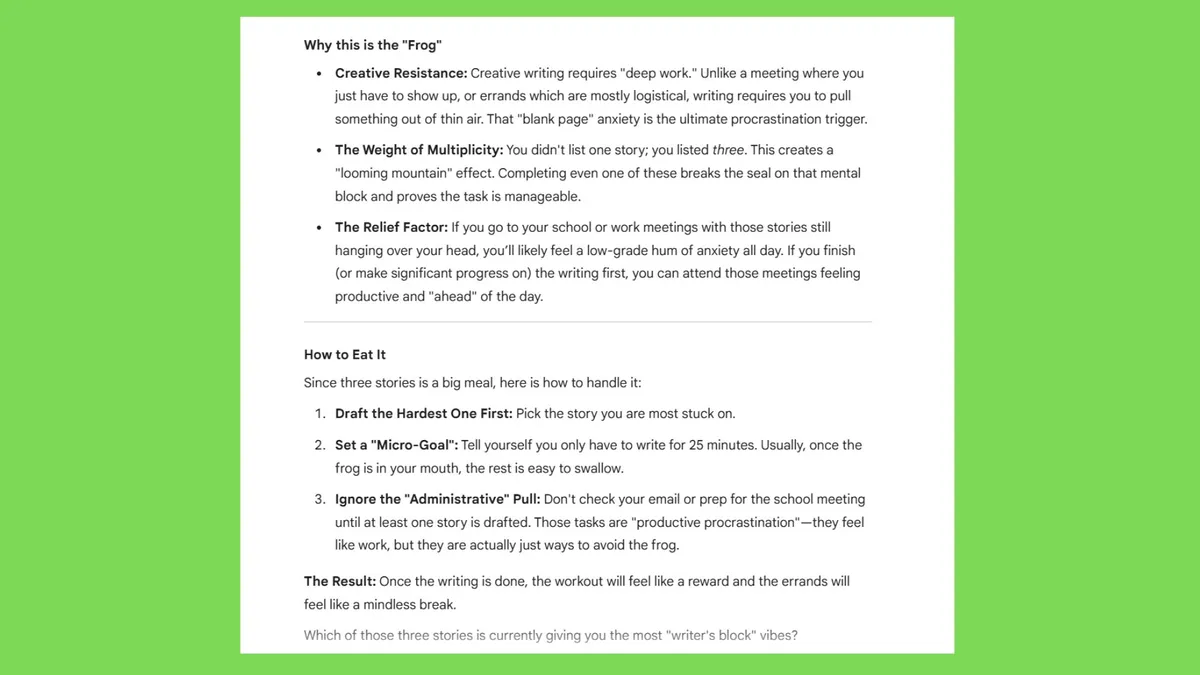
My first mistake with productivity advice is assuming I already know the problem. Usually, I’ll write down something broad like “finish article” or “deal with inbox,” then immediately feel overwhelmed.
So I started by asking Gemini to help me identify the real task I was avoiding.
Prompt I used: I’m trying to use the “Eat the Frog” rule today. Here are the things on my mind: [list tasks]. Help me identify the one task I’m most likely avoiding that would create the biggest sense of relief or momentum if I finished it first. Don’t just choose the most urgent task — explain which one is the real “frog” and why.
This worked because Gemini didn’t sort my to-do list by urgency. It helped me see which task had the most emotional weight. Although I recently stopped using Personal Intelligence with Gemini, for those who still use it, Gemini can actually see what's on your to-do list via Gmail and your Google Calendar.
What Gemini taught me is that sometimes the frog is not the task with the closest deadline. It’s the task creating the most background stress.
For me, Gemini pointed out that the task I was avoiding had three signs of being the real frog: I kept thinking about it, I kept doing easier tasks around it and finishing it would make the rest of my day feel lighter.
That was annoyingly accurate.
Step 2: I asked Gemini why I was avoiding it

Once I knew the frog, I wanted to understand the resistance. This is where AI was more useful than a normal productivity app.
A to-do list can tell me what I need to do. Gemini helped me see why I wasn’t doing it. And no, "because it's hard" isn't the answer.
Prompt I used: I know this is my frog: [task]. Help me figure out why I’m avoiding it. Give me the three most likely reasons this feels hard, then reframe each one into something more manageable.
This was the part that made the rule feel less punishing. Instead of treating procrastination like laziness, Gemini broke the avoidance into more specific causes: the task was too broad, the outcome felt uncertain and I hadn’t defined the first visible step. This exercise proved that not doing a task creates extra work in the long run. And that was key.
I wasn’t avoiding the work because I couldn’t do it. I was avoiding the moment of entering the work.
Once Gemini named that, the whole thing felt like less of a big deal.
Step 3: I made Gemini shrink the task

This was the prompt that changed the experiment. Instead of asking Gemini to “help me be productive,” I asked it to make the task smaller.
Prompt I used: Take this task: [task]. Shrink it into a 10-minute version that still counts as meaningful progress. I don’t need to finish the whole thing. I need to begin in a way that makes continuing easier.
This is where Gemini did the heavy lifting and where I realized that leaning on AI in this way is actually pretty exciting. The AI didn’t tell me to finish the entire project. It gave me a tiny version of the task that felt almost too easy to reject. For a writing task, that might mean drafting only the opening paragraph. Similar to the "2-minute rule," it worked because it removed the false choice between “finish everything” and “do nothing.” The 10-minute version gave me a way in.
Step 4: I asked for the first thing

One of the best things Gemini did was remove the blank page problem. When a task feels big, even deciding where to start can feel like another task. So I got very specific.
Prompt I used: Give me the exact first action I should take or first question I should ask. Make it so small that I can do it even if I have no motivation.
This prompt is almost embarrassingly effective. Gemini gave me a first move so specific that I didn’t have to negotiate with myself. Not “make the phone call.” Not “organize the project.” Just one sentence, one action, one place to begin.
That’s what made the “Eat the Frog” rule finally feel realistic. Gemini didn’t make the frog disappear. It cut it into the smallest possible bite.
What surprised me most

The biggest surprise was that Gemini did not make me feel more “optimized.” It made me feel less overwhelmed. And that's really the big difference; a lot of productivity tools make me feel like I need to become a better version of myself before I can get anything done. Gemini made the task feel less loaded. It helped me move from “I have to finish this huge thing” to “I only have to take the first useful step.”
That shift made the “Eat the Frog” rule like an easy strategy. Sure, I still had to do the work. Gemini didn’t magically complete the task for me. But it helped with the part I usually find hardest: turning dread into motion.
The best Gemini prompt for eating the frog that I'd use again: I want to use the “Eat the Frog” rule today, but I usually avoid my hardest task. Here are the things on my list: [insert tasks]. Identify the real frog, explain why I’m probably avoiding it, shrink it into a 10-minute version and give me the exact first action I should take. Keep it practical, specific and realistic.
Bottom line
The “Eat the Frog” rule never worked for me because I always assumed the hardest part was discipline. But I really just needed some momentum. Gemini helped me figure out what I was actually avoiding, why it felt so heavy and how to make the first step small enough to begin.
That doesn’t make the frog fun. Not by a long shot, but it does make it less impossible. And sometimes, that’s enough to get moving.
Have you tried this approach? Let me know in the comments how it worked for you.

Follow Tom's Guide on Google News and add us as a preferred source to get our up-to-date news, analysis, and reviews in your feeds.
More from Tom's Guide