Last month, I did the bear plank shoulder tap every day for a week and, while I found it an effective exercise for the deep core and upper arms, it is not one I’ll be adding to my roster. It’s a testing move and one seemingly designed to make you look ungainly. Having read the piece, my editor stroked her chin thoughtfully and said, “In that case, how about the bear plank bird dog for this month?” A variation on a theme, I mused, like an idiot.
What is the bear plank bird dog?
It is, as it sounds, another adaptation of the basic bear plank, which is itself a fairly difficult move that involves getting on all fours, then lifting your knees a few inches off the ground and holding yourself in place. The bird dog aspect means stretching out your left arm and right leg, then your right arm and left leg, while keeping your knees raised and back straight. It sounds tough, but it’s much tougher than that.
The bear plank with shoulder tap is an intense move that works your transverse abdominis muscles (the deepest layer of the abdominals), which are vital for the prevention — and even treatment — of low back pain. It also gives your upper arms something to think about.
The bird dog is a core exercise, too, but at the same time it hits the erector spinae muscles, which extend from the neck along the full length of the spine; the hamstrings; the trapezius muscles in your upper back; and the deltoid muscles, which form the rounded shape of the shoulder. Put them together and you have the bear plank bird dog, one major overachiever of an exercise.
How do I do it?
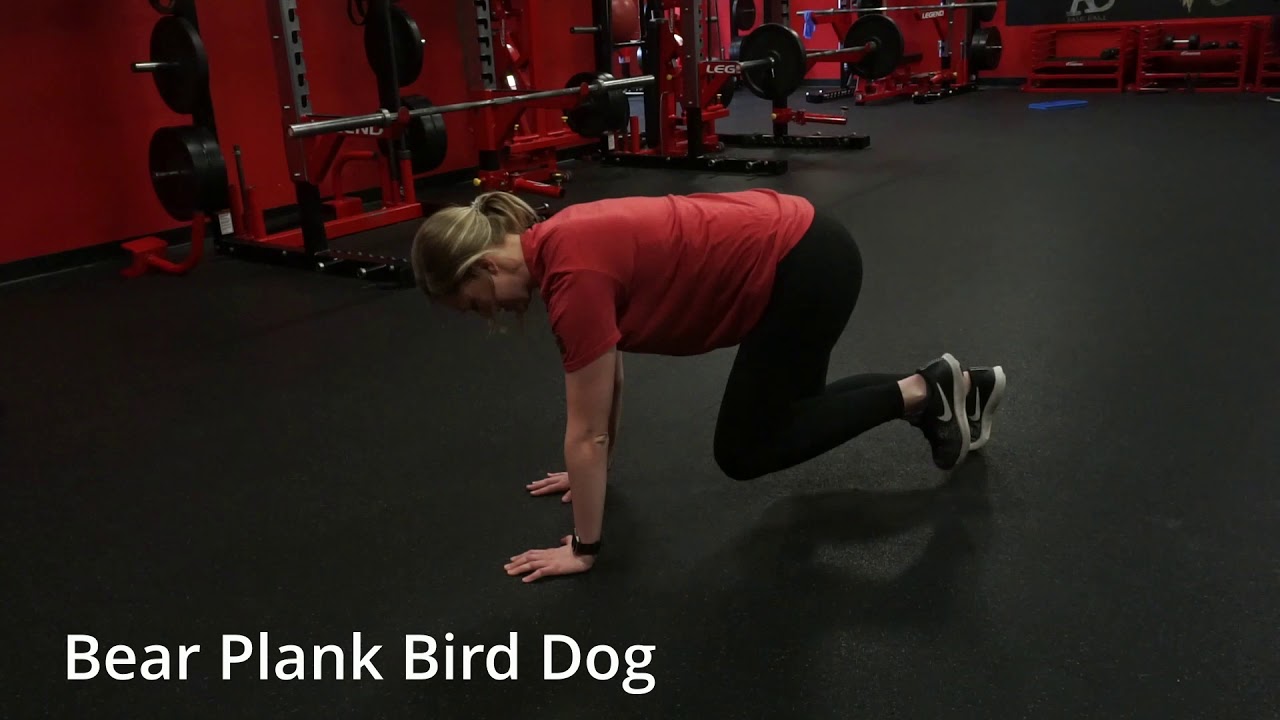
- Begin in tabletop position (all fours), knees in line with your hips and wrists in line with your shoulders.
- Push into your mat (I strongly advise using a mat, as this one is hard on the wrists), engage your core and raise both knees a couple of inches off the ground, keeping your palms flat and rising onto your toes. You should feel this in your core right away.
- Breathe in a controlled manner, keep your back straight and your head down.
- Once you feel you are balanced, raise your left arm and right leg at the same time until both are straight (or as straight as you can manage), pause for a second, then lower with control. Now repeat the move with your right arm and left leg.
- Begin with five reps on each side.
This is what happened when I did the bear plank bird dog for a week
Let me get to the point: I never mastered this move. I tried — how I tried! — but no matter how much determination I brought, no matter how patient I was, I could not do it properly. My knees came up too high, I lost my balance, I could not straighten one limb or the other… it was a mess. I still cannot pinpoint where I was going wrong, or where I am lacking strength or balance, but this one defeated me.
The daily humiliation
I keep notes when I’m doing these challenges and I began my account of day one with “almost impossible”. On both sides, I had to raise my leg before my arm could come up and even then I wobbled like a boozed-up foal. I have watched videos of this move and in them, the trainers are still as statues… while talking! And their knees rise no more than a couple of inches. Mine were headed for the ceiling. I managed three reps on each side and retired, surprised that my body was letting me down so comprehensively. Day two will be better, I reasoned. It always is.
It was not. When you are worried a move is not going according to plan and things are showing no signs of improving, you hold your breath as you tense up. This, of course, limits your options as the oxygen runs out. I completed an unsatisfactory five reps on each side and finished breathless and nonplussed. However, even though I was still not displaying anything like good form, I could tell this is an excellent exercise for the core and the upper arms.
If at first you don’t succeed…
There was no improvement on days three and four and I was now approaching the move with a negative mindset: I was no good at it, but I had a job to do. So, on day five, I decided to reset. Clear my head. Banish unhelpful thoughts.
I slowed everything down, paid close attention to everything from the position of my toes to the angle of my head, and reminded myself to breathe throughout. Then I tried a rep. Not bad. Not great, but not bad. Two. I could see my knees were still too high, so I lowered them as I tried for a third rep… and my form fell apart. The effort to keep my knees close to the ground while straightening an arm and a leg was simply too much.
…try something else
After a week, it was clear I was not going to be able to perform this move correctly. I’ve been doing these challenges for a long time and this was the first that defeated me. The bear plank with bird dog is to every other challenge I’ve taken on what playing with a ball of string is to understanding string theory. This is an advanced move that requires something more (strength? balance? co-ordination?) than I had to offer.
After the week was over, I decided to try it with leg bent to 90 degrees and this was far more successful. Not perfect, but I could hold the position. With my leg nearer to my trunk, my weight remained more centred and I could hold my knees closer to the ground. I was quietly delighted, then loudly. I also noticed in the days that followed that I could hold a normal plank for longer than usual. Causation or correlation? Who knows.
Even with my poor form, I could tell this is a savagely effective core exercise, but as I noted in my piece on the bear plank with shoulder tap, there is no shortage of exercises that work the same muscles, such as the hollow hold, the Russian twist, the dead bug, and the reverse crunch. I do not feel remotely disheartened that I could not perfect this move. It’s not for everybody, but it might be for you. Or it might be string theory.

Follow Tom's Guide on Google News and add us as a preferred source to get our up-to-date news, analysis, and reviews in your feeds. Alternatively, you can read our content on the Tom's Guide app available now for iOS and Android.
More from Tom's Guide
- I'm a personal trainer who works with clients over 50 — these are the 3 mobility exercises I never skip
- After 60, this is the 10-minute routine I use with my clients to stay strong, mobile and independent
- 'I’m a Pilates instructor, and I recommend these 5 core exercises to help older clients build strength and improve posture'