With prolonged heatwaves and fears of drought, keeping your lawn lush and green becomes increasingly difficult as warm weather and dry conditions persist.
To help you deal with extreme summer weather without destroying your turf, I asked lawn care experts how to keep your lawn alive as temperatures rise.
How to tell if your lawn is heat stressed

Before you start treating your lawn for heat stress, you need to ensure it’s the temperature and lack of water that’s causing the problem.
It changes color
“When grass undergoes drought stress, it starts to wilt and turn blue, a bluish gray, as opposed to keeping its lush green color,” says Allison Koenig, lawn and garden expert at Tractor Supply.
Craig Elworthy, founder at Lawnbright, agrees and says that detecting the grey or bluish tint is “your sign to get water on it now or it will likely begin to go dormant.”
Try the footprint test or screwdriver test
Another indication of water deficiency is the loss of resilience. “If you step on the grass and it leaves a footprint, it likely needs water,” says Koenig. “Under normal moisture conditions, the grass should spring back up instead of leaving traffic marks.”
If you’re still unsure, Koenig suggests trying the screwdriver test to check the soil’s moisture level. She says, “First, stick a screwdriver into the soil. This creates a small hole that will allow you to feel the soil about 3-4 inches down. If it’s hard to push the screwdriver in, it’s likely the soil is dry and in need of watering.”
If you haven’t got a screwdriver to hand, a soil probe or pocketknife will also do the trick.
What happens to your lawn when it’s heat-stressed?

“In a heatwave, your lawn is essentially running a marathon. It’s using all of its energy just to get through the intense heat,” says Elworthy. “This causes growth to slow down or even stop altogether.”
During extreme temperatures, grass loses moisture faster than roots absorb it
Roger May, TruGreen
Roger May, PhD, director of operations support at TruGreen, adds, “During extreme temperatures, grass loses moisture faster than roots absorb it.”
When coupled with a lack of water, the lawn will enter dormancy, turning brown until both temperature and moisture conditions are more favorable.
However, grass dying from heat alone is rarer than you might think. Koenig explains that the grass is redirecting its stored resources straight to the roots to survive, and that it will “green up” when more moderate conditions return.
But unlike your grass, the weeds can still thrive, and may well be the greenest spots on your lawn. However, it isn’t necessarily the best time to treat them.
Which grass is better at coping with extreme heat?

Grasses are split into two groups — warm-season grasses and cool-season grasses. Warm-season grasses are better equipped to withstand summer heatwaves, while cool-season grasses green up more quickly after winter. Your choice of grass should depend on the climate in your region.
“Bermuda grass and zoysia stand out as top performers for heat and drought in areas where warm-season grasses thrive,” says May. “These drought-resistant grasses stay vibrant while using less water and are recommended across very different hot climates — from the Western U.S. to Texas — because they tolerate scorching heat and dry spells while recovering quickly.”
Their root systems develop to reach beyond a foot below the surface, tapping moisture reserves that shallow-rooted varieties can’t access
Roger May, TruGreen
So, what makes these grass types able to deal with heat and drought? “Their root systems develop to reach beyond a foot below the surface, tapping moisture reserves that shallow-rooted varieties can’t access,” explains May.
He also adds that thicker leaf cells and waxy coatings reduce moisture loss, and that some varieties can still function when soil temperatures exceed 100°F.
Cool-season grasses, such as Kentucky bluegrass, fescue and ryegrass, struggle in the heat. If you are planting a cool-season grass, Elworthy recommends choosing tall fescue. “The roots can extend deep, away from the sun’s harsh rays.”
What’s more, he adds that fescue requires less water and fertilizer than other grass types.
How to care for your lawn in a heatwave
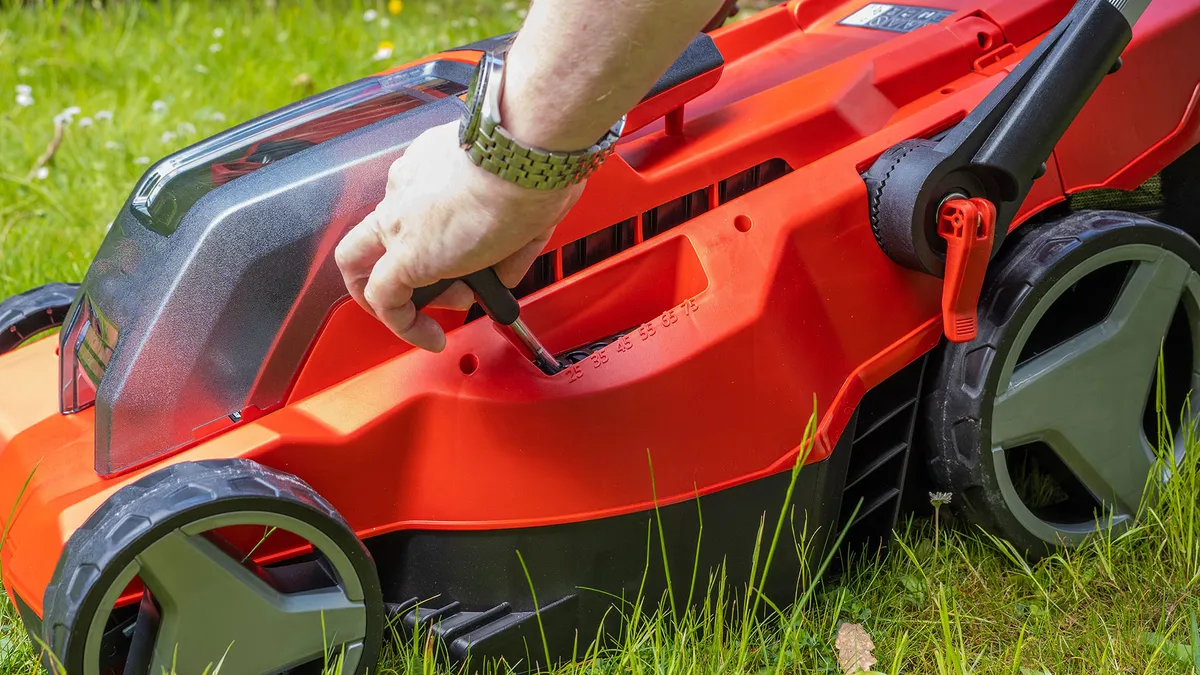
When it comes to caring for your lawn in a heatwave, the best advice is less is more.
1. Raise the height of your lawnmower
“As the temperature rises, so should your lawn height,” says Koenig. “I recommend keeping cool-season grass 3 or 3.5 inches long in the summer, or up to 4 inches for tall fescue and perennial ryegrass. Warm-season grasses should be kept shorter, around 2 to 2.5 inches.”
So why should the grass be left longer in a heatwave? According to Koenig, cutting too low exposes more soil, and in the summer, this leads to more moisture loss. “If you keep your blades slightly taller, your lawn is more protected from heat stress and weeds. This small adjustment can significantly improve drought resilience,” she explains.
Top tip: Follow the one-third rule
When mowing your lawn during a heatwave, Koenig advises never to remove more than one-third of the leaf tissue or blade at a time, as it’s where the plant’s food production occurs.
2. Leave grass clippings on your lawn
Rather than removing the grass clippings to create a tidy lawn, Chrisie Handley, lawncare specialist at Online Turf, suggests leaving them in place to act as a natural mulch. “They shade the ground, reduce water loss, and deliver a natural nitrogen boost as they break down,” she says.
3. Water deeply

A light sprinkle of water isn’t going to help your lawn, as it will encourage a shallow root system, which is more likely to burn out.
Instead, Handley recommends watering deeply for an extended period of time to promote healthier, more stable root systems. “The stronger and more stable the plant, the better chance it has of surviving drought conditions in the future,” she explains.
Top tip: The best time of day to water
Your grass will also thank you for being watered in the morning, avoiding the midday heat and the subsequent evaporation before the water reaches the roots.
4. Avoid fertilizer
Although your lawn may look like it needs nutrients, applying fertilizer in a heatwave should be avoided. Koenig explains, “Fertilizer will scorch your grass in extreme heat and damage its root system. Your lawn is already trying to conserve water during a heatwave, so extra stress will only compound the damage.”
Lawncare essentials we love

Follow Tom's Guide on Google News and add us as a preferred source to get our up-to-date news, analysis, and reviews in your feeds.
More from Tom's Guide