Tom's Guide Verdict
The Philips Café Aromis 8000 looks beautiful, with a bright, full-color screen and a gorgeous wooden embellishment on the group head. However, it’s outrageously expensive in the U.S. and makes a mid-tasting brew. I would personally skip this one, unless you value appearance over taste.
Reasons to buy
- +
Beautiful, beautiful appearance
- +
Extremely easy to use
- +
Full-color screen
- +
40+ customizable recipes
Reasons to avoid
- -
Milk texture is one-size-fits-all
- -
No dairy or plant-based milk settings
- -
Coffee tastes mid
- -
Really expensive in the U.S.
Why you can trust Tom's Guide Our writers and editors spend hours analyzing and reviewing products, services, and apps to help find what's best for you. Find out more about how we test, analyze, and rate.
I have yet to find a fully automatic espresso machine good enough to earn a permanent place in my kitchen. I’ve tested upwards of twenty now, and they all leave a little to be desired. But nothing’s been quite as disappointing as the Philips Café Aromis 8000 Series… let me explain.
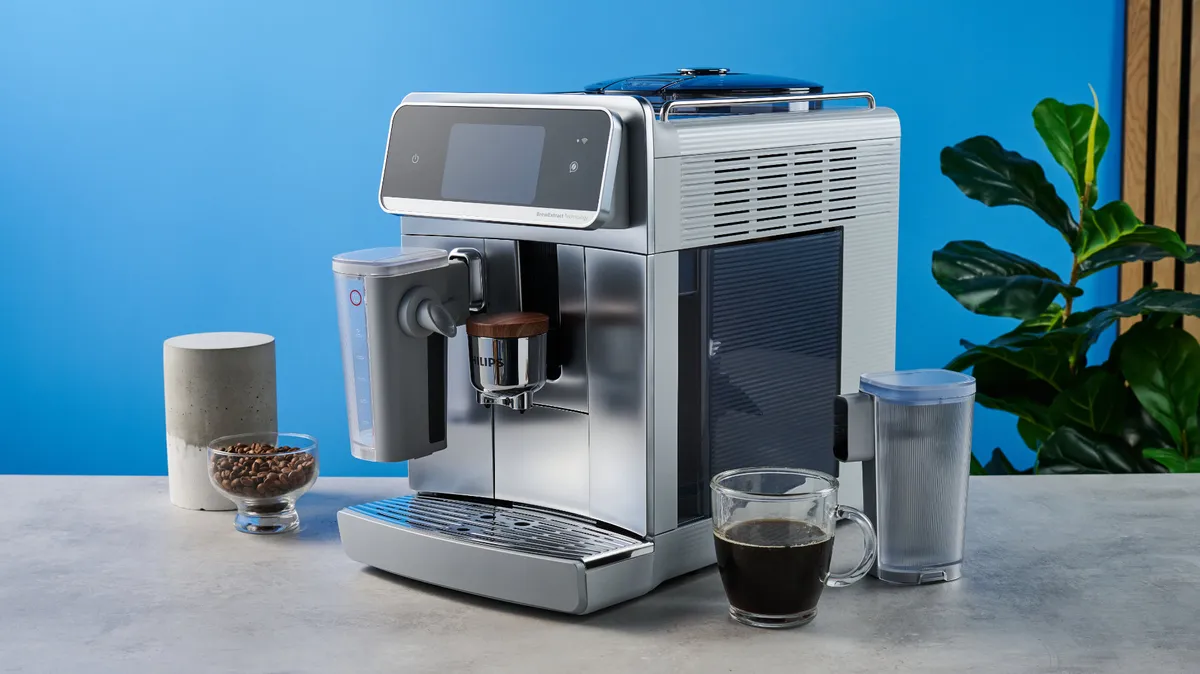
The 8000 Series looks beautiful. It’s easily one of the prettiest superautomatic coffee machines I’ve ever tested. There’s a wood-veneer group head, a cup warmer, and two silver rails on top — just like a commercial espresso machine. My hopes were sky high.
However, I’m not convinced it’s one of the best espresso machines. It’s outrageously expensive in the U.S. ($2k!), makes mid-tasting coffee, and can only make one type of milk texture. I’ll go through all the information in this Philips Café Aromis 8000 Series review.
Philips Café Aromis 8000 Series review: Specs
Philips Café Aromis 8000 Series review: Price & availability
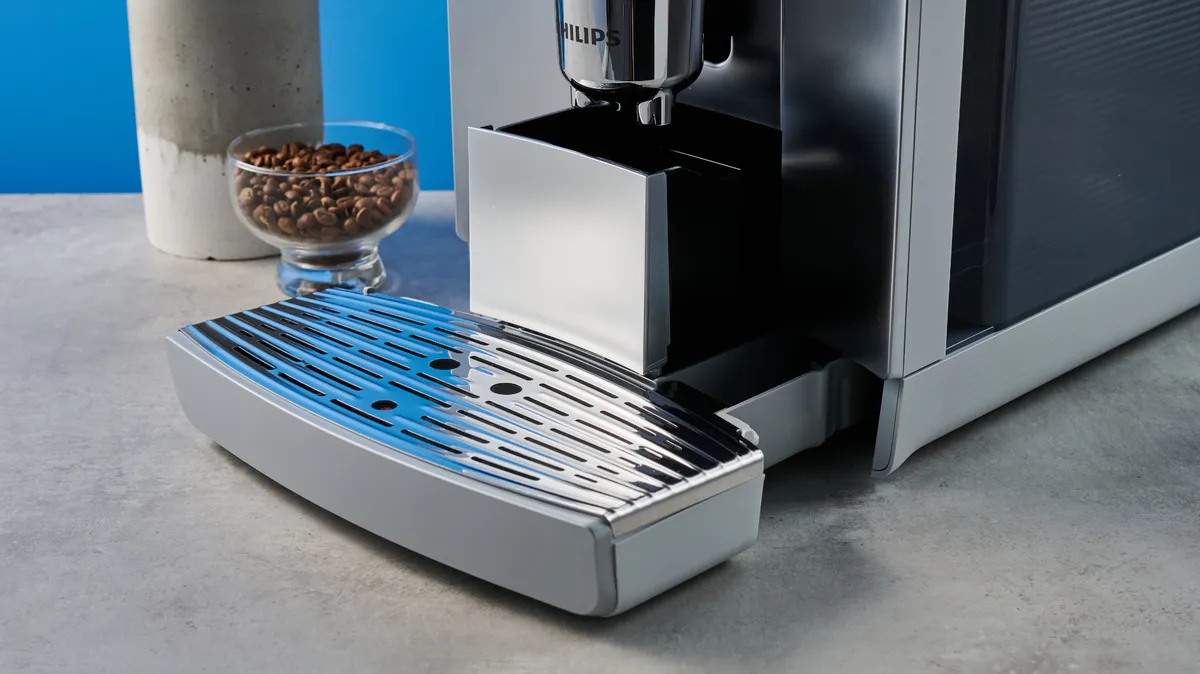
The Philips Café Aromis 8000 Series is a high-end automatic espresso machine. It’ll set you back $1,999 at Amazon U.S. and £895 at Curry’s U.K.
This is a premium price for a premium machine. Similar options would be the KitchenAid KF8 ($1,999) and the De’Longhi PrimaDonna Aromatic ($2,499).
If $2k is a little too much for you, don’t worry. De’Longhi also makes the $1,499 Rivelia, my favorite superautomatic coffee machine to date. For the money-savvy, there’s also the $795 Terra Kafe Demi, which can’t froth milk, and the Smeg BCC13, which is even cheaper at $749 but doesn’t have a full-color LED screen.
Philips also makes the $394 2200 Series. What’s actually different between the two? Honestly, not as much as you might think. The 2200 Series still has a built-in milk frother, unlike the $795 Terra Kafe Demi, and has a bright screen, unlike the $749 Smeg BCC13. Sure, the 2200 only makes “espresso”, “coffee”, and “hot water”, but that’s the foundation of any coffee drink. While the 8000 Series is much easier thanks to its one-touch recipes, I’m not sure this justifies a whole $1,600 extra. Personally, I would get the $394 2200 Series, or a standalone milk frother, like the $139 Subminimal Nanofoamer Pro Gen 2 for more finesse.
Philips Café Aromis 8000 Series review: Design
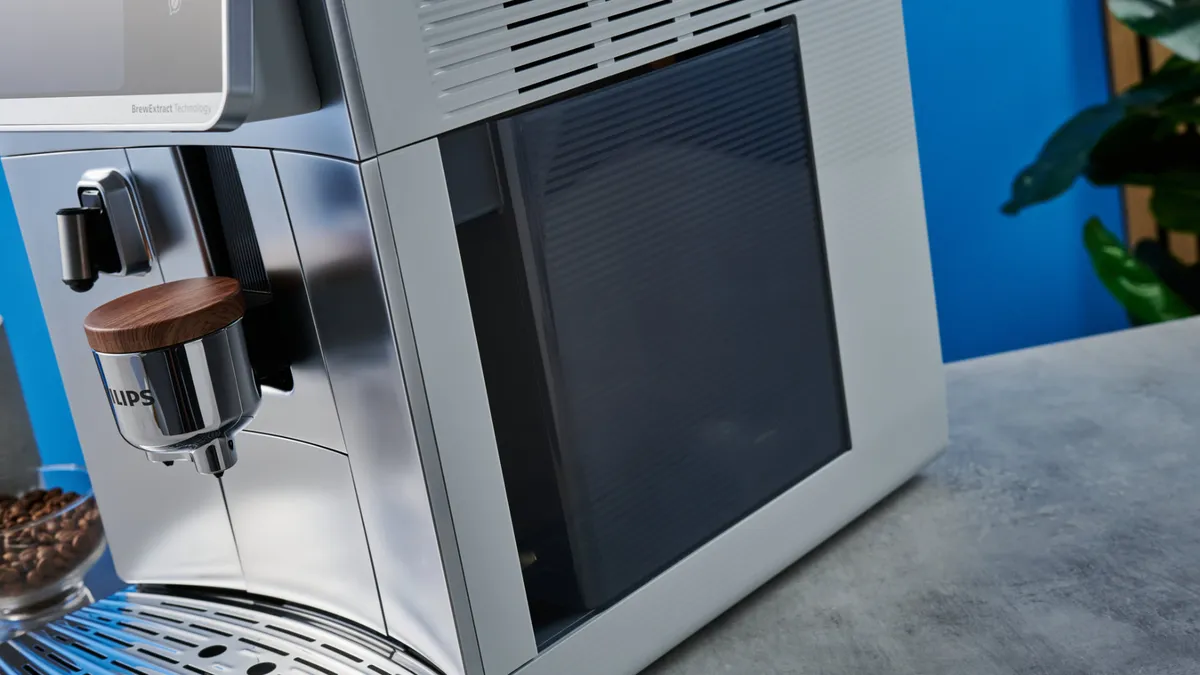
Oh, the Philips Café Aromis 8000 Series is a sight to behold. It’s gorgeous. I’d go so far as to say it’s the most beautiful automatic coffee machine I’ve ever seen. Of course, it’s essentially a big plastic-and-metal box — it’s still an automatic coffee machine, after all — but there’s a sense of finesse missing from other machines (yes, even $2,000 ones).
There’s a cup warmer on top of the machine, complete with two stainless steel rails on either side, and a low-profile grinder. The grinder holds a whole 250g bag of beans at once, even though it’s only rated for 200g.
But my favorite part is the wood finish on the portafilter. Rather than plastic or metal — boring! — the 8000 Series has a gorgeous, glossy wood veneer, making the machine look more like an automatic version of the Lelit MaraX3 than something like the Casabrews Ultra Pro.
You might be sensing a theme here, but it only gets better. Even though the water tank looks pretty small, it’s actually 64 fluid ounces (just under 2 liters). And it’s a slide-out tank, so you don’t need counter space with overhead clearance, unlike the KitchenAid KF3 ($999).
At 15.3 x 9.9 17.8 inches, the 8000 isn’t the slimmest automatic coffee machine I’ve ever tested — that would go to the aforementioned KitchenAid KF3 — but it doesn’t look as bulky as its dimensions might suggest. I had this out in the office for a week (making around ten drinks a day) and it looked right at home.
If you value a good-looking automatic coffee machine, the 8000 is surely for you. I really have nothing bad to say about its appearance.
However, the 8000 Series has “app functionality”. Here’s a screenshot of said “app functionality”.
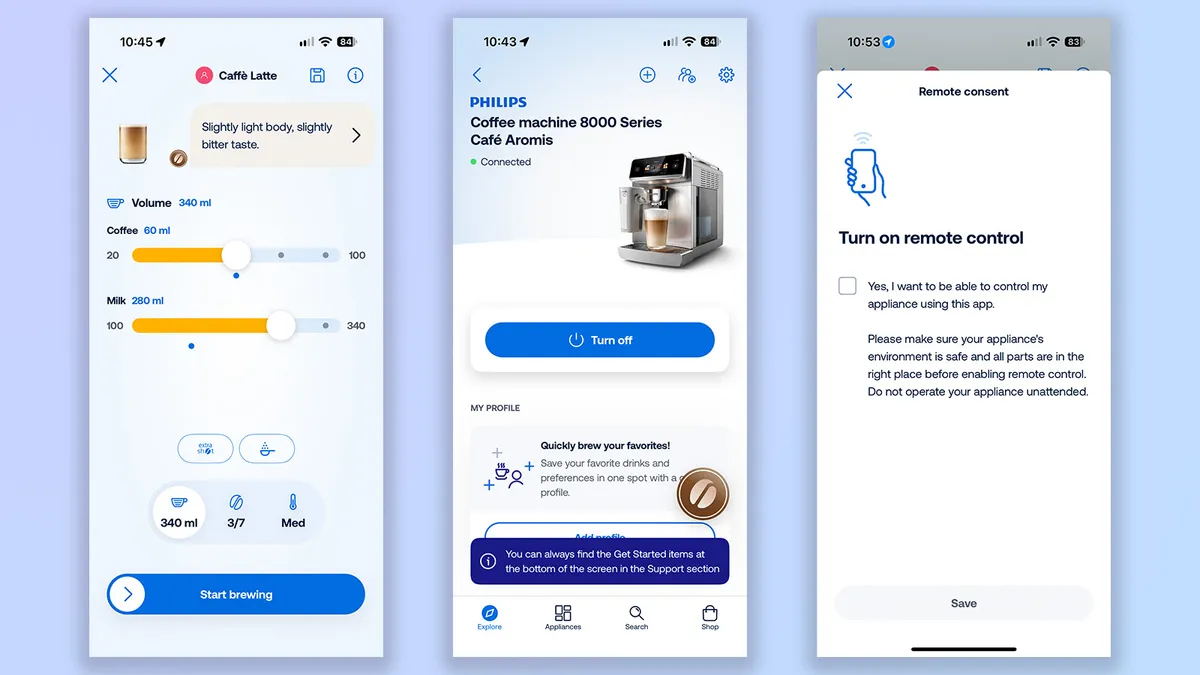
All you can really do is set user profiles and scroll through recipe ideas — most of which require extra ingredients, like custard or chocolate sauce. While I like that you can customize and save up to 8 drinks for each user profile, I do wish there was more purpose to the app. Sure, you can remote control brewing, but I wish there was something more. Or there’s not much point even having an app.
I also have a bone to pick with the language in said app. As you can see from the screenshots above, the app describes a latte as having “slightly light body, slightly bitter taste”. Coffee shouldn’t actually taste bitter. The central flavor note in a latte should not be bitterness. It should have a little bitterness to balance it out, but the prevailing taste should be fruitiness, chocolate, or nuttiness (depending on your beans). Maybe this is why the coffee tastes mediocre — because the machine is trying to make it bitter.
Philips Café Aromis 8000 Series review: Espresso
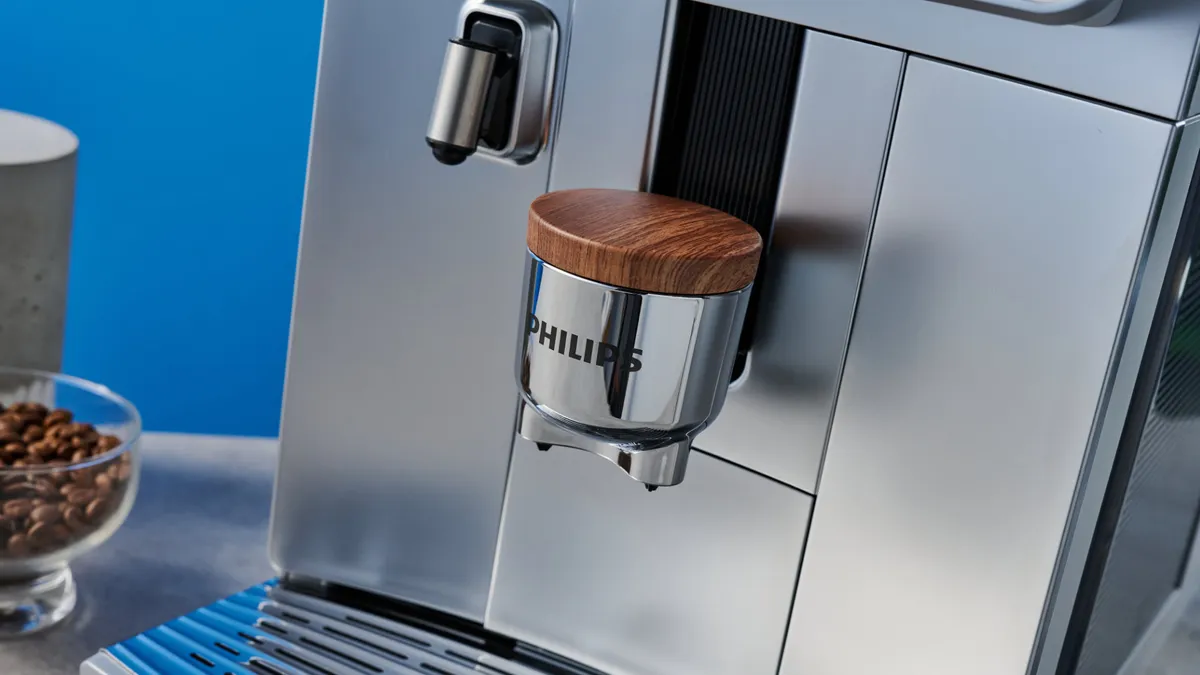
The standout feature on the 8000 Series is its ease of use. One touch makes 40+ recipes. Some of the recipes I’d never heard of, like Melange and Galão. Of course, there are also a range of cold drinks, but these are extracted hot, so in theory you could pull a normal espresso and top it up with cold milk to achieve the same results.
Here’s a photo of a straightforward espresso.
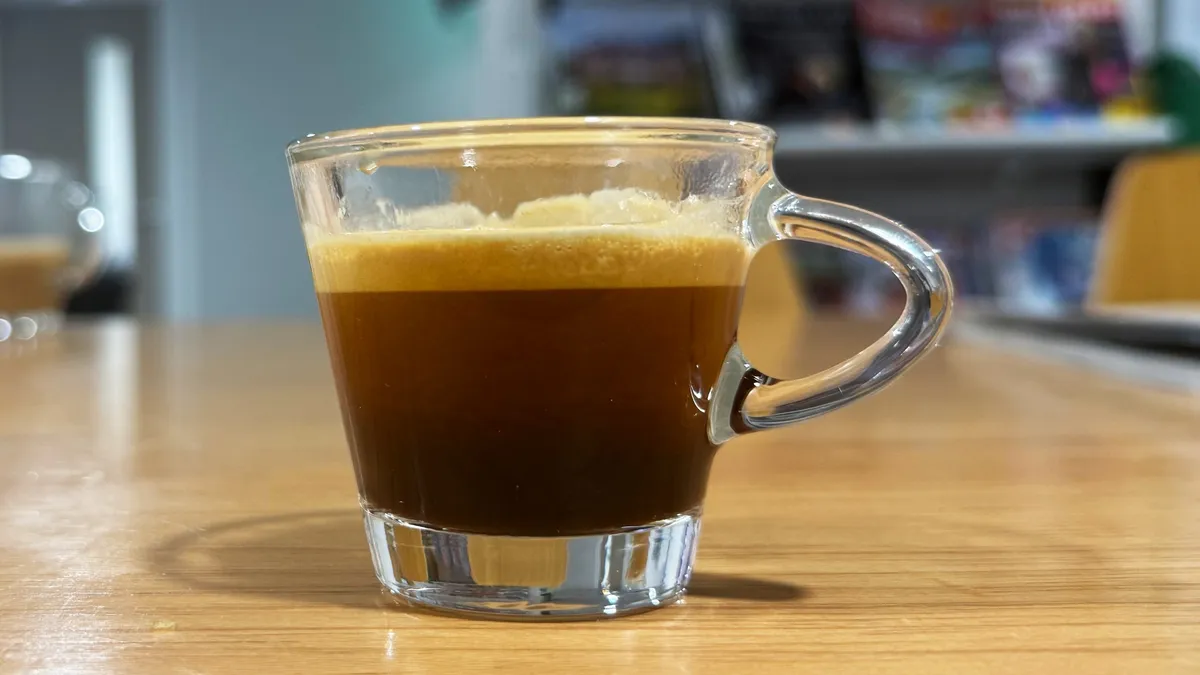
As you can see, it has a nice layer of crema, but the shot itself is a little pale. This espresso tasted rich and smooth, but with a little too much bitterness at the back of the palate for my personal taste.
You can easily customize the espresso settings for every drink (and then save your customized drinks to profiles). You can adjust the strength from 1-7, temperature, and use ground coffee if you please.
The grinder is also manually adjustable, but the machine calibrated itself based on my beans. Pressing the bean button brings up a built-in AI, which asks questions about roast and species of bean. After I provided this information, it adjusted the grind size to suit.
I found most drinks were way too bitter by default. I like the taste of coffee — I drink straight espresso to taste-test every single coffee machine. However, the 8000 Series brought out an unpleasant bitter note in my usual Ethiopian, medium-roasted testing beans, so I had to increase milk volume for every drink recipe.
The oat flat white (pictured in the “Milk” section below) was almost black. This is incredibly weird. I would recommend adjusting the default recipe for each drink to ensure it’s not overly strong.
Philips Café Aromis 8000 Series review: Milk
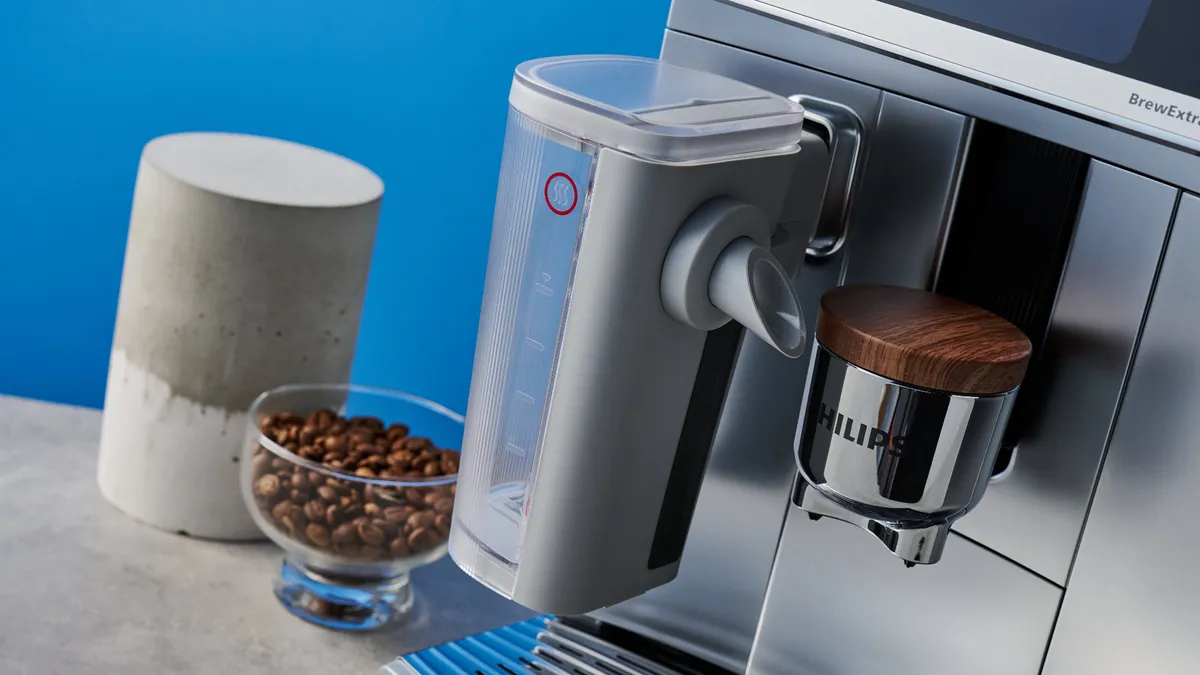
I appreciate the 8000 Series comes with both a hot and cold milk frother — more versatile than the De’Longhi Rivelia, which makes you spend extra for the cold milk system. However, you can’t customize the milk texture at all. You can adjust milk volume, but not texture. Iced latte, hot cappuccino, flat white, macchiato… all the same milk texture.
I’m sure the drinks are intended to be different milk textures, but they’re not. Everything is a little too aerated. There’s also no non-dairy/dairy milk setting, so oat milk is treated the same as cow milk, which is disappointing to see on such a pricey machine.
Here are three photos: one is an oat flat white, one is a cow milk latte, and one is an oat layered latte.
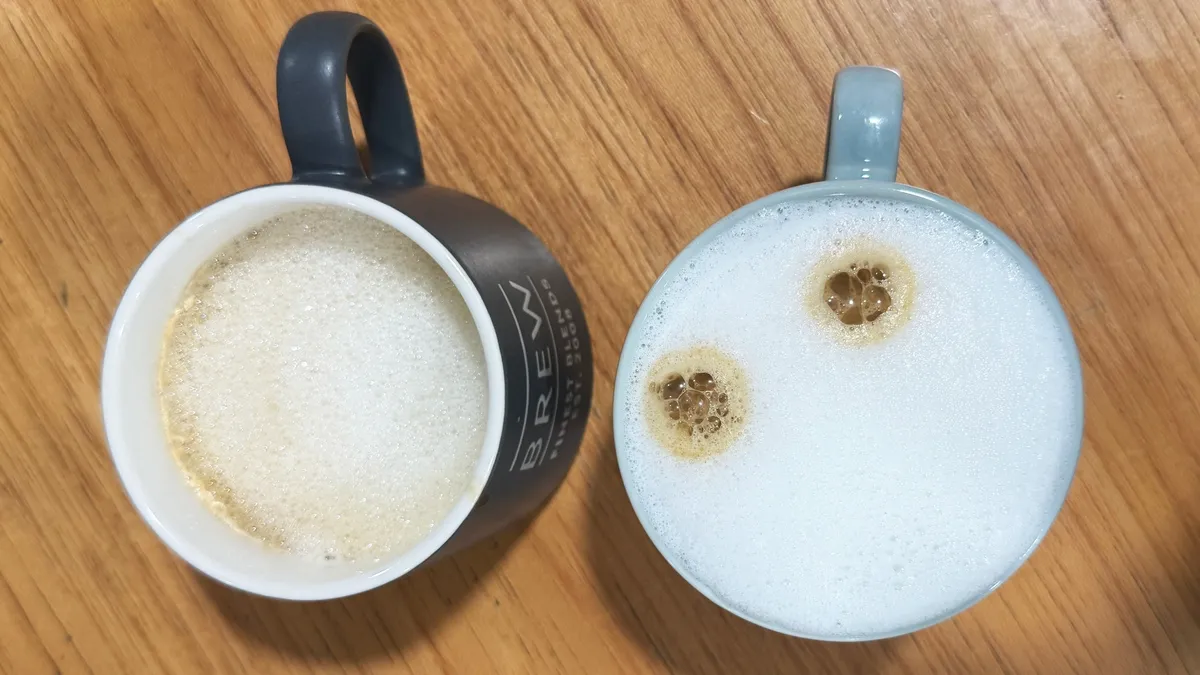


As you can see, the milk texture is relatively similar, and describable in one word: bubbly. For a $2,000 machine, it’s just not good enough. De’Longhi’s high-end milk systems allow for a three-prong customizer: you can choose low, medium, or high foam.
So, while I value the inclusion of a cold milk frother, the said milk frother isn’t as effective as De’Longhi’s “LatteCrema” systems.
Philips Café Aromis 8000 Series review: Storage & maintenance
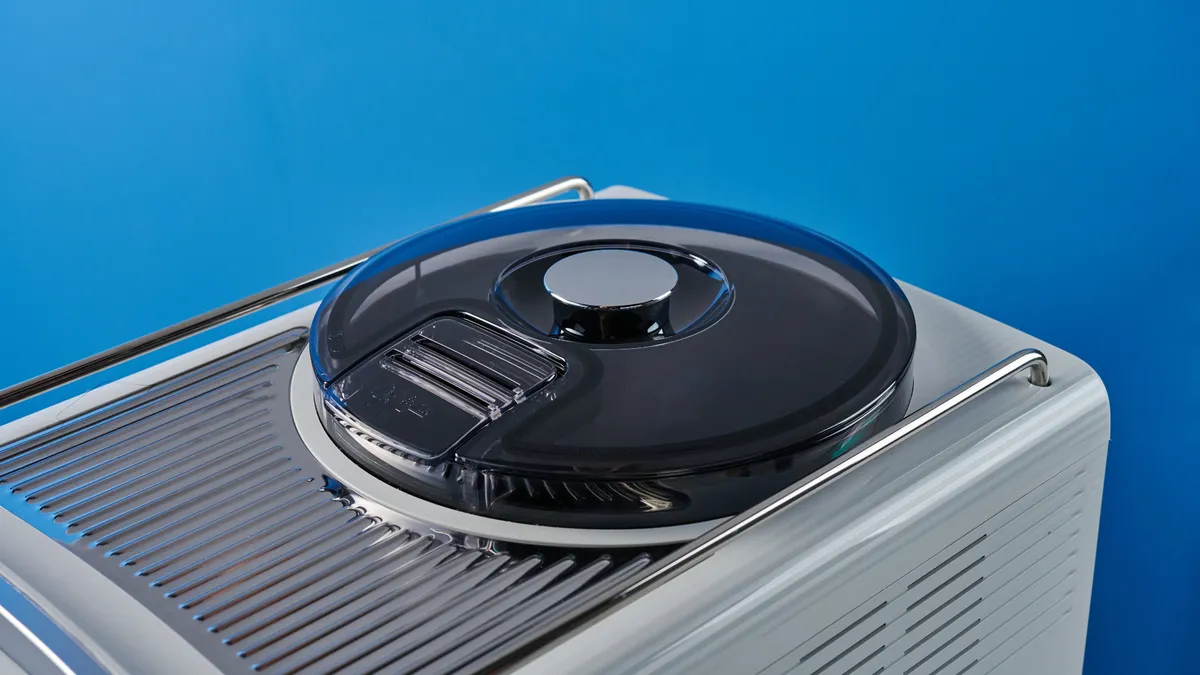
At 10 inches wide, 18 inches deep, and 15 inches tall, this is no small machine. However, it doesn’t require any overhead clearance thanks to the flush grinder hopper and side-accessible water tank, so you could theoretically get it even if your counters only have 16 inches of space.
The 8000 Series comes with a water filter, which I’d recommend installing regardless of water hardness. If you live in a particularly hard water area, you will need to descale more often than the machine recommends. Don’t worry if you don’t know your water hardness — the machine comes with a test strip.
Philips makes a descaler: $16 for two packs at Amazon. This should last you around six months depending on your water hardness.
Cleaning is also easy: the milk frothers and drip tray are dishwasher safe (but they take up a lot of space in said dishwasher), and the machine will alert you when you need to rinse internal brewing elements. Be warned that coffee grounds go moldy quickly, so empty this at least every day.
Finally, warranty. Philips offers a 2-year standard warranty, which is the same as KitchenAid, De’Longhi, Ninja, and Breville. I’d like to see coffee companies start to move towards a 5-year warranty, especially when these machines cost so much.
Philips Café Aromis 8000 Series review: Verdict
I really don’t think the Philips Café Aromis 8000 Series is worth $2,000. It tastes like coffee you can get on the $394 2200 Series. If you really, really want to spend two grand, I’d recommend the KitchenAid KF8 instead. If you want to save money but get an automatic machine, I’d go for the $1,400 De’Longhi Rivelia or $895 Smeg BCC13.
While the Café Aromis 8000 Series looks gorgeous and is incredibly easy to use, I cannot find anything to justify that price. Sure, it can make 40+ recipes, but are you really going to make a Melange or Galão on a fully automatic coffee machine? Not really. Just make it manually — it’ll taste better. As the machine can’t actually make different milk textures, it’s not a true Melange or Galão anyway.
I would personally skip this one. It’s much too expensive in the U.S. and doesn’t make nice-tasting coffee — but if you value appearance and ease of use over anything else, you might not be disappointed.