2025 was a momentous year for the VPN industry. The privacy tools were thrust into the limelight thanks to a wave of age verification laws, we saw new providers emerge to challenge the status quo, and internet censorship continued to impact billions of people worldwide.
Even for an ever-changing industry like VPNs, this year felt pretty monumental – and there's every chance 2026 continues this trend.
The Tom's Guide VPN team writes about the best VPNs every day, so we asked our three resident VPN experts to give their predictions for what 2026 has in store for the industry. Let's see what they said.

Attacks on VPNs will only increase

"We saw attacks on VPNs reach unprecedented levels in 2025, and I fear 2026 will be no different."
If you'd never heard of a VPN before 2025, you likely have now. VPNs were thrust into the limelight this year largely thanks to age verification laws and VPNs' perceived effectiveness in bypassing them.
VPNs became more mainstream than ever. As a result, huge numbers of people subscribed to VPNs for the first time, taking important steps to protect their online privacy. But this 15 minutes of fame has put VPNs on the radar of Western governments – most notably in the US, UK, and Australia – and we saw the first signs of coordinated attacks on VPN usage, something I fear will only increase in 2026.
In September, Michigan lawmakers called for a total VPN ban as part of a proposed "public morals" bill. Guidance related to Australia's social media ban for under-16s called on social media platforms to try and "stop under-16s from using VPNs to pretend to be outside Australia." In the UK, Members of Parliament called for age restrictions on VPNs and the government said "the VPN issue" would be investigated.
No definitive VPN ban has occurred in the West – yet. What we've seen in 2025 is just talk. But it's talk that is going to get louder, and it's talk that needs to be opposed at every opportunity.

We also saw attacks on VPNs and acts of internet censorship from more authoritarian countries including Russia, Pakistan, and Myanmar. This is sadly not new, and many VPNs have developed obfuscated protocols and anti-censorship features to protect the most vulnerable.
In 2026, privacy advocates are going to be fighting on multiple fronts, and I expect the pressure on VPNs to increase. We may not see the same headlines as in 2025, but privacy-targeting legislation isn't going away and it'll need to be opposed. The EU is likely to continue its attempts to introduce "Chat Control" and additional age verification legislation is due to come into effect in 2026.
The VPN Trust Initiative (VTI) shared my concerns over the future of privacy and VPNs. It said: "We expect continued pressure on encryption, VPN services, and privacy-enhancing technologies, particularly through regulatory or policy frameworks that blur the line between lawful access and systemic weakening of security."
VPN providers and privacy advocates must continue to work together and champion VPNs as a force for good. People have a right to privacy and a right to a free and open internet – this won't change in 2026.
The next generation of VPNs

"Everyday, streaming-focused VPNs that offer good privacy will always have a place, but hardened tools with privacy safeguards beyond no-logs policies are growing in popularity. 2026 could be the year they break into the mainstream."
Throughout 2025, we saw a number of "alternative" VPNs come to the fore – Obscura VPN, NymVPN and VP.NET being the three most notable. While each of these achieves it in a different way, there's a clear focus ensuring trust isn't an issue.
For example, rather than requiring you to trust that the VPN isn't logging your data, and proving that through an independent audit of its no-logging policy, Obscura VPN makes sure that at no point during your traffic's journey does one entity know both your real IP and destination. This is done by handing off your encrypted traffic to Mullvad, another VPN, which sends it on to your destination.
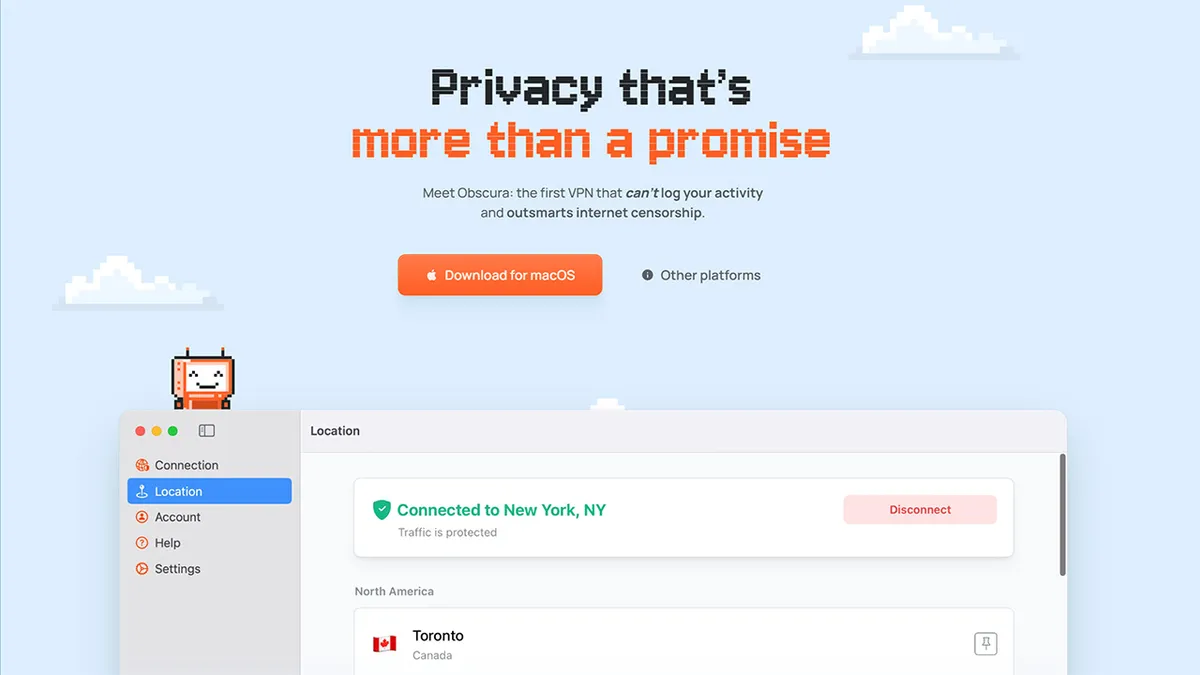
Of course, all of this is overkill for most VPN users – the vast majority of people just want to make sure their private searches can't be linked to their IP address by their internet provider, and perhaps want to unblock streaming content from abroad. However, for those that need it, these developments will be massive green flags.
It won't happen overnight, but I wouldn't be surprised if we began to see VPNs diverge: mainstream VPNs that have good privacy credentials and focus on unblocking streaming sites and day-to-day privacy, and next-gen VPNs that employ more advanced technology to obfuscate your traffic, remove any possibility of logging, and have the toughest possible privacy – likely at the cost of connection speed and streaming performance.
Cybersecurity suites

"We'll see VPNs' cybersecurity suites develop further, offering better and more extensive protection."
As we go into 2026, I think we'll see many more VPNs offering added cybersecurity features, like password managers, antimalware or antivirus, or phishing protection. Most of the major players in the VPN space offer features such as these in some capacity, with many of them expanding their offerings further in 2025.
Take NordVPN, for example – 2025 saw it introduce not only a crypto wallet checker, but an email protection feature that can stop phishing attempts in real time. Both of these features expanded on its already established cybersecurity protection, cementing its position not only as a VPN but as a complete cybersecurity suite.
While these features are nice-to-have rather than need-to-have for a VPN, many users (myself included) like the peace of mind that having added cybersecurity protection can give you, as well as an encrypted connection. Additionally, with a rise in people using VPNs in order to get around online censorship, it makes sense that they would want to bundle all their cybersecurity protection into one subscription. Convenience is king, and offering such complete protection helps give a VPN an edge in a very competitive market
With this in mind, in 2026, I think we'll see VPNs' cybersecurity suite offerings develop further, offering better and more extensive protection. We'll also see smaller VPN providers offering some form of cybersecurity protection in order to keep up with the competition.

2026 won't be quiet
Whether we see positive or negative developments, 2026 won't be a quiet year.
We already know new VPN features will be coming early in the year and as the competitiveness of the VPN market grows, providers will be looking to outdo one another.
New providers will continue to grow and innovate, and market leaders will look to cement their position. The evolution of AI, tech, and cybersecurity will see new threats and new solutions. Throw in a turbulent political climate and anything could happen.
What remains, however, is the fundamental need to protect, and campaign for, online privacy and a free and open internet.
We test and review VPN services in the context of legal recreational uses. For example: 1. Accessing a service from another country (subject to the terms and conditions of that service). 2. Protecting your online security and strengthening your online privacy when abroad. We do not support or condone the illegal or malicious use of VPN services. Consuming pirated content that is paid-for is neither endorsed nor approved by Future Publishing.