The first time I typed on the Keychron V1, I was astounded. The typing experience was nothing short of beautiful. Such lovely switches... such a delightful sound profile... such a good-looking keyboard. I loved the V1, and it stayed put on my work desk for many, many months before it was eventually replaced by the Gamakay LK75 (which then quickly got replaced by another keyboard). I've reviewed nearly 80 keyboards now so I've lost track of which ones I've ended up using for longer than the testing periods.
But even so, I often think about the V1. It was the first mechanical keyboard I was actually genuinely interested in, and few have come close to it since. It's also the only keyboard I've ever given a full 5-out-of-5 star rating — which was deserved back then, and I'd say is still deserved even today. So imagine my surprise and enthusiasm when Keychron announced its V Ultra series of keyboards in January. I was so looking forward to testing the Keychron V1 Ultra 8K... but it just didn't scratch the itch.
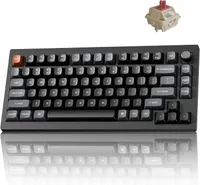
Don't get me wrong. The V1 Ultra 8K is great in its own right — if it wasn't, it wouldn't have earned a 4.5-star rating from me. It boasts 660 hours of battery life, offers a lovely typing experience, and it's got... 8,000Hz polling! Good news for the ultra-human, I guess, or people who can perceive that kinda polling more than the average human can. I like the V1 Ultra 8K but part of me thinks this was an unnecessary upgrade, and one I wouldn't have missed had it not happened. So, I'll choose the OG V1 even today. Here's why.
One upgrade I actually wanted

When I reviewed the OG Keychron V1, I was a little disappointed that it was a wired-only deck. I love a keyboard that can be connected to multiple laptops via 2.4GHz and Bluetooth wirelessly connectivity as well as wired, as these modes make it more versatile and enable me to use the keyboard with different machines at the same time. Of course, you could always get the Keychron V1 Max for a little more money, if tri-mode connectivity is more your speed.
The Keychron V1 Ultra 8K is a tri-mode keyboard, so you can use it both wired and wirelessly. And an upgrade I didn't know I needed came in the form of the deck's loooong battery life. The V1 Max is rated for 225 hours between charges, which is great, but the V1 Ultra 8K takes it a step further with its 660-hour battery life rating. Now that is phenomenal.
I'll be the first to admit that I sometimes forget to charge my devices — one of the (many) reasons why I love my 100-hour Marshall Monitor III headphones. And when I'm leaving work, I'll sometimes forget to switch off my keyboard, and I'll arrive the next day to find it has died. Thankfully, that isn't the case with the V1 Ultra 8K. The battery life will naturally depend on the usage conditions, such as whether RGB is turned on and if you have 8KHz wireless polling enabled. But knowing that the keyboard can potentially last that long is comforting.
Can you even perceive 8KHz polling?

Another upgrade Keychron has introduced in not only the V1 Ultra 8K but all of its Ultra keyboards is 8,000Hz (8kHz) polling. This basically means the keyboard (which is scanning itself for inputs) reports the results of its scans to your computer 8,000 times per second. The more of those polls, the faster it reports inputs to the computer, and the less likely any inputs are to fall between the gaps and get missed.
8kHz polling basically ensures zero latency issues and input lag, thereby theoretically lending you a competitive advantage. You know what else negates latency issues and input lag and gives you a competitive advantage? 1,000Hz polling, found in both the OG V1 and the V1 Max. Look, I can understand highly competitive esports teams and players wanting 8kHz polling to absolutely ensure the quickest inputs and that none are missed, but for 90% of users, 8kHz means nothing but a drag on system resources, while 1kHz is more than enough.
I had an extensive discussion with my editor and our in-house keyboard expert, Pete Wolinski, and both of us agreed that 8kHz polling is, for lack of a better word, gimmicky, and I've never been a fan of gimmicks. Can any human really tell the difference between an input reported at 1,000th of a second and one at 8,000th of a second? The numbers are both beyond human perception.
I also personally don't understand the point of 8kHz polling on a mechanical keyboard. When you have magnetic switches with lighting fast actuation and features like Rapid Trigger, to repeat inputs in quick succession? Sure, why not. But when your much slower mechanical keyboard has switches without those features, and which have to physically recycle before they can actuate again, what's the point? It's a drain on system resources and your deck's battery life. Every manufacturer wants to stuff 8kHz polling into their keyboards nowadays because it's "in," but for most users, including myself, a keyboard like the OG V1 is still good.
The OG V1 is still a winner in my eyes

As I mentioned earlier, the OG Keychron V1 stayed put on my desk for a long, long time. I sometimes think about buying it with my own money and perhaps one of these days I'll bite the bullet. I love its Frosted Black design and soft double-shot PBT keycaps. I remember it sounding like music to my ears, and it was the first time I preferred linear switches over tactile ones because of just how much of a joy the V1 was to type on.
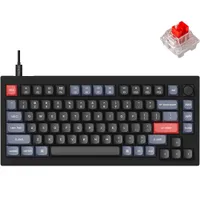
The V1 also felt much better built than the V1 Ultra 8K. Its steel plate ensured that there was no flex in the body unlike the V1 Ultra 8K whose body twists if you twist it by holding its sides. That isn't great news for the V1 Ultra 8K because it makes me question the longevity of the board. 1KHz polling on the V1 is also, again, more than enough for most users, and it doesn't overload your computer. 8KHz wireless polling is cool, but to me, it only really sounds cool on paper.
What do you think? Would you buy the V1 or the V1 Ultra 8K? Let me know in the comments below!

Follow Tom's Guide on Google News and add us as a preferred source to get our up-to-date news, analysis, and reviews in your feeds.
More from Tom's Guide
- Keychron upgraded my favorite mechanical keyboard and packed 8,000Hz polling and 660 hours of battery into it — here’s my verdict after a week of testing
- The Turtle Beach Vulcan II Max’s optical switches and bright RGB are a delight — but at this price, I expected more
- The only keyboard I want to use from now on is the Keychron V1 — here’s why