





I made the change to wireless charging years ago, and thanks to the best wireless chargers I've been testing, I've never looked back. The convenience of having my phone (and sometimes my smartwatch and wireless earbuds too) powering up on my nightstand or desk without a cable in sight hasn't got old, and the variety of single and multi-device chargers is astounding.
The majority of new smartphones work with Qi wireless charging, an open standard used by all sorts of chargers. But iPhones have their own MagSafe standard (or MagSafe 2 in the case of the iPhone 16 and iPhone 17 series) which has become a focal point for the best chargers on this list due to the popularity of Apple-made phones. But with the introduction of Qi2, based on MagSafe, Android phones are becoming capable of using these chargers as well, either natively with the Google Pixel 10 series or with the installation of a magnet ring or specially-designed case.
Because of the number of companies out there wanting to sell you a wireless charger, it can be hard figuring out what's good. For my money, the Belkin Boost Charge Pro 3-in-1 Wireless Charging Pad remains the best option for powering up your key wirelessly-charging gear, while Otterbox's Wireless Charging Pad is my pick for those wanting a basic, brand-agnostic charging experience for any device you like.

Make sure you check out our best portable chargers and power banks guide if you want power while you're on the go, or our best phone battery life rankings if you'd like to know which handsets can go longest without returning to home base. But right now let's get back into the best wireless chargers.
The best wireless chargers you can buy today
Why you can trust Tom's Guide Our writers and editors spend hours analyzing and reviewing products, services, and apps to help find what's best for you. Find out more about how we test, analyze, and rate.
The best wireless charger overall

This three-in-one charging pad from Belkin is my current favorite wireless charger. It offers 15W MagSafe charging for the iPhone 12 to iPhone 15, as well as fast charging for the Apple Watch 7 and regular wireless charging in an AirPods-sized recess, meaning all my Apple mobile devices could charge simultaneously from a single charging brick. That brick comes included too, so I didn't have to go rooting around in a cupboard for one with the correct wattage.
The only thing holding this charger back from perfection is its price, which is quite high. Also, the use of MagSafe and the Apple Watch charging cradle means this isn't a great pick for Android users, although as you'll see from other entries on this list, you've still got some good choices.
The best wireless charger value


The Otterbox wireless charger isn't much to look at, but it offers everything I could ask for from a universal charging pad. It's well-priced and comes with a compatible plug that'll deliver the maximum available power to your device.
About the only complaint I can make is that the design's kind of plain, but that's just the way Otterbox designs its products. Its compact, features a convenient light to indicate charging status and a rubberized square in the center of the pad to avoid items sliding around. The lengthy included cable makes sure you can place the pad almost anywhere you could want it too.
The best wireless charging stand

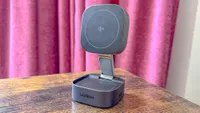
After taking the Satechi 3-in-1 Foldable Charging Stand on multiple trips at home and abroad, I can recommend it as a fantastic wireless charging stand both for travelling and for home use.
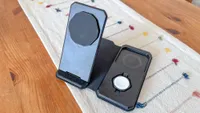
The dual-hinged arm of this charger lets you position your Qi2-ready phone easily, either horizontally or vertically as you need. Unless you have the charger completely flat, you have the option to charge a small device at the same time, and the fold-out back charging cradle for your Apple Watch is there whenever you need it.
As a compact charger, the overall footprint is pretty large when folded down, which makes it a harder fit for smaller bags if you're trying to travel super-light. But I find it hard to fault this charger otherwise, hence why it's been my go-to for some time even after I was finished with testing.
The best wireless charging stand for travel


Even if you're not moving house like I was during testing, this three-in-one charger from Anker provides a flexible way to charge your devices whether you're at home or out and about.
The pocket-sized charger comes with a fold-out stand for your phone so you can charge it vertically or horizontally. And it's not just an iPhone this time around, since this charger's Qi2 compatibility means it should work with future phones from non-Apple brands.
However the compact design of the MagGo stand means it can't charge your phone in a flat position when you want to charge your earbuds or another device on the standard charging pad beneath. Plus having an Apple Watch perched on the fold-away cradle makes the space a little cramped too. But these are small prices to pay for a charger that works just as well on your hotel room nightstand as it does on your desk at home.
The best premium wireless charger

With a solid metal and glass body, the Nomad Stand One stayed solid wherever I put it, even when pulling a MagSafe-equipped iPhone off of it. Coming in either black or white, and with a matching integrated USB-C cable, it proved a great-looking addition to my desk.
Boy, do you pay for the privilege though. This is one of the most expensive chargers on this list, and only really works with iPhone 12 models and later. Also, that price doesn't include a charging brick, which is annoying since you need a 20W or more charger to get the full 15W speed. I'd find it hard to recommend to users who aren't taken with the design, or who have more modest budgets.
If you prefer a flat charging pad with the same gorgeous build quality, then there's the Nomad Base One for you to look at as well. And if you want a spot for your Apple Watch to charge as well as your phone, then you can upgrade to the Base One Max.
The best wireless charging pad

Wireless charging is often a solitary affair, or at least a single-phone one. But Zens' Quattro Wireless Charger Pro 4 lets you charge up to four phones at once, or any combination of four wirelessly-chargeable devices. And even if it doesn't appeal to you, I think it's cool to have the option in one single charging station.
All four of the magnetic charging points have a maximum output of 15W, so I was able to charge up to three iPhones at full MagSafe speeds (thanks to my colleagues' help), plus my AirPods Pro, without a problem. It's brilliant if you have a number of friends around to yours in need of a top-up for their phone, or if you want to make nightly charging a family ritual of sorts. The only major problem with the Zens is the company's insistence on using a barrel connector rather than USB-C. The included cable is long enough for most possible placements of the charger, but not having the full flexibility of using your own cable and charger combination is a pain.
The best wireless charger with cooling

When you want to charge fast, you need to account for the increased heat that your phone generates as it takes on power at high speed. That's something that Belkin's UltraCharge Pro stand does with a built-in fan, which automatically kicks in when it detects a major power draw. But you still have control of when the fan is active with a simple toggle switch, lest it disturb you when you need some quiet time.
The rear of the charger's arm hides an Apple Watch charging cradle, and the base can be used to charge your AirPods or other small accessories. It's a great all-in-one charging option as it supports all of Apple's latest gear up to the iPhone 17 series, plus other Qi2-ready phones like the Google Pixel 10 series. It's just a little expensive, even if the materials and features make that justifiable.
Best powerbank wireless charger

The InfinaCore P3 Pro is another level of practical when it comes to wireless chargers we've tested.
Its Qi2 support means it works with MagSafe-supported iPhones as well as Android devices, while its robust 65W output meant reviewer John Velasco was able to charge his phone, laptop, and camera all at once, which was a game-changer for the busy days juggling multiple devices that John and others on our team often have.
If three-device charging wasn't enough, this charger is both a power bank and a power adapter in one. You can have it feeding your gizmos via a wall outlet when it's available, or with its chunky 10,000 mAh internal battery - good for at least two full charges of a typical smartphone.
However, there is a small drawback. The P3 Pro can’t properly support aa charging in iPhone in landscape orientation because the charger isn’t heavy enough, so it tips forward all the time. This is clearly designed to be a charging pad, rather than a charging stand.
Still, if you want a charger you can easily take with you, and one that can handle heavier-duty devices than just your phone and your earbuds, then the P3 Pro deserves your attention. But for the average person wanting wireless charging, you're perhaps better off looking at a simpler, stationary charger.
Also tested
We've tested more than just the handful of chargers above, so we're going to spotlight some other options we still like here.


How to choose the best wireless charger for you
To make sure you get the best wireless charger for your needs, you'll need to check what kind of wireless charging your phone supports. Most new wirelessly-chargeable phones are Qi-compatible, which lets them work with a wide range of products at either 7.5W or 10W of power. iPhones since the iPhone 12, as you might expect, have their own MagSafe standard that offers 15W of power when used with compatible accessories, or 25W in the case of an iPhone 16 and 2nd-gen MagSafe. Other companies like Samsung and OnePlus have their own wireless fast charging tech too, but you're less likely to find support for those in third-party products.
There's also Qi2 to contend with now. This newer standard combines MagSafe and Qi technologies together, allowing for faster charging with magnetic fastening as an option. No phones other than iPhones support this by default yet, but we expect other companies to start adopting it on their devices soon.
You'll also want to pay attention to whether a charger and charging cable are included in the box. If there is one included, look for a charger that supports Qualcomm's Quick Charge 2.0 or 3.0 technology, as these will ensure you get the maximum available speeds.
If you want to be able to charge multiple devices at once, there are some 2-in-1 or 3-in-1 chargers available that can juice your phone, earbuds and smartwatch all at once, but you're going to pay more for these accessories.
Wireless charger specs compared
Here's a table showing all our best wireless charger picks' key specs, so you can more easily see how they all compare in terms of price and features.
| Row 0 - Cell 0 | Price (USD) | Style | Power | Size |
Belkin Boost Charge Pro 3-in-1 Wireless Charging Pad with MagSafe | 149 | 3-in-1 pad with MagSafe | 15W MagSafe, fast charging for Apple Watch 7 and later | 0.835 x 3.4 x 9.3 inches |
Otterbox Wireless Charging Pad | 25 | Pad | 15W | Ø4.0 x 1.0 Inches |
Satechi 3-in-1 Foldable Qi2 Charging Stand | 129 | 3-in-1 stand with Qi2 | 15W Qi2, 5W, fast charging for Apple Watch 7 and later | 3.54 x 3.54 x 6.22 inches |
Anker MagGo Wireless Charging Station (3-in-1) | 109 | 3-in-1 stand with Qi2 | 15W Qi2, fast charging for Apple Watch 7 and later | 3.50 x 2.36 x 0.98 inches (folded) |
Nomad Stand One | 110 | Stand with MagSafe | 15W MagSafe | 5 x 3.27 x x 2.72 inches |
Zens Quattro Charger Pro 4 | 190 | Pad x 4 | 15W x 3 simultaneously, plus 1 x 5W | 6.89 x 2.68 x 2.6 inches |
Infinacore P3 Pro | 150 | Power bank with charging pad and cables | Qi2 15W wireless, up to 65W USB-C x 2 (45W from battery), USB-A | TBC |
For price, it's obvious why the Otterbox Wireless Charging Pad is our top pick. In terms of features, it'll depend on your needs as to which is best. The Anker MagGo Wireless Charging Station is the best if you need something compact that'll still power up everything in your pockets and on your wrist. The Zens Quattro Charger Pro can't be beaten when it comes to charging multiple phones at full speed, with the Belkin boost Charge Pro still doing the best job at being portable but premium-feeling, and offering maximum speeds for an iPhone, Apple Watch and another smaller device.
All these devices charge up to 15W in the case of a MagSafe-enabled iPhone. If you're not using a Qi2 charger though, non-iPhones will charge slower, so bear this in particular in mind when picking one.
How we test wireless chargers
To put wireless chargers through their paces, we take them home and live with them for at least one week, charging all supported devices on them overnight as a test of regular charging, and a timed test during the day to see how quickly the charger can fill up an iPhone.
All chargers are tested with their included cable and charger, or with a standard 30W charger and USB-C cable if required. We also assess the practicality, design, material quality and the usefulness of any special features during the testing period.
FAQ
Which company's wireless charger is best?
It's hard to pick one company as the ultimate in wireless charging, but of the brands represented on this list, we recommend Belkin, Otterbox and Nomad as our favorite wireless charger makers. But there are plenty of good ones out there!
Which 3-in-1 wireless charger is best?
The top 3-in-1 wireless charger on our list is the Belkin Boost Charge Pro 3-in-1 Wireless Charging Pad with MagSafe. In fact, we like it so much it's our overall top pick! It may not be the top choice if you aren't an iPhone user though, since it does utilize Apple's proprietary MagSafe connection.
What is the fastest wireless charger?
This is going to depend on what device you're using. If it's an iPhone 12 or newer for example, then it'll be any device that uses MagSafe and provides 15W of charging. Other phone makers have their own standards, and often the only compatible chargers are the ones they sell themselves.
In terms of generic chargers, the fastest speed you'll get is the Qi standard of 7.5W. This isn't particularly speedy, but it'll work with any wirelessly chargeable smartphone, or other devices like wireless earbuds at slower speeds.
Is 10W or 15W better for wireless charging?
When it comes to smartphone charging, the general rule is the more watts, the faster your phone charges. Therefore 15W (the highest available form of the near-universal Qi charging standard) will power up your phone quicker.
However, your phone may not support 15W wireless charging, meaning you're better off with 10W, which your device may well still support. It's good to check your phone's specs before committing to one charger or another so you're getting the best possible speeds.

