Not everyone can, or wants, to squat. It might be down to mobility, an injury, or a preference, but you perhaps want to build lower-body strength and work your hips, glutes, quads and hamstrings hard, without repeatedly bending your knees and moving up and down. You still can.
Enter a variation on the popular wall sit that I wish all my clients would do as they get older. It's low-impact, which is great news if your knees don't get on with front squats, back squats, or any other squat variation for that matter.
Below, I cover a few of the many benefits you can expect, plus the variation I love most. You don't need weights, but I like to use one of the best adjustable dumbbells.
Watch: Single-leg wall sit with dumbbell
If you experience pain at any time, stop and rest. If you're working with an injury or health condition, I recommend seeking advice before starting this exercise, especially if you find it difficult to bend or kneel.
- Stand with your back against a wall so that your spine is supported from top to bottom. You can hold a weight if you'd like.
- Step your feet out in front of you, engage your core, then slide your butt down and lower into a squat position, pressing into the wall lightly.
- Lower until your thighs are at least parallel to the ground below, knees stacked over heels and hips aligned with knees.
- Stay here, or raise one leg into the air, keeping your hips level and square.
- If you're using a weight, rest it against the thigh of your supporting leg.
- Hold, then switch sides.
How long you stay here depends on your ability to hold the single-leg wall sit with good form. Try anything from 20 to 30 seconds and build. I recommend 3-4 sets.
What are the benefits?
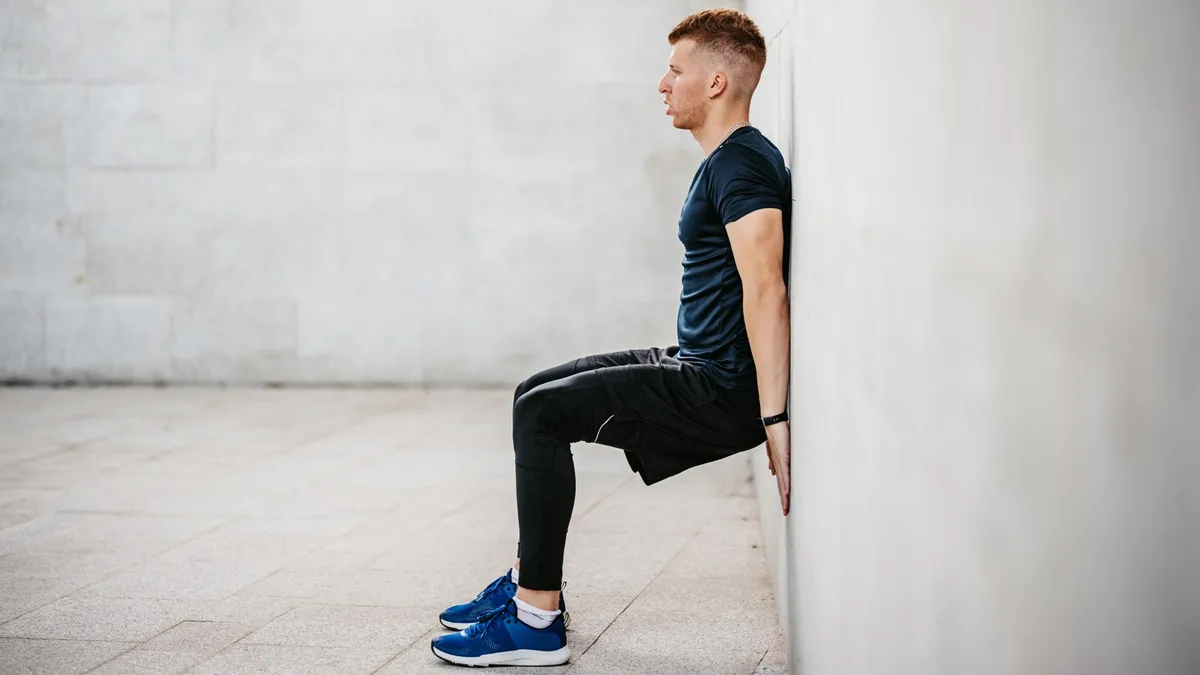
Some people are blessed with healthy joints and may never decide to try the wall sit, but for others, it's a fantastic way to access a squat hold without the impact.
Wall sits, also known as wall squats, target your quads using isometric contraction, which builds strength without any movement, meaning the muscles aren't going through flexion or extension repeatedly. This exercise also activates the glutes, core, hips, hamstrings and calves.
Avoid letting your knees push too far over your ankles, as this will make it less effective on your quads and may put more pressure on your knees. Keep your core engaged and your weight in your heels, not in your toes. To stand, press back into your heels and slide your back up the wall until you are s
This bodyweight exercise is especially great for runners, those who are currently rehabbing an injury, or anyone building up to squats. By activating the slow-twitch muscle fibers, you’re helping build endurance with or without load, but it won’t help you grow your muscles (that would require overload), so if your goal is muscle growth, consider other squat alternatives.
Some people are blessed with healthy joints and may never decide to try the wall sit, but for others, it's a fantastic way to access a squat hold without the impact.
Unlike a squat, where you have periods of work and rest, during a wall sit, you’re keeping your muscles under tension; this is known as time under tension. Try to keep your stomach braced and breathe expansively, drawing your ribcage outward to help engage your core, diaphragm and pelvic floor. You may get some trembling, which is completely normal.
Once you feel comfortable, lift a leg; this challenges balance and stability as your body must maintain the tall, upright position, and it will feel a lot harder as you place your weight into one side at a time, known as unilateral training.
Follow Tom's Guide fitness on Instagram for more workouts, routines, tips, and tricks.

Follow Tom's Guide on Google News and add us as a preferred source to get our up-to-date news, analysis, and reviews in your feeds. Alternatively, you can read our content on the Tom's Guide app available now for iOS and Android. Subscribe to Tom's Guide on YouTube and follow us on TikTok.
More from Tom's Guide
- I teach people how to be more mobile: 3 low-impact back and shoulder moves that build stability and strength after 40
- I teach people how to be strong and mobile: this is the one exercise I regret ignoring for years
- I teach people over 50 to be mobile: 3 low-impact moves that build more stability than a 30-minute walk