Garmin has launched a lot of new watches in 2025, but the most exciting of them all is the Garmin Fenix 8 Pro MicroLED, even if it’s perhaps the one people are least likely actually to buy.
The world’s first MicroLED smartwatch sits at the top of Garmin’s line-up and has an eye-popping $1,999 price tag, $700-800 more than the Garmin Fenix 8 Pro AMOLED.
As a result, it’s unlikely to prove too enticing to shoppers, but the MicroLED display on the watch is undeniably impressive and a more noticeable upgrade over the Fenix 8 Pro's AMOLED display than I expected.
In this comparison, I’ll highlight the display differences and how much of a factor they were in my real-world testing, and also go through any other differences in the two watches, like battery life.
For the most part, these two watches offer the same features, so I’ll only cover the differences below — you can get more in-depth detail on the watch in my Garmin Fenix 8 Pro review.
Garmin Fenix 8 Pro MicroLED vs AMOLED: Price and availability

Both versions of the Garmin Fenix 8 Pro launched in September 2025, and they are the most expensive Fenix watches to date. The Garmin Fenix 8 Pro AMOLED comes in two sizes — 47mm and 51mm — and costs $1,199.99-$1,299.99, which is $100 more than the standard Garmin Fenix 8.
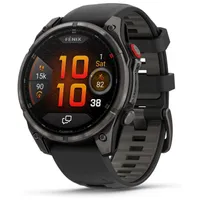
The Fenix 8 Pro MicroLED only comes in the 51mm size and is much more expensive at $1,999.99. Unlike the Fenix 8 Pro AMOLED, which made a surprise appearance in the Black Friday sales, being reduced by $100, no deals have yet cropped up on the MicroLED model of the watch.
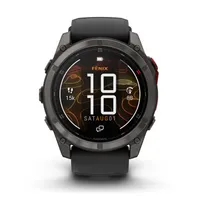
Garmin Fenix 8 Pro MicroLED vs AMOLED: Specs
| Row 0 - Cell 0 | Garmin Fenix 8 Pro AMOLED |
Garmin Fenix 8 Pro MicroLED |
Price |
$1199-$1299 |
$1999 |
Size |
47mm or 51mm |
51mm |
Thickness |
16mm (47mm), 16.5mm (51mm) |
17.5mm |
Case weight (titanium) |
56g (47mm), 65g (51mm) |
68g |
Display |
Sapphire crystal |
Sapphire crystal |
Connectivity |
LTE & satellite |
LTE & satellite |
Smartwatch battery life (raise-to-wake) |
15 days (47mm), 27 days (51m) |
10 days |
Smartwatch battery life (always-on) |
8 days (47mm), 15 days (51mm) |
4 days |
GPS battery life (all-systems) |
26 hours (47mm), 47 hours (51mm) |
16 hours |
Garmin Fenix 8 Pro MicroLED vs AMOLED: Design and display

The biggest difference between the two watches is undoubtedly the display. I’ve tested most of Garmin’s AMOLED watches, and this year, there has been a notable brightness boost across the range, and the Fenix 8 Pro AMOLED has a very clear display.
However, the MicroLED model surprised me in how much of a step up it was in terms of brightness and visibility, most notably when viewing the watch at an angle, such as when I was running and didn’t turn my wrist towards me to view my stats.

Even the always-on screen on the MicroLED Fenix 8 Pro is very bright, so it’s easy to read the time and the stats on your watch face without turning your wrist towards you.
Another benefit of the MicroLED display is that there won’t be any concerns about "burn-in," which is still a mild worry with AMOLED watches over time.
However, the drawback of the MicroLED watch is undoubtedly its size. It’s thicker and heavier even than the Fenix 8 Pro, which is already one of the larger sports watches on the market.

There’s also only one size available of the MicroLED watch, which is the largest, 51mm. I tested the 47mm AMOLED Fenix 8 Pro and would have preferred the same size in the MicroLED watch.
The size and thickness of the MicroLED model were noticeable day-to-day, and if you have thin wrists like me, it is a very big watch to have on 24/7, though you do get used to it over time.
Garmin Fenix 8 Pro MicroLED vs AMOLED: Battery life

One expected benefit of MicroLED displays in the future is better battery life, but for now, the Fenix 8 Pro MicroLED is easily outlasted by the Fenix 8 Pro AMOLED model. Even though I was testing the smaller 47mm Fenix 8 Pro AMOLED, it lasted me longer than the 51mm MicroLED watch with my use.
When running every day and with the screen set to always-on, the Fenix 8 Pro AMOLED lasts me around five days, and it would be longer if I turned LiveTrack off on activities. The Fenix 8 Pro MicroLED lasted four days between charges once running every day with the watch, though it did surpass the listed stat of four days when I was less active.
Whether you’re looking at watch mode or GPS battery life, for now, the AMOLED Fenix 8 Pro has the edge, and the 51mm watch is one of the longest-lasting AMOLED watches available from any brand.
Garmin Fenix 8 Pro MicroLED vs AMOLED: Verdict

The MicroLED display on the Garmin Fenix 8 Pro is undeniably impressive, and it’s the brightest and clearest watch I’ve tested, especially when viewing the watch at an angle.
However, right now the tech comes at too high a price compared with the AMOLED model, which is cheaper, slimmer and lighter, and lasts longer on a charge too.

I’m excited for MicroLED to potentially become the standard for Garmin watches in the future, because it’s a great display, but for now, unless you have deep pockets and thick wrists, the AMOLED Fenix 8 Pro is a better buy.

Follow Tom's Guide on Google News and add us as a preferred source to get our up-to-date news, analysis, and reviews in your feeds.
More from Tom's Guide
- Coros Pace 4 vs Coros Pace 3 vs Coros Pace Pro: Which is the best Coros watch for you?
- Apple Watch Ultra 2 vs Garmin Fenix 8: Which smartwatch should you buy?
- I wore the Garmin Fenix 8 vs. Garmin Forerunner 970 for over a week — which should you buy?