I’ve rated the Adidas Adizero Evo SL as one of the best running shoes since I tested it last year, thanks to its lightweight, versatile design. I loved using it for pretty much any kind of run, but some runners might find it lacks a little in the way of cushioning and stability.
Which is where the Adidas Hyperboost Edge comes in. The super-trainer has a much higher stack height than the Evo SL and a more stable design, and the new Hyperboost Pro foam in its midsole delivers a bouncy ride for all kinds of training runs.
Both shoes impressed me during testing thanks to their fun, versatile rides, but which is the better pick? It will come down to both your budget, the distances you regularly run, and the level of cushioning you tend to like in your shoe.
Adidas Hyperboost Edge vs Adidas Adizero Evo SL: Price

One area where the Evo SL has a big edge is price, because it costs $150 compared to $200 for the Adidas Hyperboost Edge.
It’s worth noting that the Evo SL comes in a few different versions, with the original Evo SL now joined by the Evo SL Woven and Evo SL EXO in the Adidas line-up. These three shoes have different uppers, but the same springy midsole design.
There’s also the Adidas Evo SL ATR, which is the all-terrain model of the shoe with a water-repellent upper and an outsole that offers better grip. It will set you back $160.
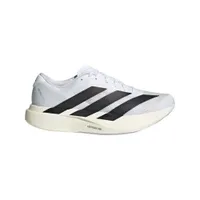
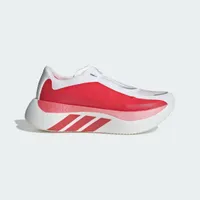
Adidas Hyperboost Edge vs Adidas Adizero Evo SL: design and fit

The Evo SL is available in a wider variety of colors and styles than the Hyperboost Edge, which is only available in red and white. There's a blue design coming in June.
I tested both shoes in my normal running shoe size and found that the Evo SL was tighter around the toes than the Hyperboost Edge. I’d consider going half a size up in the Evo SL, but stick to your normal size with the Hyperboost Edge.
Both shoes have a 6mm drop, but the Evo SL has a stack height of 39mm at the heel and 33mm at the forefoot, while the Hyperboost Edge is 45mm at the heel and 39mm at the forefoot, making it a much more cushioned shoe.
As a result of this extra foam, the Hyperboost Edge weighs more than the Evo SL. It’s 9oz in my US men’s size 9.5, whereas the Evo SL is 7.9oz in the same size.
Upper

I’ve only tested the standard Evo SL, so I can’t comment on the uppers of the Woven and EXO versions of the shoe, but I found the upper comfortable throughout testing. If you have high arches, the tongue can be hard to get in the right place, however.
The upper on the Hyperboost Edge is one of the worst features of the shoe. It’s stiff and uncomfortable around the collar, and there are a lot of overlays that make the material less flexible in general.
Midsole

Both shoes have excellent midsole foams. The Lightstrike Pro foam in the Evo SL is springy and fun, and the shoe has a small nylon shank in the midfoot to make it stiffer and speed up the transition from heel to toe.
The Hyperboost Edge introduced a new foam to the Adidas line-up called Hyperboost Pro, which is a pelletized form of Lightstrike Pro. It’s a little firmer than the Lightstrike Pro in the Evo SL, but still comfortable and exceptionally bouncy.
Outsole

The Hyperboost Edge has a full outsole made from Adidas’ Lighttraxion rubber, and should be more durable in this area than the Evo SL, which only has rubber covering the forefoot and heel of the shoe.
Both gripped well for me in wet conditions, though, and I’ve run over 100 miles in the Evo SL without seeing any significant wear and tear on the outsole.
Adidas Hyperboost Edge vs Adidas Adizero Evo SL: running performance

I’ve been using the Adidas Adizero Evo SL regularly for over a year, and it’s an exceptionally versatile shoe. I’ve done fast track workouts in it, along with tempo sessions on the road, and a whole lot of easy and steady daily training runs.
It’s very light and has a fast turnover for speed sessions, but I’ve also found it comfortable enough for easy efforts, though it's certainly not as cushioned as the Hyperboost Edge.
The Hyperboost Edge is also more stable as it has a wider base and no cutouts on the medial side of the midsole, which the Evo SL does have.
This makes the Hyperboost Edge a more comfortable option for cruising through your daily training runs, and it’s also a better option for long runs.
You can feel the bounce of the Hyperboost Edge at any pace, but it becomes even more apparent when you push to faster speeds. It’s especially good for tempo runs and long workouts, but it’s not quite as speedy as the featherweight Evo SL for shorter intervals.
I did a short run wearing both shoes at the same time, and you can really feel the disparity in the stack height. The Evo SL also feels softer and nimbler, while the booming bounce of the Hyperboost Edge is clear thanks to the depth of its midsole.
Adidas Hyperboost Edge vs Adidas Adizero Evo SL: verdict

The Adidas Evo SL is the better value pick of the two shoes, and if you like lighter, lower-stack shoes and tend to do shorter runs up to around 10K in your training, then it’s a better all-rounder in my opinion.
If you’re marathon training and regularly powering through runs of 10 miles or more, then the extra comfort and stability of the Hyperboost Edge will be a major benefit, and if you simply like more cushioned shoes in general, it’s worth the upgrade on the Evo SL.
You could also combine the shoes in a running shoe rotation, using the Evo SL for faster workouts and the Hyperboost Edge for longer runs and your daily training.
Both are great shoes, so it’s just a case of picking the one that suits your preferences and budget the best.

Follow Tom's Guide on Google News and add us as a preferred source to get our up-to-date news, analysis, and reviews in your feeds.
More from Tom's Guide