I tested 30+ electric cars in the last year — here’s the 5 most efficient EVs under $40,000 you can buy right now

If you haven’t noticed, gas prices are at their highest levels in a year — and they show no signs of receding. According to AAA, the average price of regular unleaded in the U.S. is $4.12 per gallon, which is a staggering increase over the $3.18 average this time last year. This trend will only hit consumers harder as we head into the summer driving season.
That’s why I suggest considering an electric vehicle for the long-term savings. While EVs still have higher upfront costs, prices have dropped over the last year as more affordable models hit the market. However, price shouldn't be your only metric because efficiency is just as critical to an EV's true value.
After testing more than 30 EVs in the last year, these are the most efficient models you can buy for under $40,000 right now.
What you need to know
For a long time, the average price of an EV hovered around $50,000. That’s still a stretch for many, which is why anything under $40,000 is currently considered budget. You'll likely still face a higher upfront cost compared to gas-powered equivalents, but the true savings come from charging at home, where electricity costs are significantly lower than the pump.
While there are still some EVs with MSRPs starting under $30,000, these base trims often lack the convenience features I typically see at the $40,000 mark. This is a crucial distinction because while you could pay less upfront, you might regret not stepping up to the next trim level for essentials like adaptive cruise control or 360-degree cameras.
Finally, it’s important to understand how efficiency plays a role in your total cost of ownership. The more efficient an EV is, the less you’ll pay for every recharge. Even if two EVs have identical battery sizes, the more efficient model will go farther on a single charge and cost you less over the life of the vehicle. For each vehicle, I’ll also tell you how much it costs to charge them at a residential location based on a rate of $0.18 per kilowatt-hour (kWh).
Toyota bZ


- MSRP: $37,900
- Price tested: $40,468
- Average efficiency tested: 5.4 mi/kWh
- Cost to charge: $13.45
The Toyota bZ is one of the most improved EVs I’ve tested all year, representing a massive step forward from its predecessor, the bZ4X. It’s rare to see a manufacturer actually lower the MSRP year-over-year, but what’s truly staggering is the efficiency. This all-electric crossover averaged 5.4 mi/kWh during my time with it, making it the most efficient EV I’ve ever tested.
That efficiency is even more impressive considering the bZ offers a spacious cabin and a sizable trunk. While Toyota officially estimates a 314-mile range, my real-world testing suggests it could go significantly farther on a single charge.
Read our full review: Toyota bZ
Nissan Leaf EV


- MSRP: $29,990
- Price tested: $41,930
- Average efficiency tested: 3.6 mi/kWh
- Cost to charge: $13.50
Who says EVs can’t be edgy? The redesigned Nissan Leaf proves they can, finally receiving a long-overdue makeover that trades its dated look for a modern, sharp aesthetic — all while maintaining an eye-catching starting MSRP of $29,990.
That price climbs to $41,930 for the Platinum+ trim I drove for a week. While that's a significant jump, the added features make a compelling case for the upgrade — like it stacked rectangular taillights, electronic glass roof, power liftgate, head-up display, and adaptive cruise control all add a premium feel. Most importantly, it remains a practical daily driver, averaging 3.4 mi/kWh in my real-world testing.
Read our full review: Nissan Leaf EV
Chevrolet Equinox EV
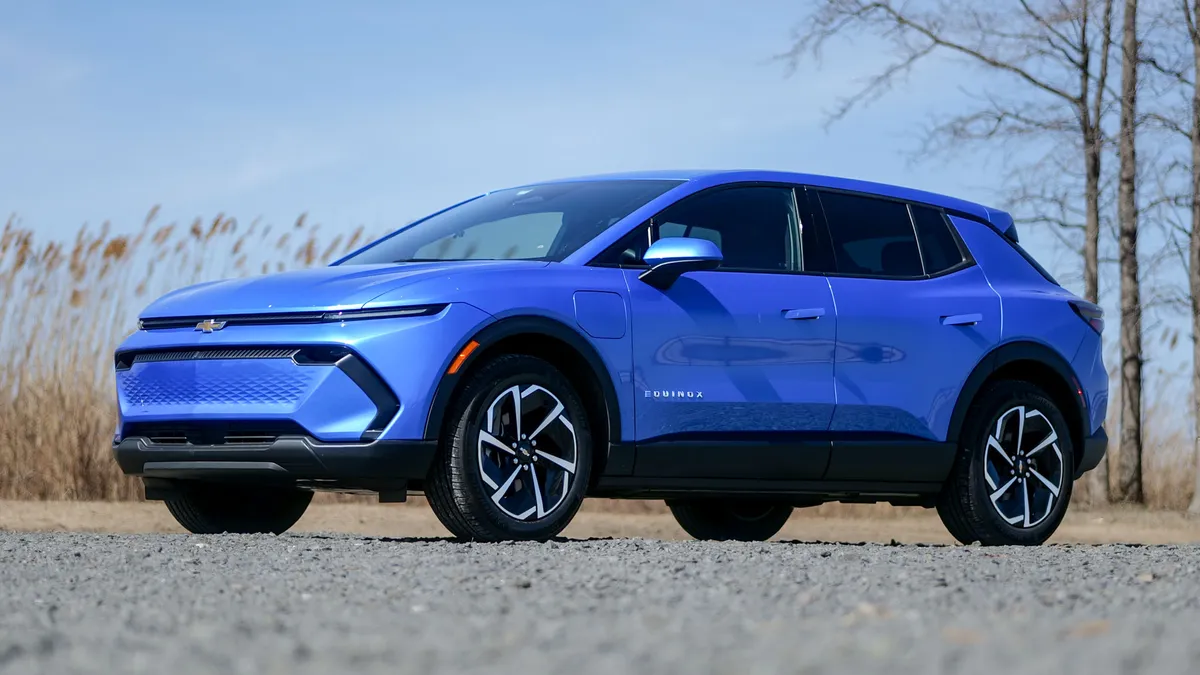


- MSRP: $35,995
- Price tested: $35,995
- Average efficiency tested: 3.5 mi/kWh
- Cost to charge: $15.30
The Chevrolet Equinox EV was one of the first budget-friendly models to prove that you don’t have to sacrifice range or efficiency to hit a low price point. In my testing, even the $35,995 base trim delivered a respectable 3.5 mi/kWh — an impressive feat for a compact SUV of this size.
While the entry-level model lacks some of the premium amenities found in other EVs on this list, it doesn't compromise on interior space. If you're working with a tight budget and don't mind trade-offs, like manual seats and the lack of a wireless phone charger, the Equinox EV is a highly capable choice. Additionally, its styling is more approachable and contemporary — perfect for drivers who aren't fans of the ultra-futuristic spaceship look.
Read our full review: Chevrolet Equinox EV
Fiat 500e


- MSRP: $30,500
- Price tested: $35,500
- Average efficiency tested: 4.28 mi/kWh
- Cost to charge: $7.56
City dwellers will find the Fiat 500e perfectly suited to their needs for several reasons, most notably a compact footprint that makes it a breeze to park. As the smallest EV currently available in the U.S., it's uniquely equipped to handle the stop-and-go nature of urban traffic, where it averaged an impressive 4.28 mi/kWh in my testing.
While you certainly sacrifice interior and cargo space, don’t be fooled by this EV's small stature. Beneath its compact exterior is a punchy electric motor that delivers a surprisingly sporty and responsive driving performance.
Read our full review: Fiat 500e
Hyundai Kona Electric


- MSRP: $32,975
- Price tested: $39,880
- Average efficiency tested: 43 mi/kWh
- Cost to charge: $11.66
Finally, we have the Hyundai Kona Electric. This all-electric subcompact SUV offers an engaging driving experience with deceptively quick acceleration. While it starts at a lower price point, the N Line trim I tested for a week — which features a more aggressive front grill and a performance-tuned feel — comes in at $39,880.
I will say that the rear seats are a bit cramped, but the sporty interior aesthetics, including the bucket seats, are a nice touch. Even with its pep and power, the Kona Electric N Line still averaged an impressive 4.3 mi/kWh. I expected its efficiency to suffer due to its sportier nature, but the results completely caught me by surprise.
Read our full review: Hyundai Kona Electric

Follow Tom's Guide on Google News and add us as a preferred source to get our up-to-date news, analysis, and reviews in your feeds.
More from Tom's Guide