Samsung — the brand whose name is synonymous with QLED — might be leaving the popular TV type in the dust.
According to a recent report by the South Korean outlet ETNews, Samsung is in the process of drastically reducing its production of QLED TVs, and could potentially phase them out entirely by 2028.
In recent years, many of Samsung’s best TVs have carried the QLED designation, and it’s a dramatic shift for a company that once fought tooth and nail for QLED supremacy. But if this is truly the path Samsung has chosen, there could be a silver lining for future TV shoppers: cheaper Micro RGB TVs.
Samsung put QLED on the map — but then the map changed

Let's start with the bad news: Samsung's QLED reduction plans could see production drop by 80%, as it’s dropping from 10 million units down to just 2 to 3 million. By 2028, all Samsung QLEDs — including Neo QLEDs — could be TVs of the past.
Samsung gets credit for popularizing the term 'QLED' as a means of describing what it viewed as a core feature.
While many popular brands offer quantum dot-enhanced TVs, Samsung gets credit for popularizing the term “QLED” as a means of describing what it viewed as a core feature.
In recent years, Samsung even expanded its lineup to include Neo QLED TVs. Initially, the term referred to quantum dot-enhanced sets that leveraged Mini-LED backlighting with full-array local dimming — the best-performing, non-OLED TVs in Samsung’s catalogue.
Unfortunately, Neo QLEDs are on their way out and, worse, some Neo QLEDs have even dropped hardware-based local dimming.
But QLED's slow demise isn't all gloom and doom: 2026 marked the first year that Samsung’s Micro RGB TVs sat at the top of its LED lineup. These souped-up Mini-LED TVs use red-, green- and blue-colored backlights to enhance color rather than quantum dots.
In retrospect, Samsung's restructuring of the Neo QLED lineup dovetailing with the release of its two first Micro RGB TVs should’ve been a strong indication that the former was on its way out.
This leaves somewhat of a vacancy in the mid-range-to-high-end, non-OLED section of Samsung’s portfolio. And the candidate that makes the most sense to fill that space is Micro RGB.
Analysis: Micro RGB expansion will lead to cheaper Micro RGB TVs

To my eyes, of the many brands taking a swing at RGB LED technology, Samsung’s Micro RGB tech is second only to Sony’s True RGB.
It’s just as important that the production of Micro RGB TVs gets more cost-effective than that the tech improves at the highest end
It takes a well-engineered combination of nimble hardware and intricate processing for a complex arrangement of red-, blue- and green-colored LEDs to properly harmonize, and Samsung seems to have figured it out.
The next step, then, is to expand. For Samsung, it’s just as important that the production of Micro RGB TVs gets more cost-effective than that the tech improves at the highest end.
There are two Micro RGB TVs available to the average consumer this year: the Samsung R85H and the flagship R95H. At the time of publishing, the 55-inch, entry-level R85H is the most affordable path to Samsung Micro RGB, but $1,199 is not cheap.
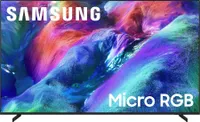
If Samsung does, indeed, phase out its QLEDs, then garden-variety, non-quantum-dot LED TVs will represent the cheapest tier of Samsung’s lineup. Some, I assume, will tap Mini-LEDs.
By the time this comes to pass, it would be shocking if Samsung's Micro RGB TV lineup hasn’t expanded beyond just a pair of (rather pricey) sets. After all, it took a few years, but Samsung now offers three tiers of OLED TV per year. When it first returned to the OLED scene, Samsung only sold one model.
There’s nothing stopping Hisense, Sony and TCL from continuing to tinker with quantum-dot color for the foreseeable future, either. Things could change in a hurry, but from where we’re sitting right now, TCL seems to be all-in on Super Quantum Dot (SQD), the brand’s newest spin on an old formula.
It may be bittersweet to say goodbye to our old friend QLED, but if Samsung plays its cards right, it could bring RGB LED technology to the masses before anyone else — just as it did with quantum dots once before.

Follow Tom's Guide on Google News and add us as a preferred source to get our up-to-date news, analysis, and reviews in your feeds.
More from Tom's Guide
- Samsung TV report card 2026: 'You can rely on Samsung to deliver exceptional performance'
- Are flagship Mini-LED TVs on their way out? Here’s how RGB LED technology is already reshaping the industry
- TCL is suing Samsung for false advertising on its Mini-LED TVs — here’s how to tell if your TV is included