At the start of the year, I upgraded our household blender from a regular non-brand contraption we picked up at the local Aldi to a Nutribullet Ultra 1200. The benefits were that it was easier to clean, looked a lot nicer, and blends your ingredients straight into the shaker you can drink from.
Over six months later, I decided to return to the pair of them (we haven't got rid of the old one; it's good to have a spare) to put a little bit more testing on the table.
Part of this, I admit, is due to selfishly wanting to mix up my smoothie game. I'm guilty of going back to the same old recipe time and time again and, with summer here, I'm feeling the need for a change.
Secondly, although I swapped to the Nutribullet without a second thought — was I giving my old blender its due? What if I fed both machines the exact same ingredients and measured them directly in a head-to-head? Which would really come out on top?
There are a ton of things the Nutribullet does better: it's objectively smaller, lighter, simpler to use and comes with a better warranty. But I was surprised at a couple of outcomes from this experiment if I'm being totally honest. I'll spoil the big one for you now: I couldn't tell the difference when it came to tasting the final product.
But we're getting ahead of ourselves. Read on to discover just what I found out from my budget vs. premium experiment.
The recipe
The wonderful thing about smoothies is they're uncomplicated. Pick stuff you like, throw it inside one of the best blenders, and chances are it'll come out alright. But this test had to be scientific, so here are the exact ingredients I used with both machines:
100g strawberries (~1 cup, yields a thick texture and rich color)
50g ripe banana (~1/2 medium banana, sliced)
100g strawberry flavored Greek yogurt (~½ cup)
180ml milk (~¾ cup)
1 tbsp of honey
Note that both of these machines are blenders and not bespoke juicers. Here's a complete rundown of the differences, but in a nutshell, juicers squeeze and extract the juice from fruits and vegetables. A juicer breaks down the fruit by separating the pulp, peel/skin, and seeds from the fruit, as the juice flows out through a sieve.
Blenders, on the other hand, pulverize all of the ingredients together. Think of them as a sledgehammer rather than a scalpel.
The blend
Forget just throwing the above ingredients into the pot without a care. This is the process I followed with both blenders — just to make sure I did what I could to make the experiment fair.
- Add liquids and soft ingredients first: Pour in the milk and spoon in the Greek yogurt. Placing liquid at the bottom helps the blender blades turn smoothly without getting stuck on the fruit.
- Layer in solids and the fruit: Next in went the banana slices, chopped strawberries, and finally I added the honey.
- Blend on high power for 30 seconds (I used my trusty Casio stopwatch to make sure they each got the same time)
- Pour out and enjoy
The result

I appreciate you can't taste the results of my experiment through the screen, but as I said at the outset. I didn't notice any difference in taste in the final product. If pressed, I would say the $129 result was a fractionally smoother than the cheaper alternative. Maybe my smoothie chops aren't what they used to be, but my takeaway is that if all you're interested in is the consistency and the taste of the final result, the cheap option will do you proud.
Also despite costing more and supposedly being quieter (Nutribullet says 87dB), the more expensive blender was louder than the budget one. It's more powerful 1,200W vs 600W and that showed when the noise level just crested 100dB for the Nutribullet compared to 99dB for the Blaupunkt. I know this is nitpicking, but I still wanted to mention it.
The Nutribullet uses a 6-point titanium-coated extractor blade rather than a 4-point one in the $30 Blaupunkt. But it's also got a lower capacity (32oz vs 52oz), so if you're mixing smoothies for a family or to batch, that may play a factor. Those two elements come in clutch because there were definitely some lumps left in the bottom of the jug on the cheaper blender when I poured out the drink.

Whereas I put the contents into a glass for the sake of this article, normally I would just cap off the Nutribullet shaker and be on my way. Similarly, I cranked the Blaupunkt all the way to five on its antiquated knob rather than the simple on/off capacitive touch of the Nutribullet.
And, last but by no means least, cleaning the Nutribullet was a simpler, quicker affair than my old budget blender.
So, both got the job done — one just did it with a little more style than the other.
Final thoughts
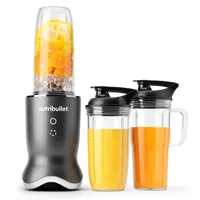
This little experiment has reinforced what I felt about leveling up blenders back at the start of the year. When it comes to the nuts and bolts of the taste of the final product, there's no difference — at least for someone with my unrefined palate.
Moreover, I can put up with a bit of noise for 30 seconds, so the fact my Nutribullet was louder than advertised is also something I can overlook.

But, all the other aspects of using a blender were far superior with the more expensive model. I like that: a) it takes up less countertop space, b) it doesn't take as long to clean, c) it comes with a dedicated shaker for less fuss c) it genuinely just looks cooler and d) if it breaks, I can claim on the warranty for longer.
Are those advantages worth $100 more? For my current lifestyle: yes. If you'd have asked me years ago when I was a student watching every dime I spent, then probably no.
The lesson I learned here was that despite our constant fixation on the end result, there's more to choosing a product than what it delivers. Less destination, more journey.
Of course, what works for me might not work for you. I happen to value how easy and quick the Nutribullet is to use so that makes the extra $100 worth it. Do you agree or not? Let me know in the comments below.

Follow Tom's Guide on Google News and add us as a preferred source to get our up-to-date news, analysis, and reviews in your feeds.
More from Tom's Guide