If, like me, you grew up in the 90s and 00s, you'll no doubt be familiar with 'As Seen On TV' home gadgets. Products whose main selling point was that they'd been demonstrated on TV sales networks or infomercials — because as we all know, that's a guaranteed marque of quality.
Recently, I got thinking about whether or not any of that tech is still knocking around, and whether it still holds up. Turns out the answer is yes! There are still loads of 'As Seen On TV' gadgets you can buy, some of which you can still get new. Surely, that means they're actually pretty good, right? After all, why else would they still be being made?
So, I used up some of the Tom's Guide testing budget (sorry Editors In Chief) to buy a few familiar infomercial fads from the last 20 years. Here's whether they're still worth buying.
1. George Foreman grill

Tagline: "The Lean, Mean, Fat-Reducin' Grillin' Machine"
I mean, come on: there had to be a George Foreman on the list! These grills are an absolute classic infomercial product in the 90s and 00s, and a huge success (reputed to have sold over 100 million units).
These grills were absolutely everywhere when I was growing up in the mid 90s. My parents got one in the late 90s, as they took a little while to blow up in the U.K. (where I live) after initial success in the States. Perhaps unsurprisingly then, you can still buy George Foreman grills new in 2026!
How it holds up in 2026
Back in 1998, I remember our family George Foreman grill felt like a serious piece of cooking gear. Maybe that was because I was 6 years old — I never actually cooked on the George, and wouldn't have known the difference between good and bad kitchen tech anyway.

Still, I was a little disappointed on picking up the 2026 model. It feels rather cheap and flimsy. At $39 (or £49 in the U.K.), our 2026 George Foreman cost $10 less than it would've in the late 90s — but that's at face value. Given inflation though, the $49 it would've cost in 1997 works out at $104 today. That means they've more than halved in adjusted value, so I guess it makes sense for this to feel like a cheap product.
But what about performance? It's much the same as it ever was. In fact, using the Foreman for this test brought up some repressed memories of my childhood that I'd rather have stayed forgotten.
I cooked a strip steak (sirloin in the U.K.) on the grill for 2 minutes, as recommended by the instructions for medium rare. It was undoubtedly the most miserable steak I've eaten since my the steaks my parents used to cook on our family Foreman way back when.


Despite showing it was at temperature, the George didn't get very hot. As such, it managed to undercook the outside while overcooking the inside. Because the fat had no contact with a cooking surface, it didn't render at all. And because the lid was on top of the steak, it got flattened. Yup: this is exactly how I remember steaks growing up. Maybe I became a chef (before becoming a journalist) as a subconscious attempt to exorcise all the awfully grilled meat I ate growing up.
The benefit of Foreman grills was always that they were Lean, Mean, Fat-Reducin' Grillin' Machine(s). You don't need any cooking oil or fat because the grill plates are nonstick. And any fat leaking out of the food drains away thanks to the grill's downward angle.
That's such a 90s/00s way of looking at food. As an ex-chef, I know (as I'm sure you do) that fat is full of nutrients and can be healthy. You don't want it all running off, but you do want it rendered. I also found that caramelized meat juices were running down the grill into the fat tray, pulling frond with them, again wasting flavor.
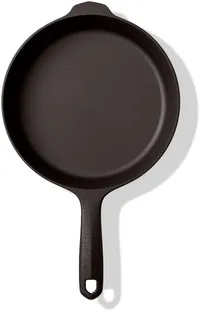
I suppose it's not a terrible grill if you're on a budget and don't care about developing good sears. But for me, it's a pass. I'll stick to my Field Company No.10 Cast Iron Skillet for steaks, thank you very much.
Score: 2/5
Worth is in 2026? Nah
2. Pocket Hose

Tagline: "The Hose That Grows & Grows"
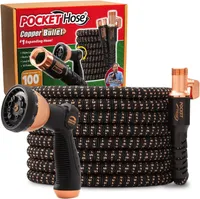
Pocket Hose launched in the early 2010, but caught on thanks to its high energy informercials and excitable host. Fun fact, he's still doing the Pocket Hose commercials in recent times!
Marketed as "The Hose That Grows & Grows," the benefit of the Pocket Hose is that, when there's no water in it, you can store it much more easily than a conventional rubber hose. As the Pocket Hose is wrapped in fabric, with a soft inner core, it coils up easily and can simply be left in a pile. Then, when you supply it with water, it grows and unkinks — this effectively removes the need for a reel.
How it holds up in 2026


Y'know what, I'm converted (in theory). I ride a motorcycle and need to clean my bike quite a bit. It's a pain constantly having to reel in the hose from my lawn, pass it over the side gate, then reel it back in when I'm done.
The Pocket Hose has genuinely made my life easier. It's way easier to move about the yard and over my gate; it doesn't need reeling in; and it takes up much less space when left on the floor than a rubber hose.
Also, this thing holds pressure. So much that I was able to shoot a jet of water nearly twice the distance as my normal rubber hose, using the same spray nozzle. I was actually kinda worried the Pocket Hose would burst while testing, as you could see the pressure building inside.
My only issue is that I bought an original retro version from the early 2010s, which uses plastic connectors. These really suck and were prone to leaking. I would definitely advise upgrading to the copper models for more security from leaks.
Score: 4/5
Worth it in 2026? Definitely
3. Slap Chop

Tagline: "Making America Skinny, One Slap At A Time"
Oh man. Oh lord. That tagline really hasn't aged well. It's just... I have no words. The 00s was a crazy, crazy time.
Slap Chop featured in some classic TV sales network infomercials with the blue-aproned, Britney-mic'd Vince Offer (A.K.A The ShamWow Guy). "You're gonna be in a great mood all day 'cos you're gonna be slappin' your troubles away with the Slap Chop," promised Vince back in 2008.
It's pretty self-explanatory what the Slap Chop does. Put some stuff inside it, slap the top, and it chops instantly. And the more you slap, the finer the dice. The Slap Chop promised to speed up prep massively.
How it holds up in 2026


Just like that eating-disorder-plus-domestic-violence-loaded tagline, the Slap Chop doesn't stand up today. With certain foods, it made my life easier. It was OK for chopping potatoes, for instance.
Anything remotely moist, though, such as onions, and the slap chop would get stuck at the bottom. The spring underneath the slapping plunger just isn't taught enough. It's messy, too. Bits fly everywhere when you adjust food or lift up the device to get stuff out.
On, and it also cuts unevenly. You can get around this to some extent by slapping repeatedly until everything is more or less minced, but you're still left with some pieces tinier than others. That means your food will cook unevenly.


Food gets stuck in between the blades. And unless you cut stuff to the perfect size, the Slap Chop won't work. The perfect size being pretty tiny — half an onion, a fifth of a potato, etc.
In the end, I had to mess around so much with sizing and cleaning out the blades that it would've just been quicker for me to use a knife.
Now, granted, I am an ex-chef and am very quick at dicing vegetables. If you're completely unaccustomed to knives and chopping techniques, the Slap Chop will probably save you time. However, it cost us $25 / £20. In the U.S. at least, you can pick up a super cheap electric dicer for less than that — that'll be event quicker, less effort and can handle bigger amounts of food.
Score: 2/5
Worth it in 2026? Nah, go electric
4. JML Scrub Buddi

Tagline: "The handheld scrubber that does all the scrubbing for you"
I don't think this one made it to the States, so allow me to introduce the JML Scrub Buddi. For my American readers, JML is a household name in Britain. Imagine every cheap, crappy infomercial/As Seen On TV product was made by a single brand, and you have JML.
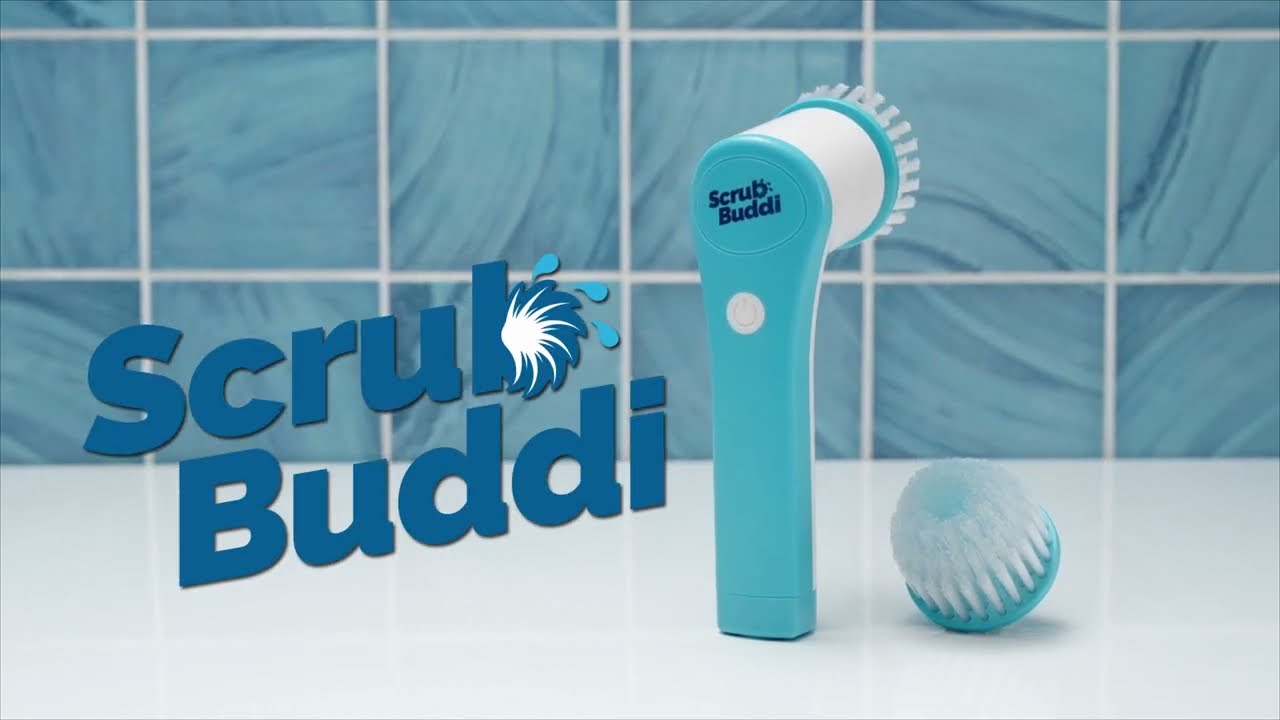
The Scrub Buddi is a motorized scrubbing brush from JML, and one of those products they'd show being demonstrated on daytime shopping channels. It's intended for cleaning sinks, bathrooms, kitchen surfaces and even car alloy wheels. Basically, it provides effort free agitation of cleaning products, as well as mild abrasion.
How it holds up in 2026
I absolutely love the Scrub Buddi. It's genuinely really, really useful. My wife and I live near Bath Spa in the South West of the U.K., which is built on top of a limestone seam.
As such, we have some of (if not the) hardest water in Britain. Indeed, Bath has been a spa town since at least Roman times precisely because of the minerals in the water. Little did the Romans know, those minerals are terrible for your hair.

Anyway, all that means we have a limescale problem here. Our appliances die unless they're descaled. Our electric kettles have literal stalagmites growing up inside them before long. And our sinks and bathroom surfaces are usually tainted by limescale residue.
The Scrub Buddi has been absolutely awesome for removing limescale on faucets and chrome surfaces. Even without using limescale remover, it provides enough abrasion to leave metal surfaces sparkly. I'm not sure how long it would've taken me to get the same results by hand.
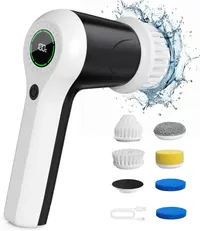
Admittedly, it's not as effective on glass as on metal. But hey, anything that'll lighten the burden of housework at least a little is fine by me. The Scrub Buddi is also water resistant and these days it's rechargeable via USB-C!
We paid £11 for our Scrub Buddi, and I think that's a bargain. In the U.S., you can pick up an Amazon-special version for like $25 at Amazon.
Score: 4.5/5
Worth it in 2026: Hell yeah!
5. SodaStream

Tagline: "Get Busy With The Fizzy"
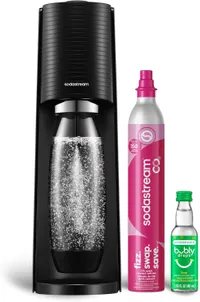
OK, this is an oldie! The SodaStream actually launched in the 50s, and I know loads of people who still use these in the U.K. and Europe (my parents included). I'm not sure whether these were a hit in the States, though.
Sodastream had some iconic marketing campaigns in the 80s and 90s, and I remember them having a resurgence in popularity in the 00s here in Britain. If you're unaware, SodaStream uses gas canisters to carbonate your drinks and make them fizzy. Homemade soda.
How it holds up in 2026

Y'know, there's a reason the SodaStream has stuck around since the 1950s. I'd never actually used one before testing for this article, but I'm a convert for sure.
If you don't like sparkling water, the SodaStream isn't worth it. Even when you add flavorings (you can buy big-brand syrups from the likes of Pepsi), you still get that bitter sparkling water taste.
If, like me, you'd rather drink sparkling than normal water, the SodaStream is for you. Why spend money on store-bought fizzy water when you can just make it yourself in seconds? You can also add natural flavorings like sugar, lemon etc, to make your water taste how you like, safe in the knowledge that no artificial additives or flavors have been used.

Best of all, carbonation is an analog process. You simply load in a gas tank and you're ready to connect the bottle and go. That means there's no need to plug the SodaStream into power, so you can put it anywhere. I test a lot of kitchen gadgets for work, so my worktops are already full. I simply stuck the SodaStream on a side stand.
We paid $52 / £59 for our basic SodaStream, which includes a single gas canister that's good for 60 liters of drinks. Each 60L canister costs around $34 / £20. That means each 500ml glass of sparkling water costs you about 28 cents / 16 pence. Goodbye, San Pellegrino.
Score: 5/5
Worth it in 2026? Hell yeah (if you like sparkling water)
What's next?

You tell me! There's no way I could cover all the As Seen On TV products out there. Are there any important ones I've missed? If so, I'd love to hear about them. I know the Ronco Rotisserie is an obvious choice. It's tricky finding one here in the U.K., but that's next on my agenda.

Follow Tom's Guide on Google News and add us as a preferred source to get our up-to-date news, analysis, and reviews in your feeds.
More from Tom's Guide