Going into Lance Oppenheim and Nathan Fielder’s documentary “You Can See Everything,” I was dealing with mixed expectations. I think Oppenheim is one of the most talented documentary filmmakers currently working, thanks to feature films “Some Kind of Heaven” and “Spermworld” and HBO series “Ren Faire.” But I can’t stand Fielder and his prank-style cringe-comedy reality shows “Nathan for You” and “The Rehearsal.”
So despite the over-the-top positive reactions from early film festival screenings, I wasn’t sure how I would respond to the duo’s film about convicted fraudster Elizabeth Holmes.
- Rating: 3.5/5 Stars
- Verdict: “You Can See Everything” is a bold, innovative documentary from alt-comedy creator Nathan Fielder and nonfiction filmmaker Lance Oppenheim, offering a fascinating look at convicted fraudster Elizabeth Holmes. Fielder and Oppenheim find new ways to examine the evasive and mysterious Holmes while also questioning their own motives as documentarians.
- Where to watch: Opens in theaters Oct. 16
Although Fielder’s onscreen presence is prominent, especially in the second half of the nearly three-hour movie, “You Can See Everything” feels more serious and less smug than his TV shows, perhaps because the often manipulative Fielder is facing someone nearly as manipulative as he is, if not more so. Oppenheim’s familiar oversaturated visual style is toned down a bit, but “You Can See Everything” still looks more cinematic than Fielder’s TV shows, and even before the movie starts relying heavily on re-enactments, it has a docu-fiction feel, as Oppenheim has employed in his past work.
As someone deeply skeptical of Fielder’s persona and vision, I found myself mostly engrossed by “You Can See Everything,” particularly during the first half, in which Fielder spends time with Holmes and her husband, Billy Evans, in the month before her incarceration. It may not be one of the greatest documentaries ever made or a contender for the first documentary to be nominated for a Best Picture Oscar, but it’s still fascinating and ambitious, offering a fresh take on a news story that has already received extensive pop-culture coverage.
‘You Can See Everything’ is a character study of an inscrutable character
The movie begins in 2023, 34 days before Holmes is set to begin her 11-year sentence in federal prison for defrauding investors in her medical start-up Theranos. Although she hasn’t spoken to the press in years, Holmes and Evans invite Fielder and Oppenheim into their San Diego, California, home with theoretically unrestricted access, even allowing Fielder to stay in the guest suite. The couple, who have two young children, are a mesmerizing combination of transparent and evasive, theoretically answering all of Fielder’s questions while avoiding any sense of accountability or self-reflection.
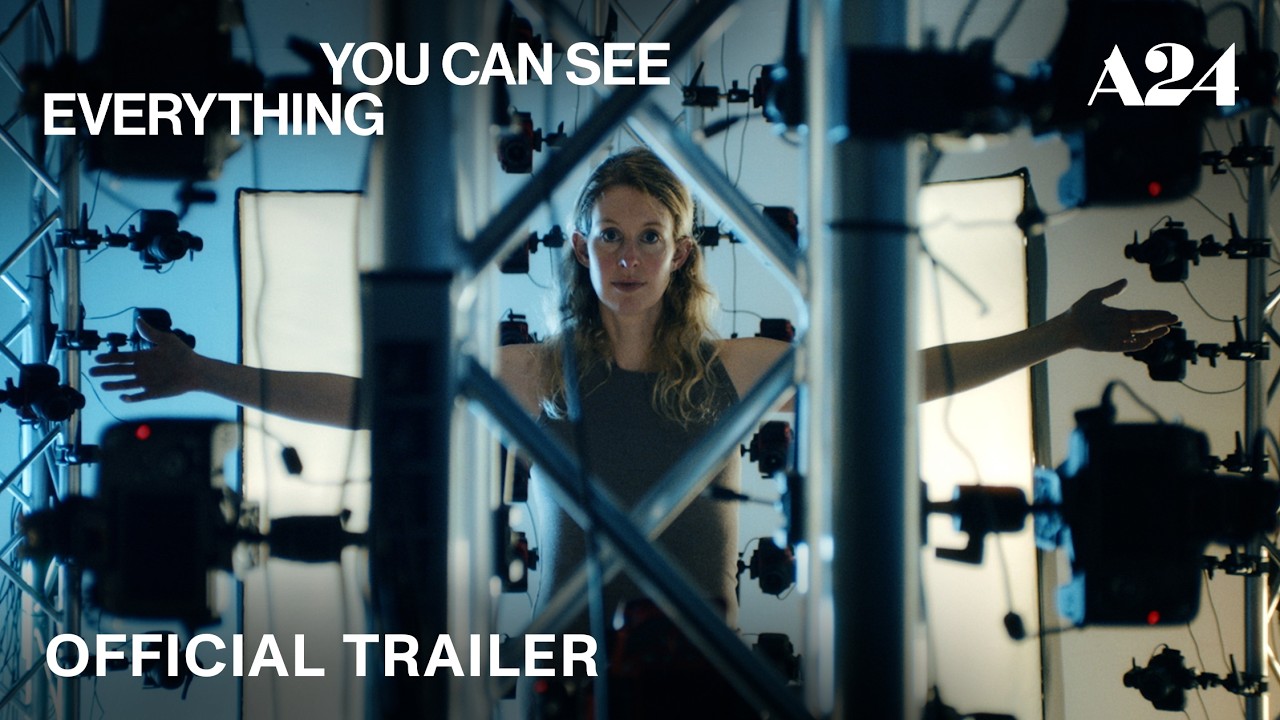
Holmes steadfastly maintains her innocence, in a matter that is either naïvely sincere or deviously deceptive, and even Fielder can’t figure out which one it is. Evans is much easier to read, and he increasingly comes across as the villain, someone who’s using Holmes’ infamy to further his own hunger for recognition, even though he comes from a wealthy family and Holmes is essentially broke after her criminal convictions.
While Fielder is known for concocting elaborate, multilayered scenarios around his often unwitting subjects in his TV shows, no such subterfuge is necessary here. All he has to do is ask some basic follow-up questions in order to get Holmes and Evans to reveal their deranged perspectives, which they seem unable to view as anything but normal.
There’s a stunning sequence in which Fielder shows the couple the classic Abbott and Costello routine “Who’s on First?” as a way of illustrating his frustration with Holmes’ opaque responses, and she completely fails to understand the core concept behind one of the most famous comedy bits of all time.
‘You Can See Everything’ falters when it gets more meta
At the halfway point, “You Can See Everything” shifts gears into a different sort of movie, one that more closely resembles Fielder’s work on “The Rehearsal.” With Holmes now in prison, Fielder has no way to continue interacting with his subject, and his relationship with the belligerent, controlling Evans becomes more and more combative. So Fielder and Oppenheim bring in a ringer, a famous person closely associated with Holmes who provides a welcome outside point of view and also allows the filmmakers to re-enact scenes with Holmes that they can’t film.

Those re-enactments aren’t quite as illuminating as the filmmakers make them out to be, and Fielder falls back on the kind of self-congratulatory cleverness that can make his TV shows uncomfortable and unpleasant to watch. Still, he’s well-matched by both Holmes and his later onscreen collaborator, who push back in ways that the ordinary people he’s targeted on TV are unable to do.
The co-star in the film’s second half is being treated as a spoiler, but her open, enthusiastic participation would be a more effective marketing tool than the dueling creepy stares of Fielder and Holmes.
Verdict: ‘You Can See Everything’ is a bold take on a well-worn subject
After the hit Hulu series “The Dropout” and director Alex Gibney’s documentary “The Inventor: Out for Blood in Silicon Valley,” not to mention the books, podcasts and news magazines, it would be easy to assume that there’s nothing left to say about Holmes and her crimes. But Fielder and Oppenheim confidently counteract that assumption by merely spending time with this strange, intense woman, whose often unblinking gaze and odd manner of speaking are unsettling all on their own.
Does “You Can See Everything” belong on the list of the best documentaries of all time? No, and the way it captures a specific moment in the news cycle means that it may look dated within a few years. But it’s certainly one of the most striking documentaries of 2026, created by filmmakers who aren’t afraid of taking chances and looking foolish.
The ironic distance of Fielder’s other work melts away in the face of such a bizarre, unknowable subject, and that makes the movie more challenging and more rewarding.
“You Can See Everything” opens Oct. 14 in theaters

Follow Tom's Guide on Google News and add us as a preferred source to get our up-to-date news, analysis, and reviews in your feeds. Subscribe to Tom's Guide on YouTube and follow Tom's Guide Entertainment on TikTok and Instagram.