Let me be clear from the top. If you are looking for the raw benchmark data, the thermal charts and synthetic scores for Nvidia’s RTX Spark, you can head over to my live blog running right now.
…ok are all the speeds and feeds people gone? Good, because while I’m over there doing the math, and everyone else on the internet combs over the numbers, data doesn’t explain what it actually feels like to use a machine with a locally hosted AI brain.
You have to unlearn years of cloud-tethered habits (like relying on a browser-based chatbot tab) and start treating your operating system like an overly eager digital intern. And over the past few days, I found this out and quite frankly, it’s a bit of a breakthrough.
So, before you dive into the frame rates, here is a diary of my first week ditching the M5 MacBook Pro, and living exclusively on an Microsoft Surface Laptop Ultra with RTX Spark (and 128GB of unified memory).
Day 1: The Sims 4 disaster (and a lesson in patience)

I returned from the Surface Laptop Ultra event in San Francisco pretty late, but I didn’t feel tired. I was caught up in the excitement of tearing this machine out of the box and seeing what it could do.
And my first test? Nothing to do with productivity. Instead, I installed Hermes agent with Qwen 3.8 Flash Next to play The Sims 4 — build a house and get a job.
Now with that out the way, this first test did not instill me with immediate confidence in Nvidia’s vision of a local agentic future. The AI fumbled around, got lost in the house building menu, and when I got it to the point of having a home roughly three hours later, it managed to start a kitchen fire.
Throughout that time, my prompts to the agent grew more frustrated, and it repeatedly made the same mistakes — forgetting that the graph of co-ordinates keeps moving with the character in the center of the screen and going round in circles.

But watching it stumble taught me a crucial lesson in local reinforcement learning. I had another go in the morning with a calmer head, continued to tell it when it was doing the right thing, encouraging it to keep going and we made it to the first gym.
You see, interacting with a local agent isn’t like querying a search engine or talking to a cloud frontier model; it’s exactly like playing two-player Portal 2 with my eight-year-old nephew. You can’t get frustrated when he jumps into the water and dies for the 5th time. You have to give him the carrot, not the stick — guide with positive reinforcement and structured boundaries.
Once that clicked in my mind and my behavior changed, learning how to actually “parent” the agent immediately skyrocketed the output quality. And that’s when I truly got to work.
Day 2: The butler arrives

By the next day, I booted up the Hermes agent and built a set of custom skills. I hooked it directly to my personal Google Workspace API, and for my Tom’s Guide account (Future locks down API access pretty tightly), I set up a script allowing it to physically operate my browser.
There’s a noticeable speed advantage in AI between RTX Spark systems and trying Hermes Agent on my MacBook Pro.
I named it Jeeves, and every morning, I just write “check-emails” and it gets to work across both accounts — reading my inboxes, deleting anything unnecessary (like marketing emails or phishing scams), drafts surprisingly human responses to those that are important, and generates a prioritized to-do list for my workday based on emails and Slack.
Now I know what you’re thinking. Isn’t this possible on other machines? Yes. Hermes is an agentic machine that works across Macs and other Windows PCs too (including AMD machines and we all know how they feel about the RTX Spark hype).
But Nvidia’s GPU is the key advantage here, and it comes down to CUDA (which stands for Compute Unified Device Architecture). Basically, it's a technology that unlocked the power of the GPU for other purposes (like AI in this instance).
It’s the reason why Team Green is the biggest picks and shovels company in the cloud AI gold rush (or bubble…however you see it), and an overwhelming majority of open-source models used for local AI (including the Qwen model I’ve been using) are built, trained and initially optimized specifically for Nvidia’s CUDA platform.

There’s a noticeable speed advantage in AI between RTX Spark systems and trying Hermes Agent on my MacBook Pro. On top of that, you're seeing Spark lead substantially against Ryzen AI Max+ 395 (I haven't had access to test 495 PRO).
I’m getting into the weeds here, the difference maker here comes down to my awful work-life balance. I usually sleep with a laptop next to me (...awful, I know), and when the alarm goes off at 8am, I’m right back on my MacBook checking emails and figuring out what to do that day.
Now, I can just throw my agent at it, go make breakfast and coffee and chill out talking to my wife before the day begins at 9am. It’s these small but significant time saves that I feel are the most important.
Day 3: Embracing the creator chaos

Mid-week, I dove into content creation. This is kind of the RTX Spark’s bread and butter, because while the Arm-based Grace CPU has noticeably slower single-core speeds compared to the current heavyweight champions over at Apple, its multicore performance is a runaway freight train.
Throw in that massive Blackwell GPU, and I was having a ball blasting through a project on an open-source creative suite.

Then, I tackled ComfyUI. At first glance, the node-mapping interface is a chaotic, terrifying mess of digital spaghetti. But after a day of tinkering and reading guides, the logic clicks. My first challenge: ask my wife to send me a quick sketch. She doodled a picture of Medusa, which I fed into the local UI.
Within 20 seconds, the RTX Spark chewed through the local rendering and spat out a 90s-style cartoon image of her drawing. Then going a little over the top, I went further with an image-to-video pipeline and made a Saturday morning cartoon-style scene of Medusa turning a man into stone.



The speed differentials of this are massive, and one of the jewels in the RTX Spark's crown — roughly 2-3 seconds faster per image generation in my UL Procyon testing against AMD Ryzen AI Max+, and the MacBook Pro trails too.
I’m no fan of AI slop, but credit where credit’s due. Doing this with a cloud AI model would have cost a premium subscription, and without the finite controls of ComfyUI, it would have taken a lot longer to get the results just right.
Day 4: Mutating code and webcam magic

I’ve got distracted enough by AI. Now it’s time to do the thing that I love — gaming. And being honest, playing on RTX Spark is generally excellent. Turns out the fix to gaming on Arm systems is to just throw a massive GPU at it.
Having your laptop dynamically rewrite the game code to fix its own compatibility issues feels like pure sci-fi.
007 First Light runs at 1440p with everything turned up to Ultra, DLSS 4.5 and Dynamic Frame Generation maxes out the refresh rate on this laptop screen, DLSS 5 on NBA 2K27 is still as photorealistic (and divisive, looking at my comments) as ever, and shooters that require low latency rapid reactions run smoothly on here (complete with anti-cheat support).
But there are still some gremlins in the system. Red Dead Redemption 2 hit a brick wall by throwing an incompatibility error and refusing to run.
After speaking to Nvidia, I got a guide to make it run on DirectX 12 rather than Vulkan, which didn’t work through the physical steps given to me. So rather than search Reddit for an answer, I simply asked the Hermes agent to make it work.

The local AI dug into the file director, literally rewrote the offending configuration code to bypass the Arm translation block, and the game booted up. Having your laptop dynamically rewrite the game code to fix its own compatibility issues feels like pure sci-fi.

I also had meetings to go to, so I fired up the new version of Nvidia Broadcast, which is basically DLSS for webcams. This 1080p 30 FPS shooter can embrace that GPU prowess to upscale to 4K60 with a studio light — cleaning up the muddy laptop camera feed in real-time. My team really noticed the difference!
Day 5: The MacBook Pro reckoning
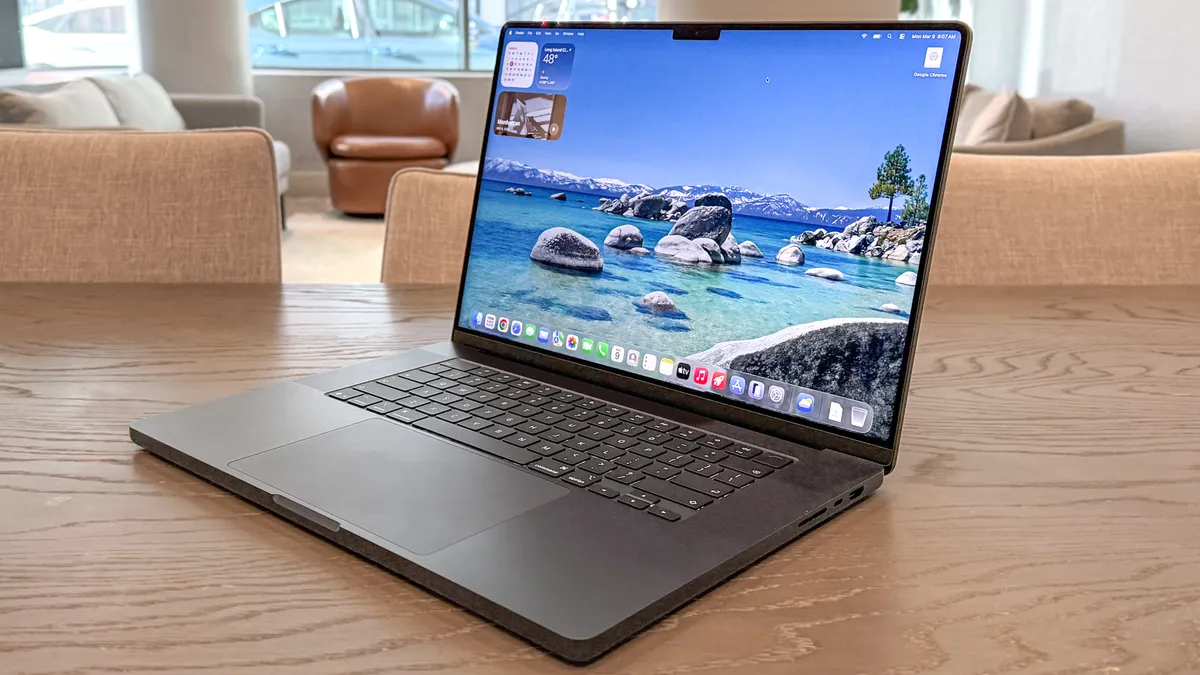
By the end of my first week, I had to face the reality of the silicon and hardware encasing it.
Going into this, everyone — Microsoft (with that $1,000 trade-in offer), tech journalists, and myself included — came in thinking the RTX Spark could be the ultimate MacBook Pro killer. The truth? It’s not.
In my standard browser run-down test, the battery died right around the 10-hour mark. That’s solid for a Windows machine and does fit Nvidia’s claims of all-day battery life, but it isn’t touching Apple’s endurance. Furthermore, Apple’s M5 Pro and Max chips easily outstrip the CPU speeds of this system.

But I realized that comparing it to a MacBook Pro misses the point entirely. The RTX Spark isn’t trying to be a better Mac; it is a different species of computer that has arrived early.
It is a statement of intent from Nvidia about where computing is going — trading raw benchmarking crowns on the stats that we currently see as important for the ability to carry a self-rewriting, fully autonomous, CUDA-accelerated digital brain in your backpack.
It requires a new set of behaviors, but once you let local AI take the wheel in some areas, it makes you believe the future of computing is entirely local (and without a subscription fee).

Follow Tom's Guide on Google News and add us as a preferred source to get our up-to-date news, analysis, and reviews in your feeds.
More from Tom's Guide
- I didn’t believe an Nvidia RTX Spark laptop would have the same performance both on and off the charger — so I put it to the test
- Forget RTX Spark: The Surface Laptop Ultra’s magnetic USB-C charger is a game-changer that makes Apple’s MagSafe look obsolete
- I just tested Windows 11 26H2 — here’s how to update now and why Microsoft finally fixed the two worst things about Windows 11