Listen, I love my iPhone 17 Pro, and have very few complaints about its camera. It does everything I need a smartphone camera to do… which is to take copious photos of my dogs and the occasional picture of my wife and/or family. For more serious photography, I have my Fujifilm X-E4 and Fujifilm X-T5.
Not everyone is as lucky as me in owning a mirrorless camera, though, which is why iPhone lenses are a thing. The best iPhone lenses provide a moderately affordable way to boost your smartphone’s capabilities — by adding a better macro lens, for example, or a more characterful lens for video or portraiture.
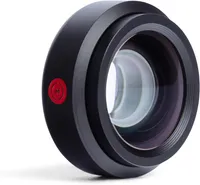
There are loads of smartphone lenses out there: from anamorphic video lenses through to fisheyes and macros, and on to super telephotos, like the Sandmarc 10x super tele lens I’ve been delving into this week.
This lens has a 10x magnification, which is equivalent to 200mm on a full frame camera. That’s longer than the optical reach of my iPhone 17 Pro’s 8x lens, although the built-in lens can digitally zoom to 10x (and far beyond) to match framing.
The Sandmarc 10x costs a whopping $329, so I wanted to see how it fared against the iPhone’s built-in lens. Is it worth the spend? And are iPhone lenses worth it at all, for that matter? Read on to find out.

I'm Pete Wolinski, senior editor here at Tom's Guide and in charge of our reviews and cameras coverage. I oversee all smartphone lens testing, so I've used plenty of them. Follow me on Instagram to see my photography.
Sharpness (or lack thereof)
I’m gonna get a major issue with the Sandmarc out of the way first: this lens is not sharp. In fact, it’s anything but. Much of that is to do with the optics themselves. When you use a smartphone lens, you’re placing glass in front of an already finely-tuned and calibrated optic (your phone's built-in lens) — it’s almost never going to come out sharper than the standard lens without the additional glass.


When people ask me whether iPhone lenses are worth it, I ask them about purpose. If you want sharp, don’t put anything in front of your iPhone’s lenses. If you want to add something your iPhone can’t do, and especially if you want characterful results… that’s different.
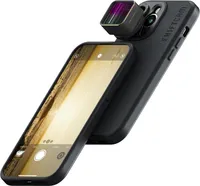
For instance, anamorphic iPhone lenses (like ShiftCam's lenses) give a softer, cinematic look with beautiful lens flares and in ultra widescreen, which the iPhone can’t do on its own. Macro lenses, well, do better macro photography than the built-in lens. Below are some shots taken on Sandmarc and Moment macro lenses, and they produce results that you simply can't achieve with the iPhone's hardware.


External telephoto lenses can give a softer look, nicer blur and better bokeh for portraits, which the iPhone's lens can’t. Unfortunately, the trade off for getting those characteristics with an external lens is usually decreased image quality.
All this is to say that the Sandmarc 10x ain’t sharp, and suffers from a lot of ostensibly undesirable lens characteristics, which is normal with these kinds of optics.
As you can see in the bird images at the top of this section, the Sandmarc tele's sharpness falls off dramatically around the center and the subject is blurred from the lack of stabilization. It also demonstrates significant lateral chromatic aberration, visible as yellow banding around high contrast areas (see the swan images below). Again, this is all pretty normal for iPhone lenses — your iPhone’s glass was never meant to have extra glass stuck in front of it.
Stabilization (or lack thereof)

At 200mm full frame equivalent, the 10x lens is super telephoto, which is a little problematic. Longer focal lengths magnify micro-blur, resulting in more visible camera shake affecting the sharpness of your image. Your iPhone’s built-in lens uses optical image stabilization to reduce blur, but it can’t do that for an enormous lens that’s simply stuck on the front and not connected electronically to the phone camera in any way.


The Sandmarc is also heavy, so your hand is going to be more shaky, exacerbating the blurring issue. As you can see in the images above, the iPhone photos are simply much sharper, with more detail visible in the face of the statue and stained glass windows.
You can solve the issue in part by using one of the best iPhone tripods to keep things steady. I’d recommend the Joby Compact Tripod — it's basically a smaller, lighter version of a full-size mirrorless camera tripod, allowing you to keep your phone properly stable while also giving you lots of height adjustment.

It’s also important to use a good case that holds the lens firmly. I use the SmallRig Mobile Video Cage, which is awesome — it lets you swap out lens cover plates between bayonet and threaded lens mounts (the two main types) making it universal fit, and comes with an outer rig for attaching cold shoe accessories.
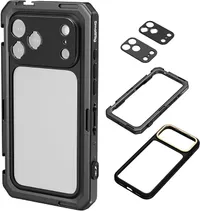
Don't waste your money on proprietary cases from individual lens manufacturers when you could buy an excellent universal alternative for the same (or less) money!
Bags of character
The upshot to all this (and there is one) is that the artefacting and generally imperfect nature of using iPhone lenses results in “character” — i.e., not every image has to be razor sharp, and it’s kinda fun when that isn’t the case.
If you just accept the imperfections and get creative with them, a seemingly poor lens can be a lot of fun. I mean, that’s one of the reasons why many photographers choose to fit older vintage lenses to their modern cameras.


With the Sandmarc 10x tele, like I said earlier, sharpness drops off very quickly around the center, so you need to put your subject in the middle. Once you do that, you can use the sharpness drop-off as a frame — extra blur to help isolate your subject.
The blur itself is quite nice, too. It’s tight and a little swirly at times, which lends an artistic, painter-y style that I really like. Although, hilariously, it mostly appears on the right hand side of the image for some reason. By contrast, the iPhone’e tele lens at 10x just looks a little bland. There’s no tight blur in the background, making the scene feel flat.
Admittedly, I’d like a bit more bokeh from the Sandmarc 10x — light sources are a little more artistic than the standard iPhone lens, but not by much. However, I don’t care about the other artefacts. A little chromatic aberration is fine, and the Sandmarc swan photo still looks way nicer than the iPhone photo.
Improved color and contrast
One thing I love about certain external lenses (the Sandmarc 10x included) is how much they improve the color and contrast of images. The iPhone’s built-in tele lens is sharper, yes, but it’s so boring. There’s much less contrast, resulting in a washed-out, flatter, often gray look.


In comparison, look at the color difference when using the Sandmarc 10x lens in the image gallery above. Reds and oranges really pop, making the Sandmarc photo look much more vibrant. The same is true in the swan images above, where the bird’s orange bill really stands out in the center of the photo. Compare that to the iPhone photo, where the swan’s bill looks literally gray.
Additionally, there’s just much more contrast with the Sandmarc lens, which combined with the better background blur results in a more three-dimensional image. Again, in the bird images above, the added contrast in the water really brings out the ripples and stops the photos looking flat like the iPhone snap.
So are external iPhone lenses worth buying?
I alluded to this already above, and it all comes down to one question: what do you want? If you want a lens to be sharper than your phone’s built-in camera, you’re out of luck almost entirely with external smartphone lenses. The sharpest iPhone lens I’ve tested is Sandmarc’s 58mm 2x tele lens, but even that is still only on par with the iPhone 1x lens at similar framing, and it still had some issues with chromatic aberration. You’re putting glass made by a small manufacturer in front of glass calibrated by one of the biggest tech firms in the world — that's never going to give you dramatically sharper results.
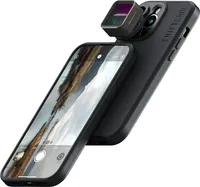
But while the Sandmarc 10x and other iPhone lenses may not be a quality upgrade, they are certainly a character upgrade. If you want to have fun with your phone camera without spending thousands on a big camera, additional smartphone lenses can help with that. And, importantly, certain smartphone lenses will allow you to achieve effects or styles that simply aren't possible with your phone's default hardware otherwise — particularly anamorphic and macro lenses.
I personally much prefer the look and feel of the images taken using the Sandmarc 10x tele lens to those taken with the iPhone’s built-in tele lens. Not everything has to be about sharpness, and sometimes imperfection has its charms. Would I recommend spending $329 on this particular lens, though? I'm not so sure.

Follow Tom's Guide on Google News and add us as a preferred source to get our up-to-date news, analysis, and reviews in your feeds.
More from Tom's Guide
- ShiftCam iPhone lenses review: the most characterful iPhone lenses around
- Best mirrorless cameras in 2026
- I just bought this 5-year-old Fujifilm and it proves newer isn't always better