







So you're going to take the plunge and join those who like listening to our favorite tunes on spinning plastic discs — and I don't mean CDs. I'm talking about records, which are a wonderful, tactile way of feeling more involved in your listening.
But where do you start? There are so many things to think about when it comes to buying one of the best turntables. What extra devices do I need? What's a cartridge, what's a needle, what's all this about speeds? The questions are endless, the answers sometimes complicated.
Thankfully, I've been using and testing turntables for years, so I've put my knowledge to good use to make sure you're well-equipped before you take your vinyl journey.
How does a turntable work?

We all know that vinyl discs are covered with microscopic grooves (and if you didn't, now you do!). Those grooves are the physical representation of your music. The turntable's needle (or stylus) drags itself through those grooves, then converts them into listenable sounds inside the cartridge at the end of the tonearm.
Unfortunately, those sounds are completely un-amplified, so we need a device that can make them loud enough for even a larger amplifier to pick up. That's where a phono pre-amp steps in. It takes that sound and makes it loud enough to send through a cable to your amp. Beginners should look for a turntable with a built-in pre-amp, so you don't have to buy a separate one.
So where do I start?

First of all, work out how often you're going to be using your player. Once in a while, or all the time? What do you want out of the player — ease of use or excellent sound? From there, work out how much you're going to spend on your turntable, remembering you're likely going to need to pick up some speakers.
It's very possible to get something that sounds excellent for not very many dollars, but it might not be the most user-friendly. Similarly, something simpler to use might not sound quite as good. Or, you might get something easy to use that sounds good but isn't built as well to keep the price down.
Below are three options for turntables under $500. If you’re just starting out, I don’t recommend anything more expensive; if you really get into it, you can always upgrade in the future.
What you get for under $200
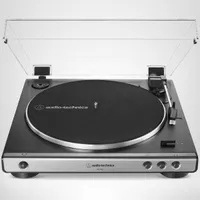
There are plenty of budget options available if you’re looking for your first turntable, and you’d be surprised how fully featured they are. Interestingly, you’ll often find automatic models for this price (that means you press a button and the tonearm moves itself), with replaceable needles and some very funky-looking designs.
You will, however, lose some adjustability. You won’t find any replaceable cartridges, so you can’t fit a new model for a quick upgrade. Tonearms are generally pre-set from factory, and rather than using counter weights, they use springs to exert the necessary pressure on the record.
This isn’t going to damage your discs, but it does mean that you can’t change the counterweight for different styluses. Some people think that a nonadjustable tone arm wears out vinyl quicker as well, although evidence is tricky to come by.
Here’s a great option under $200:
What you get for $300
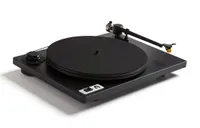
If you spend a little more money, you can get a very good beginner turntable, although you should expect it to be manual. That means you have to do everything yourself, from moving the tonearm over the record and lowering it, to changing the speed with the belt drive mechanism.
Now, to (weirdos) people like me, that just adds to the immersion of the process, enhancing the vinyl experience. To less pretentious people, it means there’s more manual labor to listen to your music. Your mileage may vary.
What you get in exchange is more adjustment — that means you can change out the cartridge so that you can use a more premium stylus. The counterweight on the back of the tonearm can be manipulated so that you can change the tracking force for your new stylus.
Thanks to these differences, a $300 turntable can be upgraded, making sure that it lasts for longer. Here’s a great option for around $300:
What you get for under $500
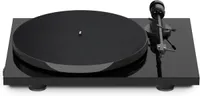
So take all the features of the $300 turntable — the adjustment, the more manual experience — and then replace all the bits with nicer, more premium parts. Spend the extra up front and you’ll be in for better sound quality and even some mod-cons like electronic speed control.
Here is a great turntable for less than $500:
What do I plug it into?
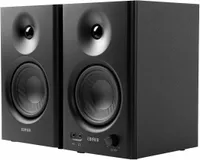
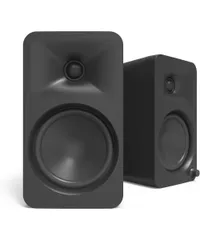
A turntable without some kind of music maker isn't going to make much noise, so you’re going to need a decent pair of speakers. They're easy enough to find, and you needn't spend loads. Here are a couple of different options at different budgets:
Two things to look for and three things to avoid

You want to make sure that your new beginner turntable has two things. The first is a replaceable cartridge (the bit that actually touches the record), and the second is a built-in phono pre-amp. The first means your turntable will last for a long time, and the second means you don't need to buy as many extra devices.
When shopping for a turntable, there are some other pitfalls to avoid. The first? Steer clear of models that have the same plastic tonearm and platter design that you'll generally find in JCPenney and Urban Outfitters. I'm not going to say they'll damage your records, but they're not going to sound good.
I'd also avoid models with built-in speakers. To keep the disc free from extra vibrations and other potentially sound-ruining issues, these built-in speakers generally keep the bass low. They end up sounding cheap and tinny as a result.
Lastly, avoid turntables that don’t feature any kind of vibration-dampening. Ideally, you want separate rubber feet on the bottom as a minimum, but isolated plinths and other vibration-reducing techniques are always good. Essentially, any vibrations around the deck can cause your sound issues. For example, accidentally bumping the table that an undamped player sits on could make your sound skip.
You’re good to go

So now you know what you should be looking out for when it comes to a vinyl player, and you can join the many who have already started their groove-powered journey. Remember, as much as there are some important (boring) bits to making sure that you’re happy with your first player, the most important thing is that you have fun.
The other great part about owning a turntable is that it now gives you an excuse to spend hours browsing through albums at your local record store. Three albums I recommend you listen to first are Led Zeppelin's "Led Zeppelin IV" (because you need to listen to stairway first), Miles Davis' Kind of Blue for the quintessential hit of jazz, and Black Sabbath's Paranoid because, you know. War Pigs.
That’s what vinyl in 2026 is all about. There are more convenient ways to listen to your music, some with even better sound quality. But none deliver the same hands-on involvement or deliberate listening experience that you get out of a shiny LP. And nothing looks cooler on your shelf.

Follow Tom's Guide on Google News and add us as a preferred source to get our up-to-date news, analysis, and reviews in your feeds.
More from Tom's Guide

