
AI-generated images and videos have reached the point where many seem very real and spotting them with human eyes alone isn't easy. Google now wants to give everyone another way to check.
The company has opened its standalone SynthID verification website to the public, allowing anyone to upload an image, video or audio file and check it for an invisible watermark used to identify AI-generated content.
SynthID itself isn't new. Google DeepMind first introduced the technology in 2023, and Google has steadily expanded it across its AI products since then. What's different now is access. The dedicated verification tool had previously been available to a smaller group of journalists, researchers and media professionals. Now anyone can use it.
And considering how quickly convincing AI images, videos and audio clips can spread online, this is one website worth knowing about.
What is SynthID?
SynthID is Google's system for embedding an invisible digital watermark into AI-generated media. Google says the watermark can also remain detectable after common changes such as compression, filters and adjustments to color or brightness.
That's good to know because traditional metadata can disappear when you download, edit or repost a file. A visible watermark can also simply be cropped out. SynthID is embedded directly into the content instead.
Google now uses SynthID across AI models and products including Nano Banana, Veo, Lyria, Gemini, Flow and Google Vids.
And Google isn't the only company supporting it. OpenAI, Nvidia and Kakao have also adopted SynthID for at least some AI-generated content.
How to check an image, video or audio file

The new SynthID website makes the process fairly straightforward. Head to the SynthID site and upload the media you want to check. The tool supports a long list of common image formats including JPG, PNG, WEBP, HEIC and GIF, along with MP4, MOV and WEBM video and audio formats including MP3, WAV, AAC and M4A.
SynthID then analyzes the file for the invisible watermark. If one is detected, that's a strong signal that at least some of the content was created or edited using an AI system that supports SynthID.
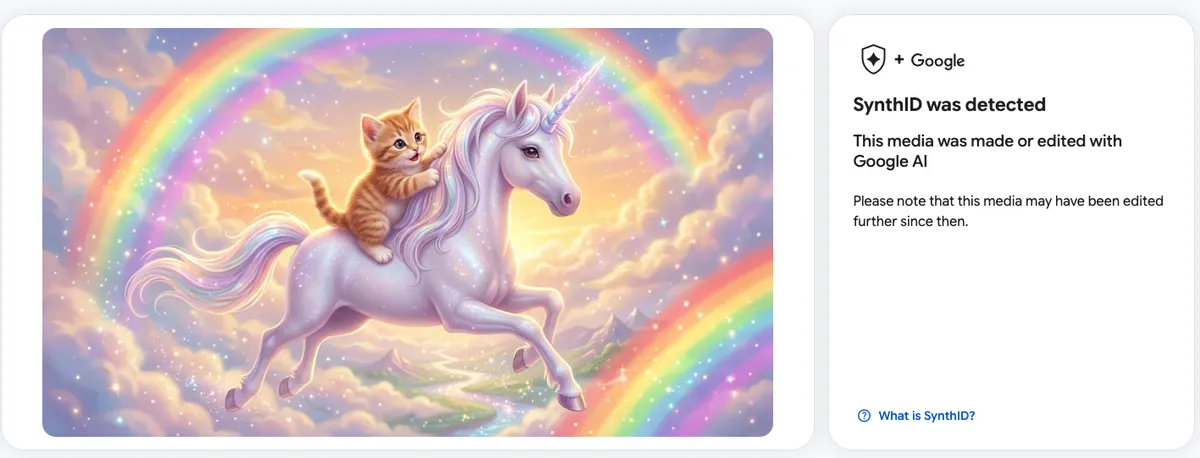
Google has also built SynthID verification into Gemini, so this isn't necessarily the first time you've had access to the technology. You can already upload supported media to Gemini and ask whether it was made with AI.
The difference is that SynthID now has a dedicated destination specifically for checking content. Google says people are already making around 1 million SynthID verification requests every day.
There's one big catch

SynthID should not be treated as a universal AI detector. It's looking for a specific watermark embedded by compatible AI systems. If SynthID finds that watermark, you have useful evidence about where the media came from.
But if it doesn't find one, that doesn't automatically mean the photo, video or audio is authentic. An AI generator that doesn't use SynthID could have created it. Watermarks can also potentially be weakened by sufficiently heavy modification, and Google itself has previously acknowledged that the technology isn't foolproof against extreme manipulation.
In other words, "SynthID detected" and "SynthID not detected" don't mean quite the same thing.
A positive result can tell you immediately that an image is AI generated, but a negative one doesn't always prove that what you're looking at is real.
Why I think this matters
There's still a long way to go. SynthID works best when AI companies actually adopt it, and competing watermarking and provenance systems mean there isn't yet one universal check that covers everything you encounter online. But opening SynthID to everyone is a useful step.
The next time an unbelievable image or video lands in your group chat or starts trending on social media, you might not have to second guess it.
Follow Tom's Guide on Google News and add us as a preferred source to get our up-to-date news, analysis, and reviews in your feeds. Subscribe to Tom's Guide on YouTube and follow us on TikTok.

More from Tom's Guide