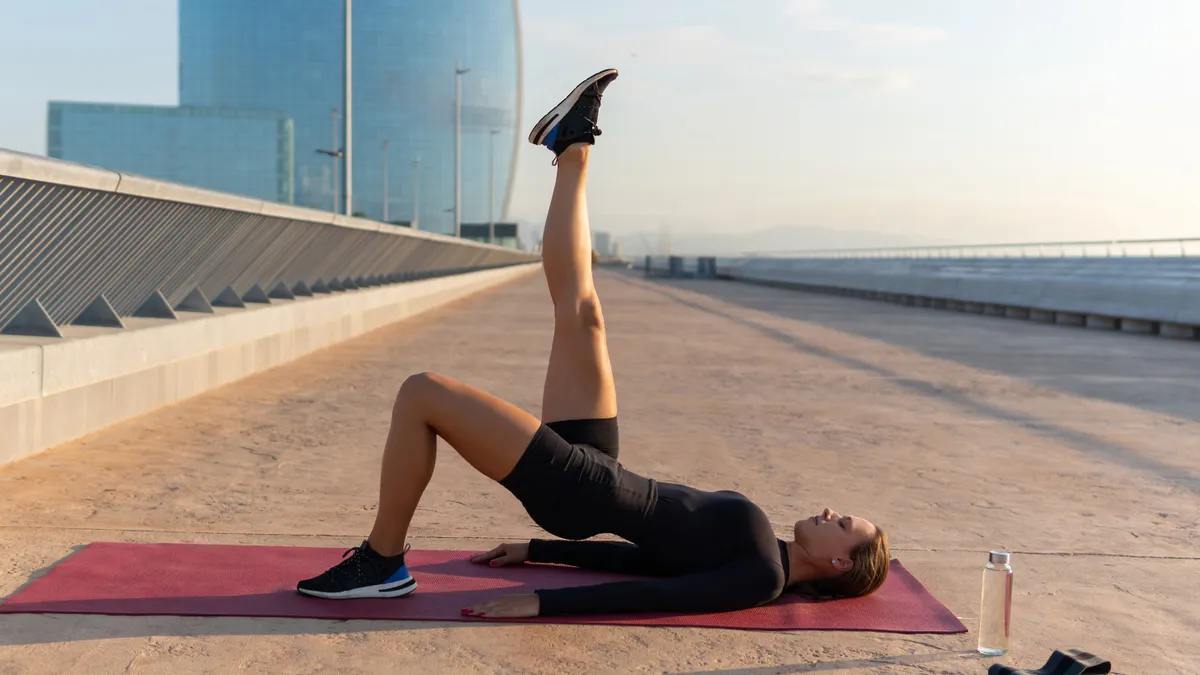
Whether you’re after a shapely backside or a super-strong lower body (or both), one of my favorite exercises to target the glutes is the single-leg glute bridge. I give this exercise to nearly all of my personal training clients and do it regularly myself.
One of the reasons I love this exercise is because of its adaptability. Beginners who master the standard glute bridge can progress to the single-leg glute bridge quickly and easily, and advanced athletes can challenge themselves by adding dumbbells or resistance bands to the movement.
Additionally, the single-leg glute bridge is incredibly effective in many rehab and corrective exercise programs. When I work with clients who have knee injuries, hip issues, or are recovering postpartum, the single-leg glute bridge functions as a safe, accessible way to strengthen important stabilizing muscles.
If you’ve got a yoga mat handy, you can give single-leg glute bridges a try. Below I’ll cover how to do the exercise, its many benefits, and ways to modify and progress the movement.
How to do single-leg glute bridges
This exercise is doable for the majority of people, but you’ll still want to discuss it with your doctor first. They may recommend trying other exercises first, depending on your specific health concerns.
If you have the means, consider meeting with a certified personal trainer to learn how to do the single-leg glute bridge with correct form.
Start out with one set of 10 reps on each side. As you get stronger, you can gradually add sets and reps. Do single-leg glute bridges on their own, as a part of your lower body workout, or add them to your warm-ups.

Here’s how to do them:
- Lie on your back with your knees bent and feet flat on the floor.
- Engage your core muscles.
- Lift your left foot off the ground, bringing your left knee to a tabletop position.
- Squeeze your right glute, press your right foot into the floor, and lift your hips off of the mat.
- Keep your hips square – don’t allow them to rotate to one side.
- Lower your hips down to the mat with control.
- Continue for 10 reps on each side, or until you reach muscle fatigue.
What are the benefits of single-leg glute bridges?
Standard glute bridges, done with both feet on the floor while engaging the glute muscles on both sides, are one of the best exercises to strengthen your posterior chain.
However, like most exercises that are done bilaterally (or both sides at the same time), your stronger side can make up for strength deficits in your weaker side. You can be doing the exercise with correct form and a good mind-muscle connection, but it’s still common for one side to be working harder than the other.
The single-leg glute bridge takes all the benefits of the standard glute bridge and isolates the movement to one side. My clients are often shocked at how difficult this exercise can feel on one side versus the other. This signifies the muscle imbalances one can experience without ever realizing it.
By targeting the glutes and hamstrings independently, the muscles are forced to contract against gravity without “help” from the other side. This is not only incredibly beneficial for proper movement mechanics overall, but especially helpful when rehabilitating from injuries.
How to modify the single-leg glute bridge
Be sure you can properly execute a standard glute bridge before trying the single-leg version. I often find that my clients who have trouble with the movement haven’t fully mastered the standard glute bridge, so we go back to basics before progressing.
If your standard glute bridges feel easy but you’re still finding single-leg glute bridges too difficult, reduce your range of motion and only lift your hips slightly off the mat. As you build the necessary stability and strength, your range of motion will improve.
You can also do a marching glute bridge instead. With both feet on the ground, lift your hips into the air and hold in that position. Then, lift one foot off the ground and pause briefly. Lower that foot back onto the mat, then lift your other foot off the mat and pause briefly. Continue alternating between your two sides for 10 reps on each side.
How to progress the single-leg glute bridge
If you’re able to do 15-20 reps without getting fatigued, it may be time to add a challenge to your single-leg glute bridges.
Increase your range of motion by placing your feet on top of a raised surface, like a bench or step. Elevated glute bridges require more stability, more strength, and more control to do properly.
You can also add resistance to your single-leg glute bridges by performing the exercise with a dumbbell across your hips. Be sure to keep your hips square and avoid excessive arching in your lower back. If you notice either of those things happening, use a lighter dumbbell or perform the exercise unweighted again.
Resistance bands can also add difficulty to single-leg glute bridges. You can focus on building stronger inner and outer thighs by looping a resistance band around your knee. Pressing your knee out against the band will target the hip abductors, while pressing your knee in against the band will target the hip adductors.

Follow Tom's Guide on Google News and add us as a preferred source to get our up-to-date news, analysis, and reviews in your feeds.
More from Tom's Guide
- I’m a physical therapist who works with seniors: Here are the 5 bodyweight exercises I recommend
- No, not planks! I'm a personal trainer for seniors, and these are the 4 best exercises you can do for core stability at every age
- Over 60? I’m a personal trainer, and these 3 floor exercises will show you how strong your core is