I'm 35 years old and a personal trainer who lives, teaches and trains in London. I've seen a lot of exercises come and go, but there are three moves I highly recommend adding to your routine to build and maintain muscle and strength as you age.
I'm under no illusion that being 35 makes me ancient, but compared to the younger exercisers enjoying workouts in their teens and twenties, I have definitely found myself tailoring my strength training toward longevity — something that has become a buzzword now, but wasn't a trend when I was exercising 10 years ago.
Longevity workouts help you build and maintain functional strength and lean muscle mass; they focus on agility, balance, resistance training, stability and control, so that you can exercise well into your later years with less chance of falls and injuries. Basically, it's about training your body now for your mind and body later.
Here are three moves to get you started if this sounds like you, plus the benefits.
What are the exercises?
Some of the fittest, strongest people I know are over 70, and I’ve trained people from all walks of life. However, inevitably, your body changes as you get older, and surprisingly, some fitness components begin to decline in the mid-thirties. Muscle mass and bone density begin to decline, joints may become stiffer without a regular mobility routine, and this has a knock-on effect on how you move daily.
It's about training your body now for your mind and body later.
These three exercises are functional, which means they mimic the types of tasks you carry out day-to-day, such as reaching overhead, squatting down to pick something up, or engaging your core to protect your back. Each one is designed to improve strength and mobility, meaning you won't just be lifting weights, but focusing on your range of motion, too.
You can start with your bodyweight or add a set of adjustable dumbbells when you feel ready to lift weights.
Follow Tom's Guide fitness on Instagram for more workouts, routines, tips, and tricks.
1. L-sit press
L-sit presses force your body to exclude momentum, meaning your core, shoulders, upper chest, triceps and upper back must move the weight, improving upper-body strength and pressing power.
The L position also reinforces proper upright posture and tests hamstring flexibility. You can bring more of a bend to the knees if you need to. Try to lift your arms slightly behind your ears and draw your head through your arms, as if putting something on a shelf behind you. This encourages proper shoulder mobility.
Begin this move against a wall if you need extra support.
- Sit with your legs extended and pressing down into the mat
- Imagine a piece of string extending from the crown of your head and pulling you tall. Draw your shoulders down and back away from your ears
- Hold a weight in each hand, rack them to your shoulders, engage your core and sit tall. Lift your elbows
- On your exhale, press the weights overhead and extend both arms. Keep your gaze ahead
- Slowly lower the weights to your shoulders
- Continue for 3-4 sets and 8-10 reps.
2. Hollow hold with triceps pulses
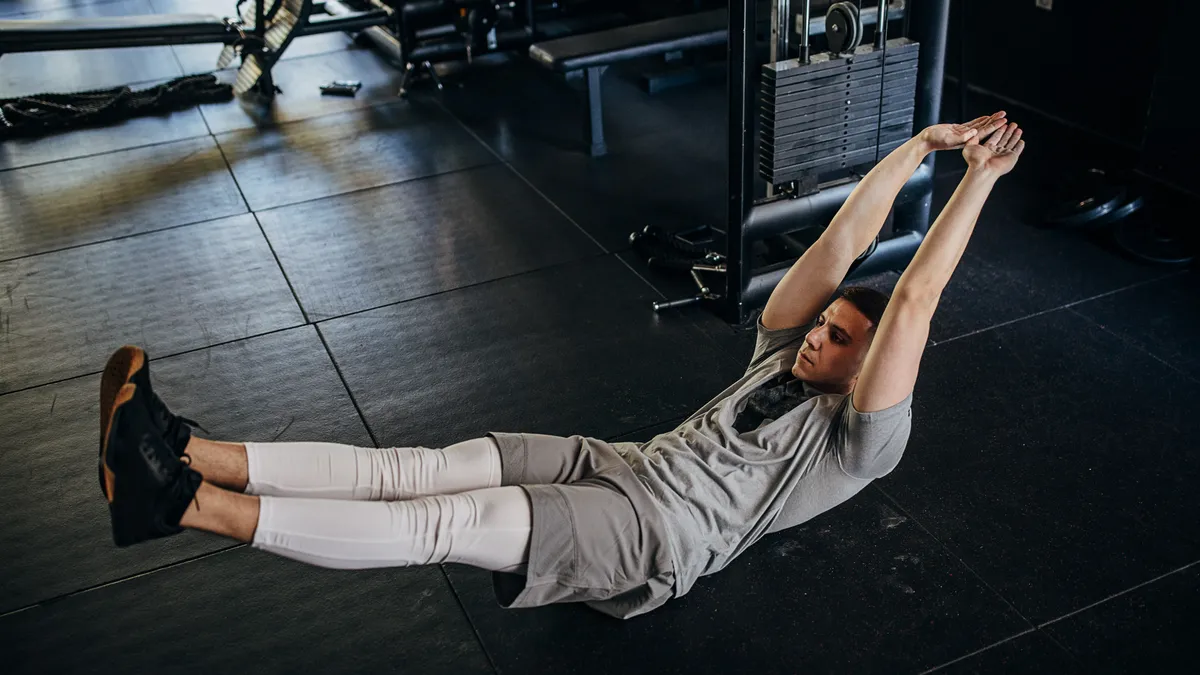
The hollow hold encourages you to keep tension in your core muscles, including the deeper stabilizing muscles that support your trunk, without moving them through flexion, rotation, or extension. It's crucial to focus on your breathing in this position; exhale toward your stomach as if blowing up a balloon.
If you prefer, bend your knees or keep your legs on the mat for extra support, but otherwise, try to keep your legs extended and toes pointed. Use light weights as you flutter your arms up and down.
- Lie on your back with your arms by your sides and a light weight in each hand. You can also perform this without weights
- Extend your legs and press your lower back into the mat
- Engage your core and gently lift your upper back, shoulders, arms and head away from the ground. Tuck your chin and keep your gaze forward
- Lift your legs and point your toes. You may feel some shaking in your midsection, which is normal
- Gently pulse your arms up and down without moving the rest of your body
- Continue for 3-4 sets of 30-second efforts.
3. Overhead squat

Overhead squats test thoracic and lower-body mobility. Most people I know find this the most challenging squat to do as your arms reach overhead while you squat. You can use your bodyweight or hold a weight in each hand, but focus on your squat depth first. Aim for your thighs to be at least parallel to the ground at the bottom, and keep your shoulders pulled back, without the weights traveling forward or your chest dropping.
Unless you're super mobile or you've done this exercise before, don't be disheartened if it takes a while to build on this move. Keep your feet pressed down, spreading the weight through your heels, big and little toes.
- Stand with your feet hip or shoulder-width apart
- Extend your arms overhead with your shoulders pulled back and down. Hold weights if you want to
- Engage your core, stay tall through your spine and lift your chest
- Sit your hips back and lower into a squat as if sitting in a chair behind you. Try to keep your back straight, gaze forward and chest upright
- Pause at the bottom of the squat, then press through your feet and core to stand
- Continue for 3-4 sets and 8-10 reps.
What are the benefits?
L-sit presses focus on improving upper-body strength and posture; hollow holds with pulses build core and arm strength, stability and endurance; overhead squats increase thoracic mobility, upper-body engagement and lower-body strength.
Each of these exercises also helps improve balance and remove momentum from the equation, meaning you must rely on your strength and control to move the weights rather than speed.
Take your time with each of the movements and don't give up if they don't work for you straight away. It might take time to build the strength and mobility you need; go for lighter weights, fewer reps or sets, or focus on simply practicing your form. If you experience pain, stop immediately and seek advice from a medical professional.

Follow Tom's Guide on Google News and add us as a preferred source to get our up-to-date news, analysis, and reviews in your feeds.
More from Tom's Guide