We often talk about building a strong core, but we’re not referring to visible six-pack abs. Instead, we’re referring to the complex network of muscles that wrap around your trunk, acting as your body’s corset. This includes the deep transverse abominis, the obliques, the lower back muscles, as well as the glutes and pelvic floor.
When your core is weak, your spine absorbs more stress as you move and lift, so working on your core strength is one of the best ways to manage and prevent lower back pain. Your core also helps overall balance and prevents falls.
Yet if you’re a complete beginner or returning to exercise following an extended break, it can be difficult to know where to start. Luckily, you’ve landed in the right place. I asked certified personal trainer and strength coach Amy Kiser Schemper for a simple home workout that can build core strength and stability.
Read on to find out more. As always, if you’re pregnant or postpartum, or you’re exercising with an injury, it’s always best to seek personalized advice from a qualified professional.

Amy Kiser Schemper is a personal trainer, fitness instructor, and prenatal/postnatal exercise specialist with 15 years of experience helping people build strength, confidence and consistency in their fitness routines. She holds a Master’s in Exercise Science from Concordia University Chicago, two undergraduate degrees from Virginia Tech, and is the founder of BodyFit by Amy, an online fitness community and YouTube channel with more than half a million subscribers across 180 countries. She serves as a fitness advisor at BowFlex.
What is the workout?
The workout consists of three different circuits, all with three exercises. Schemper says to do each exercise for 40 seconds, followed by a 20-second rest. Repeat the circuits for a longer workout.
When these exercises feel easy, increase the intensity by holding a set of dumbbells. Check out the best adjustable dumbbells for working out at home.
Circuit 1
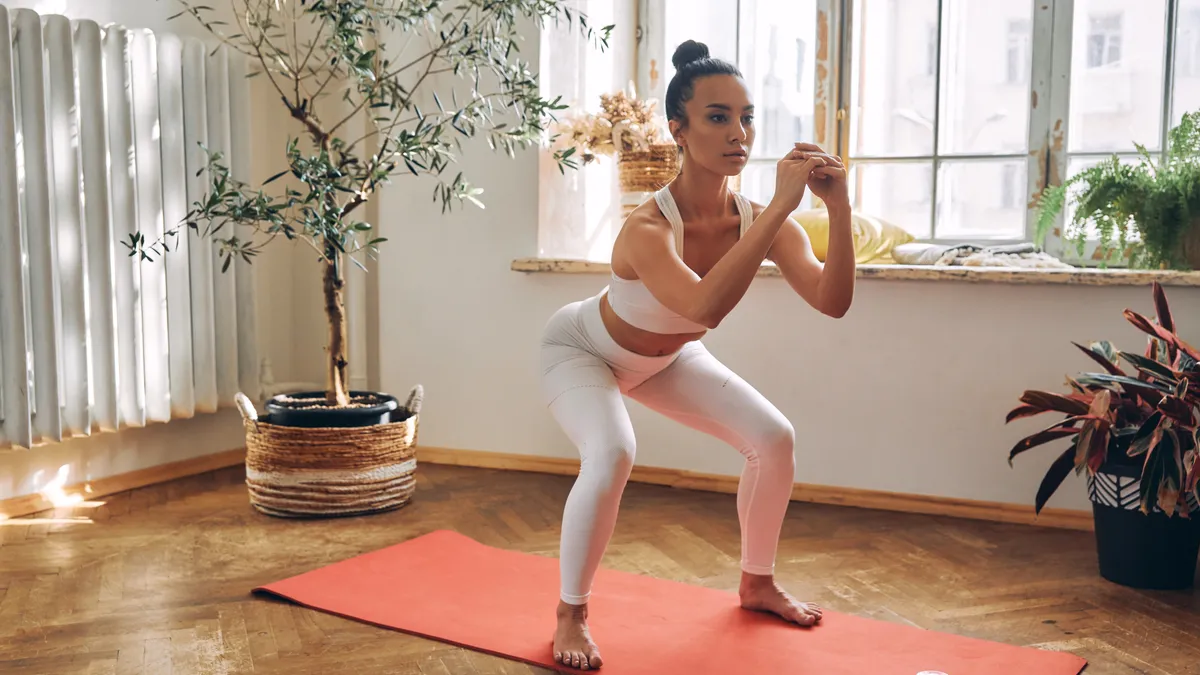
- Squat and rotational reach: Stand with feet hip-distance apart and sit back into a squat, keeping your chest lifted. As you stand out of the squat, rotate your torso and reach one arm overhead and across your body. Return to the center and repeat on the opposite side.
- Standing knee cross: Stand tall with your core engaged and posture upright, with hands behind your head. Slowly lift one knee across your body, bringing a knee toward the opposite elbow. Return to standing and repeat on the other side.
- Single-leg balance hold: Stand tall and shift your weight onto one foot. Lift the opposite foot off the floor and hold your balance while keeping your hips level and core engaged. Repeat on the opposite side. Place one hand on a wall, sturdy chair, or counter for added balance if needed.
Circuit 2

- Bridge hip lift: Lie on your back with knees bent and feet flat. Engage your core and lift your hips toward the ceiling, squeezing the glutes and hamstrings while staying connected to the abs. Pause at the top, then slowly lower your hips back to the floor.
- Dead bug: Lie on your back with arms reaching toward the ceiling and knees bent in tabletop (a 90-degree angle). Keep your core tight, and slowly extend the opposite arm and leg toward the floor. Return to the starting position and alternate sides.
- Lying knee drop: Lie on your back with knees bent and feet flat, or lift your legs into a tabletop position for more challenge. Keeping your core engaged and hips stable, slowly lower one knee toward the side without allowing your pelvis to rotate. Return to center and alternate sides.
Circuit 3

- Bird dog: Come to the mat on your hands and knees with your hands under your shoulders and knees under your hips. Keep the core pulled in and slowly extend one arm and the opposite leg. Keep your hips and shoulders square to the floor. Pause, then return to the starting position and switch sides.
- Plank singles: Start with your torso and legs facing down on the mat, lifting up onto your elbows. Using your core to control the movement, slowly lift onto your knees, trying to only use your abs to lift. For an added challenge, continue to lift up to the toes in a full plank position. Hold for a count at the top, then slowly return to the starting position with control. Minimize movement through the hips and shoulders — the goal is to create and control the movement primarily with your core.
- Side plank hip lift (on knees): Begin on your side with your knees bent and your elbow directly beneath your shoulder. Lift your hips off the floor to create a straight line from your shoulders to your knees. Slowly lower your hips toward the floor, then lift them back up. Keep your core tight and avoid rotating your torso. Repeat on both sides.

More from Tom's Guide
Follow Tom's Guide on Google News and add us as a preferred source to get our up-to-date news, analysis, and reviews in your feeds. Alternatively, you can read our content on the Tom's Guide app available now for iOS and Android.